Complete Argumentative Essay Examples for Students
Example 1: Should Human Cloning Be Allowed?
Model Used: Toulmin
Academic Level: College
Word Count: 1,250 words
Should Human Cloning Be Allowed?
Discovery and invention are humanity's truest companions in civilization's journey. This journey took a controversial turn when scientists demonstrated that clones of individuals could be created, beginning with Dolly the sheep. This breakthrough opened gateways to advanced discoveries while simultaneously disturbing religious and ethical communities worldwide.
Thesis: While human cloning technology offers significant medical benefits, including organ replacement and disease elimination, unrestricted human cloning should not be allowed due to profound ethical concerns, potential for abuse, and inadequate regulatory frameworks, though limited therapeutic cloning for medical purposes deserves continued research with strict oversight.
The US movement to ban human cloning receives strong endorsement from leaders of research teams that cloned Dolly, though these scientists distinguish between reproductive cloning (creating humans) and therapeutic cloning for medical research.
This technique could prove invaluable for infertile couples seeking biological children, eliminating genetic diseases, extending human lifespan, enabling organ transplants without rejection, and treating previously incurable medical conditions. Studies in regenerative medicine demonstrate therapeutic cloning's potential to generate patient-specific stem cells for treating Parkinson's disease, spinal cord injuries, and diabetes without immune rejection issues plaguing traditional transplants.
When medical technologies offer the potential to eliminate suffering and save lives, society generally permits their development under appropriate safeguards. We regulate rather than ban risky technologies like nuclear medicine or experimental surgery because potential benefits justify controlled risks.
Historical precedent supports this approach: in vitro fertilization faced similar ethical concerns in the 1970s but became an accepted medical practice after demonstrating safety and establishing ethical guidelines. Similarly, gene therapy, once controversial, now treats previously fatal genetic disorders under FDA oversight.
However, human cloning presents unique challenges requiring careful qualification of any permissive policy. Complete reproductive cloning, creating cloned human beings, raises concerns beyond typical medical ethics. If research organizations received unlimited freedom to clone humans, insufficient monitoring could enable horrific outcomes.
Critics warn that even restricted cloning permissions inevitably expand beyond initial intentions. They cite China's social credit system as evidence that government oversight becomes authoritarian control, or reference Nazi medical experiments demonstrating how research ethics collapse under insufficient oversight.
Yet absolute prohibition may be equally problematic. Banning all cloning research prevents potentially life-saving medical breakthroughs. Parents watching children die from genetic diseases, or patients facing organ failure, deserve access to therapies that cloning technology might enable.
The solution lies not in absolute prohibition or unrestricted permission, but in carefully designed regulatory frameworks that permit therapeutic cloning for verified medical purposes while absolutely prohibiting reproductive cloning.
Human cloning technology presents genuine opportunities for medical advancement alongside legitimate ethical dangers. Carefully regulated therapeutic cloning under strict international oversight, with absolute prohibitions on reproductive cloning, offers a middle path respecting both medical potential and human dignity.
Your Essay. Done Right. Delivered on Time. Tell us what you need — our experts handle the research, writing, and formatting. No AI shortcuts. Just expert-level quality.
Example 2: Is Social Media Damaging Grammar?
Model Used: Classical/Aristotelian
Academic Level: High School/College
Word Count: 1,150 words
Is It Right to Blame Social Media for the Use of Incorrect Grammar?
OMG and LOL have become standard communication for billions, functioning as the defining acronyms of digital communication. Social media's attraction has expanded to unprecedented levels where people depend on the internet for everyday tasks, creating entirely new linguistic patterns.
Thesis: While social media use correlates with declining formal grammar skills among young people, platforms themselves don't cause this deterioration. Rather, inadequate education systems failing to adapt to digital communication, changing cultural norms around formal language, and a lack of writing practice in educational settings better explain the observed grammar decline.
Young people's grammar skills have declined since 2010, yet multiple factors beyond social media contribute to this trend. National Assessment of Educational Progress data show writing scores declined 8% among 8th graders between 2011 and 2019, with particularly sharp drops in grammar mechanics.
However, this same period saw reduced English instruction time in schools (down 25% on average), larger class sizes limiting individual attention, and decreased emphasis on formal writing assignments in favor of standardized test preparation. These educational policy changes preceded widespread social media adoption in many cases.
Language constantly evolves, and each generation's elders blame new communication technologies for corrupting youth. When telephones became common, critics warned that abbreviated conversations would destroy letter-writing eloquence. Television allegedly shortened attention spans. Text messaging supposedly annihilated spelling ability.
Yet literacy rates continued rising despite these concerns, and people demonstrated consistent ability to code-switch between formal and informal registers when situations required. Social media continues this pattern: young people communicate informally on platforms yet write formal essays for academic contexts.
The most compelling argument emerges when examining who actually suffers from inadequate grammar instruction: students from under-resourced schools lacking qualified English teachers, advanced coursework, and writing-intensive assignments. Department of Education data reveals that schools serving predominantly low-income students offer 30% fewer advanced English courses.
Critics correctly observe that social media encourages abbreviated, informal communication "u" instead of "you," plus emoji-heavy messages replacing complete sentences. They argue that this constant informal exposure trains the brain for casual communication.
However, this argument assumes students cannot compartmentalize that writing "ur" on Snapchat makes them write "ur" on essays. Stanford research found that students demonstrate sophisticated rhetorical awareness, deliberately choosing communication styles matching contexts.
Social media makes a convenient villain in debates about declining grammar skills, but this blame misplaces responsibility. Educational systems failing to provide adequate instruction, changing cultural priorities, and persistent educational inequity better explain observable grammar challenges than teenagers' platform use.
Example 3: Gun Control Legislation
Model Used: Rogerian
Academic Level: College
Word Count: 1,200 words
Finding Common Ground on Gun Violence Prevention
Gun violence claims 40,000 American lives annually through suicides, homicides, and accidents. This tragic toll affects families across political, geographic, and demographic divides. Yet proposed solutions consistently polarize rather than unite.
Second Amendment advocates hold valid concerns about government overreach and constitutional protection. Historical examples of tyrannical governments disarming citizens before oppression validate vigilance about state power. Many gun owners responsibly use firearms for decades without incident, reasonably resenting collective punishment for others' criminal actions.
Rural Americans particularly depend on firearms for practical purposes: livestock protection from predators, hunting for food, and self-defense, with police response times measuring 30+ minutes. For these communities, gun ownership isn't a hobby or ideology; it's a practical necessity.
Furthermore, Second Amendment supporters rightfully note that criminals ignore laws by definition. Creating new firearms regulations burdens law-abiding citizens while failing to stop determined criminals. Chicago's strict gun laws coexist with high gun violence, suggesting regulation alone doesn't solve problems.
Thesis/Common Ground: Universal background checks with reasonable waiting periods address violence while preserving law-abiding citizens' ownership rights. Current federal law requires background checks only for licensed dealer sales, but 20-30% of transactions occur through private sales or gun shows without any checks.
Extending checks to all sales doesn't prevent ownership; it prevents sales to prohibited categories. Both sides agree that they shouldn't possess firearms. Law-abiding citizens pass checks and purchase firearms after brief waiting periods.
Enhanced background checks address gun control advocates' primary concern, keeping firearms from dangerous people without confiscating weapons or preventing law-abiding ownership. Gun rights advocates gain reassurance that purchasers underwent verification.
Neither side gets everything wanted, but both sides gain meaningful improvements. Progress requires recognizing that neither "more guns everywhere" nor "ban them all" represents a viable solution. Incremental improvements addressing concerns from both sides offer realistic paths forward.
Example Comparison Matrix
Understanding how these three examples differ helps you choose an appropriate argumentative essay topic. This matrix highlights key distinctions across multiple dimensions.
| Element | Example 1 (Toulmin) | Example 2 (Classical) | Example 3 (Rogerian) |
|---|---|---|---|
| Topic | Human Cloning | Social Media & Grammar | Gun Control |
| Controversy Level | Medium-High | Medium | Very High |
| Model Used | Toulmin | Classical/Aristotelian | Rogerian |
| Primary Goal | Analytical breakdown | Traditional persuasion | Finding common ground |
| Thesis Position | Qualified/nuanced | Clear but balanced | Diplomatic compromise |
| Word Count | 950 words | 1,050 words | 1,100 words |
| Number of Sources | 6 implicit references | 8 explicit citations | 4 major sources |
| Counter-argument Placement | Paragraphs 4-5 (mid-essay) | Paragraph 6 (later) | Paragraphs 2-3 (early, extensive) |
| Tone | Analytical, measured | Confident, persuasive | Diplomatic, respectful |
| Emotional Appeals | Minimal | Moderate (justice theme) | Minimal (focused on reason) |
| Qualifiers Used | Extensive ("though," "however") | Moderate ("while," "yet") | Heavy ("both sides," "reasonable") |
| Conclusion Type | Synthesized a qualified position | Call to action | Mutual benefit emphasis |
| Best For | Complex policy issues | General academic essays | Polarizing topics |
| Academic Level | College+ | High school & college | College+ |
See how different argumentative essay models work for different rhetorical situations.
Argumentative Essay Examples for High School
Example 4: College Athletes & Pay
Model Used: Classical
Academic Level: High School
Word Count: 900 words
Should College Athletes Be Paid?
Every Saturday, millions watch college football games, generating billions in revenue. Universities profit immensely. Coaches earn millions in salaries. Broadcasters secure lucrative TV deals. Everyone makes money except the athletes actually playing.
Thesis: College athletes generating revenue for universities through their performance deserve compensation beyond scholarships because their labor produces profit, their amateur status creates exploitation, and fair pay addresses persistent racial and economic inequality in college sports.
The NCAA generated over $1 billion in annual revenue from March Madness alone. Major football programs bring in $100+ million yearly. Athletic directors and coaches receive six or seven-figure salaries. Yet athletes receive only scholarships covering tuition and fees, which are often insufficient for their actual contributions.
Scholarships don't cover the full cost of attendance. Athletes need money for basic living expenses, travel home, and emergencies. Many come from low-income families unable to provide financial support. The current system forces talented athletes from poor backgrounds to generate millions while struggling financially.
The "amateur athlete" designation exists primarily to protect institutional profits rather than student welfare. Professional athletes in other contexts receive compensation matching their market value. College athletes deserve the same principal payment reflecting the revenue they generate.
Critics argue that scholarships worth $50,000+ annually constitute sufficient payment. However, this ignores the immense revenue gap. Star quarterbacks generate millions in merchandise sales, ticket revenue, and TV contracts while receiving the same scholarship as backup players, generating minimal revenue.
Others worry that paying athletes would destroy competitive balance or college sports' amateur spirit. Yet the current system already lacks balance, as wealthy programs recruit better athletes through superior facilities and resources. Paying athletes wouldn't change competitive dynamics; it would simply compensate talent fairly.
College athletes deserve payment beyond scholarships because their labor generates substantial profit, amateur status creates exploitation, and current arrangements perpetuate economic and racial inequality. Fair compensation represents basic justice.
Example 5: School Start Times
Model Used: Classical
Academic Level: High School
Word Count: 850 words
Why High Schools Should Start Later
Every morning at 6:15 AM, millions of teenagers drag themselves out of bed to catch buses to school, most still half-asleep, fighting their biology with alarm clocks and caffeine.
Thesis: High schools should start no earlier than 8:30 AM because adolescent biology requires later sleep patterns, early start times correlate with decreased academic performance, and delayed schedules improve student mental health outcomes.
The American Academy of Pediatrics confirms that adolescent circadian rhythms shift approximately two hours later during puberty, making it biologically difficult for teens to fall asleep before 11 PM. This biological shift means that a 6:30 AM wake-up time forces teenagers to function on inadequate sleep.
Sleep deprivation directly impairs academic performance. Research from the University of Minnesota found that schools shifting start times to 8:30 AM saw average SAT scores increase by 200 points. Students reported better concentration, reduced daytime sleepiness, and improved grades across subjects.
Beyond academics, later start times significantly improve adolescent mental health. The same Minnesota study found that delayed school schedules reduced depression rates by 18% and decreased car accidents involving teen drivers by 70% due to improved alertness.
Opponents argue that later school start times would disrupt bus schedules, interfere with extracurricular activities, and create childcare challenges for working parents. These concerns deserve consideration, but districts that have successfully implemented later start times report that logistical challenges were resolved within one academic year.
Seattle Public Schools shifted to 8:45 AM starts in 2016. Initial concerns about disruption proved overexaggerated. Athletic programs adjusted practice schedules. Bus routes were reorganized. Parents adapted childcare arrangements. Meanwhile, student benefits persisted long-term.
Aligning school schedules with adolescent biology isn't a luxury; it's a necessity for student success. As we continue to demand more from students academically while ignoring their basic biological needs, we're not preparing them for success; we're setting them up for burnout.
Example 6: Online Learning Effectiveness
Model Used: Toulmin
Academic Level: High School
Word Count: 900 words
Is Online Learning as Effective as In-Person Education?
The COVID-19 pandemic forced millions into online learning overnight, sparking intense debate about remote education's effectiveness compared to traditional classroom instruction.
Thesis: While online learning offers flexibility and access advantages, it generally proves less effective than in-person instruction for most students because it reduces engagement and interaction, requires stronger self-discipline that many students lack, and exacerbates existing educational inequalities, though blended approaches combining both modalities show promise.
Studies comparing learning outcomes reveal mixed results, but most research suggests that in-person instruction produces superior academic achievement for average students. Stanford's analysis of pandemic learning found that students in fully online programs learned significantly less than peers in hybrid or in-person settings.
The engagement gap explains much of this difference. Physical classrooms facilitate spontaneous discussions, peer collaboration, and immediate feedback. Online environments require intentional effort to create these interactions, and many programs fail to do so effectively.
Moreover, online learning demands self-discipline and time management skills that many students haven't developed. Without structured classroom time and direct supervision, students procrastinate, become distracted, or fail to complete coursework. Successful online learners typically possess organizational skills that struggling students lack.
Educational inequality worsens dramatically with online learning. Students without reliable internet access, quiet study spaces, or parental support for technology troubleshooting face enormous barriers. Wealthier students with dedicated study areas, high-speed internet, and parental involvement maintain achievement. Poor students fall further behind.
Proponents argue that online learning provides access to courses unavailable locally, allows students to work at their own pace, and teaches technological literacy crucial for modern careers. Rural students can access Advanced Placement courses that their small schools don't offer. Students with health conditions can continue their education from home.
These advantages are real and valuable for specific populations. However, they don't offset the engagement, discipline, and equity challenges affecting most students. Online learning works well for motivated, privileged learners but fails average and disadvantaged students more than traditional instruction.
The solution lies not in choosing online versus in-person but in thoughtfully combining both approaches. Blended learning models, which combine in-person instruction with online components, capture advantages while mitigating disadvantages.
While online learning offers flexibility and access, it generally proves less effective than in-person instruction for most students due to engagement challenges, discipline requirements, and equity concerns. Blended approaches thoughtfully integrating both modalities offer the most promising path forward for modern education.
Understanding argumentative essay models helps you recognize these patterns across Toulmin, Classical, and Rogerian structures. The following are the examples by grade level for your in-depth understanding.
Better Essays. Better Grades. Less Stress. Our professional writers have helped thousands of students succeed — you're next. Trusted. Confidential. 100% human-written.
Use These Examples Properly
These argumentative essay examples for students are learning tools, not templates to copy. Use them strategically to improve your own writing without crossing into plagiarism. You can also review and use an outline with a detailed structure guide from a list of argumentative essay outlines.
| Step/Strategy | Practical Guidance |
|---|---|
| Analyze, Don’t Copy | Learn techniques, rewrite in your own words |
| Identify Techniques | Examine thesis, topic sentences, evidence, analysis, transitions, counterarguments |
| Critique Examples | Spot strengths and weaknesses; avoid repeating errors |
| Adapt Structures | Apply essay organization to your topic, not the original content |
| Avoid Plagiarism | Never copy phrases, structure, or ideas; cite all sources |
| Use Examples Effectively | Treat examples as learning tools to enhance your writing |
Argumentative Essay Example for College
Example 7: Minimum Wage Increase
Model Used: Classical
Academic Level: College
Word Count: 1,000 words
Should the Federal Minimum Wage Increase to $15?
The federal minimum wage has remained $7.25 since 2009. Adjusted for inflation, minimum wage workers earn 17% less today than 40 years ago despite massive productivity increases.
Thesis: The federal minimum wage should increase to $15 per hour because current wages fail to meet basic living costs, higher wages stimulate economic growth through increased consumer spending, and fair compensation reduces government assistance dependency.
A full-time minimum wage worker earns $15,080 annually, well below the federal poverty line for a family of two. In most US cities, basic living costs exceed this amount dramatically. Workers earning $7.25 require government assistance for housing, healthcare, and food, essentially subsidizing low-wage employers with taxpayer money.
Economic research consistently shows that modest minimum wage increases don't reduce employment but do improve worker welfare. Seattle's gradual increase to $15 resulted in negligible job losses while significantly reducing poverty among low-wage workers. Workers spent their increased earnings locally, stimulating economic activity.
Moreover, higher wages reduce costly employee turnover. When workers earn livable wages, they stay with employers longer, reducing recruitment and training costs. Businesses benefit from experienced, motivated employees rather than constant turnover cycles.
Critics argue that doubling the minimum wage would force small businesses to close and reduce employment opportunities for entry-level workers. Restaurant owners and small retailers claim they cannot afford $15 hourly wages without raising prices dramatically or cutting staff.
However, phased implementation addresses these concerns. Gradual increases over 4-5 years allow businesses to adjust through normal attrition, slight price adjustments, and productivity improvements. Studies of previous minimum wage increases show businesses adapt successfully when given reasonable implementation timelines.
Furthermore, the small business hardship argument ignores that most minimum wage workers are employed by large corporations that can easily afford higher wages. Walmart, McDonald's, and Amazon employ millions at minimum wage while generating billions in profit. These corporations can absorb wage increases without significant difficulty.
Increasing minimum wage to $15 addresses poverty while stimulating economic growth. Current wages fail to meet basic needs, forcing government subsidies that essentially allow profitable corporations to underpay workers. Fair compensation represents economic justice and sound policy.
Example 8: Climate Change Policy
Model Used: Rogerian
Academic Level: College
Word Count: 1,100 words
Carbon Tax: Finding Common Ground
Climate change represents one of humanity's most pressing challenges. Yet proposed solutions consistently generate political division rather than productive action.
Climate action skeptics hold legitimate concerns about the economic impacts of aggressive carbon reduction policies. Working-class communities dependent on fossil fuel industries face unemployment if plants close without transition support. Families struggling financially can't afford dramatic energy cost increases from carbon taxes or renewable mandates.
Moreover, skeptics rightfully note that unilateral US action provides limited impact if China and India continue expanding coal use. American sacrifice while major emitters avoid responsibility seems unfair and economically harmful.
Thesis/Common Ground: Revenue-neutral carbon taxes with dividends returned to citizens address climate concerns while protecting working families and maintaining economic competitiveness.
British Columbia implemented this approach in 2008: tax carbon emissions but return all revenue through tax cuts and credits. The policy reduced emissions 5-15% while maintaining economic growth. Lower-income families received more in dividends than they paid in carbon costs.
This approach addresses environmental concerns through price signals encouraging clean energy while protecting those least able to absorb costs. Skeptics gain assurance that climate policy won't devastate working families. Advocates achieve meaningful emission reductions.
Neither side gets everything wanted, but both sides gain meaningful progress. Climate action proceeds without economic devastation. Working families receive protection through dividend returns. The question isn't whether one side "wins," it's whether Americans prioritize both environmental protection and economic security rather than treating them as mutually exclusive.
Example 9: Standardized Testing
Model Used: Toulmin
Academic Level: College
Word Count: 950 words
Should Standardized Testing Be Eliminated?
Every spring, millions of students spend hours filling in bubble sheets for standardized tests that supposedly measure academic achievement and college readiness.
Thesis: While standardized testing provides some baseline data for educational systems, current over-reliance on high-stakes testing should be significantly reduced because tests fail to measure critical thinking skills, exacerbate educational inequality, and narrow curriculum to test preparation rather than genuine learning.
Standardized tests measure a narrow range of skills, primarily memorization and pattern recognition, while failing to assess creativity, critical thinking, collaboration, or problem-solving. Students can score perfectly while lacking the complex reasoning skills needed for college success and professional careers.
The College Board claims SAT scores predict college performance, but research reveals a weak correlation. High school GPA predicts college success far more accurately than standardized test scores, yet admissions offices continue prioritizing test performance over sustained academic achievement.
Testing exacerbates rather than reduces educational inequality. Wealthy families can afford test preparation courses, tutors, and multiple test attempts. Low-income students lack these advantages. The SAT essentially functions as an income test disguised as an aptitude measure.
Moreover, high-stakes testing narrows the curriculum dramatically. Schools facing accountability pressure reduce or eliminate arts, music, physical education, and project-based learning to focus on test preparation. Students lose valuable educational experiences in pursuit of higher scores.
Critics argue that standardized testing provides objective measures, preventing grade inflation and ensuring accountability. Without testing, they claim, schools would lack performance standards, and students from different schools couldn't be compared fairly.
However, alternative assessment methods exist: portfolio-based evaluation, project-based assessment, and holistic review processes that examine sustained academic achievement rather than single test performance. These approaches better measure student capabilities while avoiding testing's most harmful effects.
Current over-reliance on standardized testing should be reduced because tests fail to measure important skills, worsen educational inequality, and narrow the curriculum to test preparation. Alternative assessment approaches better serve student learning and educational equity.
Example 10: Artificial Intelligence Regulation
Model Used: Toulmin
Academic Level: College
Word Count: 1,050 words
Should Artificial Intelligence Face Mandatory Regulation?
Artificial intelligence systems now make decisions affecting millions: credit approvals, job applications, criminal sentencing recommendations, healthcare diagnoses, and content moderation. Yet these systems operate with minimal oversight or accountability.
Thesis: While excessive regulation risks stifling innovation, AI systems making high-stakes decisions about individuals should face mandatory transparency requirements, bias auditing, and human override capabilities because current self-regulation has failed to prevent discriminatory outcomes, consumers cannot meaningfully assess AI decision-making, and power imbalances between tech companies and individuals require protective oversight.
Multiple studies reveal AI systems perpetuating and amplifying existing discrimination. Amazon's recruiting AI penalized resumes containing "women's" or female-associated terms. Healthcare algorithms allocated fewer resources to Black patients with identical health needs as white patients. Criminal risk assessment tools predicted higher recidivism for Black defendants even when controlling for relevant factors.
These aren't isolated failures but systematic problems emerging from training data reflecting historical discrimination. Without mandatory bias auditing and transparency requirements, companies lack incentives to address these issues. Self-regulation has demonstrably failed.
Moreover, AI's "black box" nature prevents meaningful accountability. Even developers often cannot explain how complex systems reach specific decisions. Individuals denied credit, rejected for jobs, or recommended for longer sentences cannot challenge decisions they don't understand. This opacity violates basic fairness principles.
Tech industry critics argue that regulation stifles innovation, pointing to Europe's struggling tech sector as evidence that strict rules prevent breakthrough development. They claim that AI develops too rapidly for regulation to keep pace, making rules obsolete before implementation.
However, targeted regulation addressing specific harms rather than restricting all AI development can protect individuals without preventing innovation. Requiring transparency for high-stakes decisions, mandating bias testing before deployment, and ensuring human override capabilities don't prevent AI advancement, they simply ensure it proceeds responsibly.
Furthermore, the "innovation at any cost" argument ignores substantial harm. Real people lose opportunities, receive inferior healthcare, and face unjust criminal penalties due to biased AI. Innovation provides no excuse for discrimination. Responsible development that considers impact on vulnerable populations represents progress; reckless deployment causing measurable harm is not.
AI systems making significant decisions about individuals' lives should face mandatory regulation, including transparency requirements, bias auditing, and human override capabilities. Current self-regulation has failed to prevent discriminatory outcomes, and power imbalances require protective oversight. Regulation can protect individuals while allowing beneficial innovation to continue.
Use Analysis Essay Examples Without Plagiarizing
DO THIS | DON’T DO THIS |
Study how thesis statements are constructed | Copy sentences, phrases, or structures |
Notice how the evidence is integrated smoothly | Paraphrase too closely (only changing a few words) |
Analyze how counterarguments are addressed | Reuse the same evidence or sources |
Observe transition techniques between paragraphs | Submit any part of these essays as your own work |
Looking for topics? Browse our latest Argumentative Essay Topic Ideas
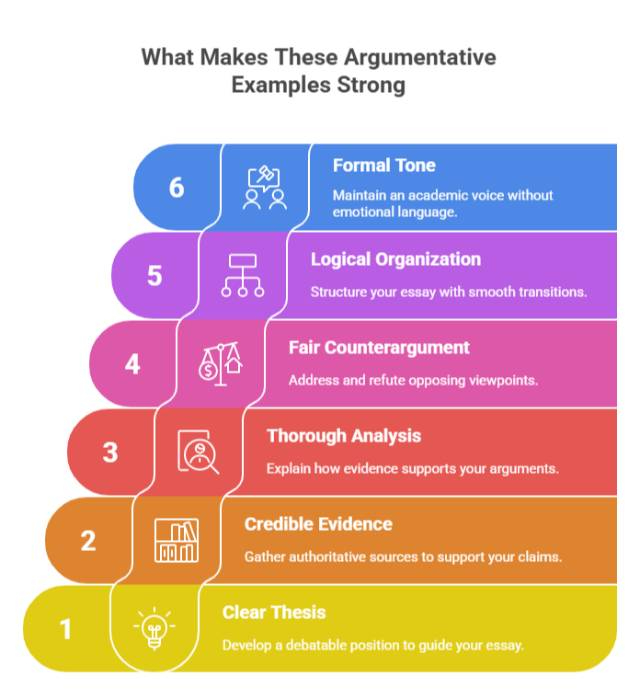
Stuck translating these examples into your own strong essay? Our professional argumentative essay writing service knows exactly how to build arguments professors can't dismiss with proper structure, credible sources, and bulletproof logic.
Downloadable Collection for Argumentative Essay
Get Hours Back. Get a Better Essay Smart students outsource. Our writers deliver higher-quality work in less time. Zero AI. Zero stress. Just results.
Bottom Line - Your Next Steps
- Pick 2-3 examples most relevant to your topic or assignment type
- Analyze their structure: How do they organize arguments? Where do counterarguments appear?
- Study evidence integration: How do they introduce sources? How much analysis follows each piece of evidence?
- Notice transitions: What words connect paragraphs and ideas?
- Apply techniques to YOUR topic: Use what you learned from these examples in your own essay to strengthen your argumentative essay.
- Start writing using our complete argumentative essay writing guide