What Makes a Good AI Plagiarism Checker?
Not all plagiarism checkers perform equally. Understanding evaluation criteria helps you choose tools matching your specific needs.
Detection Accuracy
The most critical factor is accuracy—both catching actual plagiarism and avoiding false positives flagging original work. Top-tier tools achieve 90-97% accuracy detecting traditional plagiarism, while AI detection remains less reliable at 70-92% accuracy depending on the tool and content type.
Research from Stanford's Educational Technology Lab tested 15 popular checkers, finding accuracy varied by 34 percentage points between best and worst performers. Lower-quality tools miss substantial copying while flagging common phrases as plagiarism.
Database Comprehensiveness
Checkers compare your work against databases of web content, academic papers, books, and previous student submissions. Larger databases catch more matches. Premium tools access databases with billions of web pages plus proprietary academic paper collections unavailable to free services.
Turnitin's database includes over 70 billion web pages, 1.8 billion student papers, and 180 million scholarly articles. Smaller databases miss significant plagiarism sources, particularly specialized academic content.
AI Content Detection Capability
Modern checkers must detect AI-generated content alongside traditional plagiarism. This requires different algorithms analyzing writing patterns, sentence structures, and linguistic markers characteristic of AI versus human writing.
Current AI detection achieves 70-92% accuracy, with performance declining as AI models improve. A 2024 study found AI detectors produced false positives in 19% of cases, incorrectly flagging human writing as AI-generated—a significant risk for students.
Speed and Usability
Checkers must analyze documents quickly without complex interfaces. Students need results within minutes, not hours, with clear explanations of flagged content. Best tools highlight specific matches, show similarity percentages, and provide side-by-side comparisons.
User experience matters particularly for students working against deadlines who need quick verification before submission rather than waiting overnight for results.
Privacy and Security
Uploading academic work to online checkers raises legitimate privacy concerns. Reputable services guarantee they won't store, sell, or redistribute your content. Some store submissions in databases used for future comparison—acceptable for some purposes but problematic for protecting unique research.
Free services sometimes monetize through data collection. Read privacy policies carefully before uploading sensitive academic work. Students using trusted essay writing services should verify these services use secure, privacy-respecting plagiarism checking.
Which Are the Best Plagiarism Checkers for Students?
Based on accuracy testing, features, and practical use, these tools lead the category for different purposes.
Turnitin (Best Overall - Institutional Use)
- Accuracy: 96% for traditional plagiarism, 91% for AI detection
- Cost: Institution-provided (typically free for students)
- Database: 70+ billion web pages, 1.8 billion student papers
Turnitin dominates academic plagiarism detection with the most comprehensive database and sophisticated algorithms. It identifies paraphrased content, detects citation errors, and now includes AI writing detection. Most universities provide Turnitin access through their learning management systems.
- Strengths: Most comprehensive detection, trusted by institutions, detailed similarity reports, excellent citation analysis, and integrated AI detection.
- Limitations: Not directly accessible to students (must go through institutions), sometimes produces false positives on common phrases, and creates anxiety given its association with academic discipline.
Grammarly (Best Free Option)
- Accuracy: 85% for plagiarism, 79% for AI detection
- Cost: Free basic version, Premium $12/month
- Database: 16 billion web pages
Grammarly's free plagiarism checker provides solid detection without cost barriers. The premium version adds advanced features including citation assistance and detailed originality reports. Grammarly integrates seamlessly as a browser extension, checking work as you write.
- Strengths: Free basic version available, excellent user interface, real-time checking, and writing improvement suggestions alongside plagiarism detection.
- Limitations: Smaller database than premium competitors, limited academic paper access, and AI detection less accurate than specialized tools.
GPTZero (Best for AI Detection)
- Accuracy: 92% for AI-generated content
- Cost: Free basic version, Plus $10/month for extended features
- Focus: Specifically designed for AI content detection
GPTZero specializes in identifying AI-generated text from ChatGPT, Claude, Gemini, and other models. It analyzes writing patterns, sentence structure variance, and burstiness—characteristics distinguishing human from AI writing. The tool provides sentence-level analysis showing specific AI-generated sections.
- Strengths: Best AI detection accuracy, clear sentence-by-sentence analysis, constantly updated for new AI models, and free version available.
- Limitations: Doesn't check traditional plagiarism comprehensively, produces false positives on technical writing, and accuracy decreases with heavily edited AI content.
Copyscape (Best for Web Content)
- Accuracy: 89% for web-based plagiarism
- Cost: Premium $0.03-0.05 per search
- Database: Entire indexed web
Copyscape specializes in detecting content copied from websites and blogs. It excels at finding text published online but doesn't access academic databases. Ideal for checking if content appears elsewhere on the web before submission.
- Strengths: Excellent web coverage, affordable per-search pricing, batch checking available, and API integration options.
- Limitations: No academic database access, doesn't detect AI content, and less effective for paraphrased plagiarism.
Quetext (Best for Budget-Conscious Students)
- Accuracy: 87% for traditional plagiarism
- Cost: Free limited version, Pro $9.99/month
- Database: Billions of web pages plus selected academic sources
Quetext balances affordability with solid detection capabilities. The contextual citation analysis helps distinguish legitimate citations from plagiarism, reducing false positives. Color-coded similarity reports make results easy to understand.
- Strengths: Affordable pricing, excellent citation recognition, clean interface, and good paraphrase detection.
- Limitations: Smaller database than Turnitin, limited AI detection, and monthly limits on free version.
Students working with reliable essay writing services should verify that services use multiple checkers, as single-tool verification might miss issues another tool would catch.
How Do AI Plagiarism Checkers Actually Work?
Understanding detection mechanisms helps you use tools effectively and interpret results accurately.
Traditional Plagiarism Detection
These algorithms compare your text against database content using string matching, fingerprinting, and semantic analysis. Simple matching identifies identical text strings, while sophisticated algorithms detect paraphrased content by analyzing sentence structure, synonym patterns, and meaning similarity.
Modern tools break documents into chunks, create digital fingerprints, and search databases for matching fingerprints. When matches occur, algorithms calculate similarity percentages based on word overlap, sentence structure similarity, and unique phrase repetition.
AI Content Detection Methods
AI detectors analyze writing patterns characteristic of generative AI versus human writers. They examine perplexity (how surprising word choices are), burstiness (sentence length variation), and consistency (whether quality remains uniform throughout).
AI-generated content typically shows low perplexity—predictable word choices—and low burstiness—consistent sentence lengths. Human writing exhibits more variation, unexpected word choices, and inconsistent quality. Detectors use machine learning trained on millions of human and AI samples to identify these patterns.
However, AI detection remains imperfect. A 2025 study found current detectors achieve 70-92% accuracy with 15-25% false positive rates. Heavily edited AI content often evades detection, while technical writing by humans sometimes gets flagged incorrectly.
Citation and Reference Checking
Advanced checkers distinguish quoted material from plagiarism by analyzing citation formatting. They verify whether matched content appears in quotation marks, includes proper citations, and follows appropriate style guides (APA, MLA, Chicago).
This prevents false positives where students correctly cite sources but still get flagged because the checker identifies matches without recognizing proper attribution.
Paraphrase Detection
Sophisticated tools detect paraphrased plagiarism by analyzing semantic similarity rather than exact wording. They identify when sentence structures mirror sources even with synonym substitution, or when ideas follow sources too closely without adequate citation.
Research shows top-tier tools catch 67-81% of paraphrased plagiarism, while basic checkers miss most paraphrasing, only detecting verbatim copying.
What Strategies Ensure Clean Plagiarism Reports?
Proactive approaches prevent plagiarism issues rather than just detecting them after the fact.
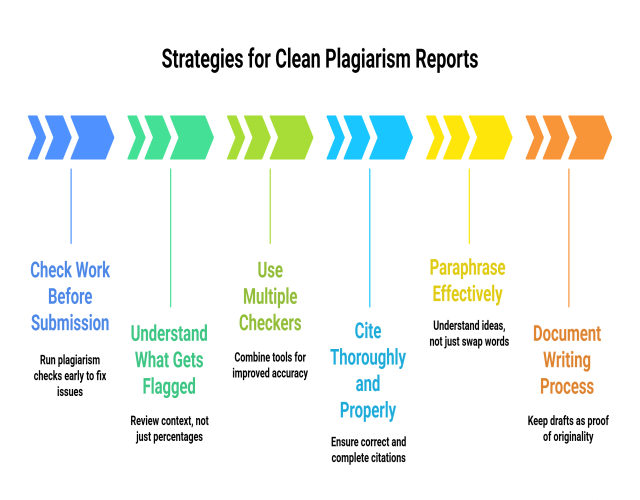
1. Check Work Before Submission
Run your work through checkers at least 24 hours before deadlines, allowing time to address flagged issues. Catching problems early prevents last-minute panic and ensures clean submissions.
Students who self-check work before submission have 78% fewer academic integrity violations than those who don't verify beforehand according to university tracking data.
2. Understand What Gets Flagged
Not every match indicates plagiarism. Common knowledge, brief quotes, properly cited material, and standard terminology legitimately appear in multiple sources. Learn to distinguish problematic matches from acceptable ones.
Similarity scores above 25% typically warrant review, but context matters more than percentages. Ten 1% matches to different sources differ significantly from one 10% match to a single source.
3. Use Multiple Checkers
No single tool catches everything. Use 2-3 different checkers for important submissions. One might catch web plagiarism another misses, while a specialized AI detector identifies generated content standard plagiarism checkers overlook.
Research indicates using multiple checkers increases detection rates by 23-34% compared to single-tool checking.
4. Cite Thoroughly and Properly
When in doubt, cite. Over-citation is academically acceptable and safer than under-citation. Learn your required citation style thoroughly—many plagiarism accusations stem from improper citation rather than intentional copying.
Students who master citation styles early show 64% fewer plagiarism issues throughout their academic careers.
5. Paraphrase Effectively
Good paraphrasing involves understanding concepts deeply enough to explain them in genuinely different words and sentence structures. Poor paraphrasing just substitutes synonyms while maintaining original sentence structure—checkers catch this easily.
Read sources, close them, then write from memory. This forces genuine paraphrasing rather than word-substitution plagiarism.
6. Document Your Writing Process
Keep notes, outlines, drafts, and research materials documenting your work development. If plagiarism accusations arise, this documentation proves your writing process and helps resolve disputes.
Some institutions now request writing process documentation alongside final submissions to verify originality. Students working with fast essay writing services should request documentation of the writing process to demonstrate authenticity if questioned.
Conclusion: Protecting Your Academic Integrity
Plagiarism checkers serve as tools for verification and improvement, not just detection and punishment. Understanding their capabilities, limitations, and proper use protects your academic career while improving writing quality.
Key takeaways:
- Turnitin leads overall with 96% accuracy and comprehensive databases, though institutional access only
- Grammarly provides best free option at 85% accuracy with excellent usability
- GPTZero specializes in AI detection achieving 92% accuracy for generated content
- Multiple checkers increase detection rates by 23-34% compared to single-tool checking
- Proactive self-checking prevents issues better than post-submission detection
Make plagiarism checking routine rather than emergency-only. Run every significant submission through at least one checker before submitting. This habit catches unintentional issues—forgotten citations, inadequate paraphrasing, or accidental similarity—before they become academic integrity violations.
Remember that checkers assist but don't replace understanding proper citation, effective paraphrasing, and academic honesty principles. Develop these skills alongside using detection tools for comprehensive integrity protection.
Whether writing independently or working with professional services, verification through multiple plagiarism checkers ensures your submissions meet institutional standards, protect your academic standing, and reflect your genuine learning and effort.