Choose a Compare and Contrast Essay Method First
Before jumping to the outline, select your organizational structure.
Point-by-Point Method
Structure: Each body section addresses one criterion, discussing both subjects within that section.
Best For:
- Subjects with many similarities and differences
- Direct comparison illuminates relationships
- Subjects that are relatively similar with subtle distinctions
- Longer essays (1,500+ words)
Advantages: Direct comparison within paragraphs makes relationships explicit, preventing readers from forgetting Subject A details when reading about Subject B.
Disadvantages: Requires more complex paragraph construction, can feel choppy in shorter essays.
Essay Due Tomorrow? Organization Still Unclear?
Our expert writers create comparison essays daily:
- Organize complex comparisons into clear structures
- Balance analysis between subjects perfectly
- Use specific evidence effectively throughout
- Meet any deadline
Zero AI. Just clear, sophisticated comparison analysis.
Order NowBlock Method
Structure: Discuss all aspects of Subject A completely, then all aspects of Subject B using the same criteria in the same order.
Pattern:
- Introduction with thesis
- Subject A: All criteria (A, B, C)
- Subject B: All criteria (A, B, C)
- Conclusion with explicit comparison
Best For:
- Quite different subjects needing independent explanation
- Shorter essays (under 1,000 words)
- Subjects requiring contextual background
- Arguing one subject's clear superiority
Advantages: Each subject receives coherent, uninterrupted treatment, simpler paragraph construction.
Disadvantages: Readers must remember Subject A details when reading Subject B section, less dynamic reading experience.
Decision Framework Visual
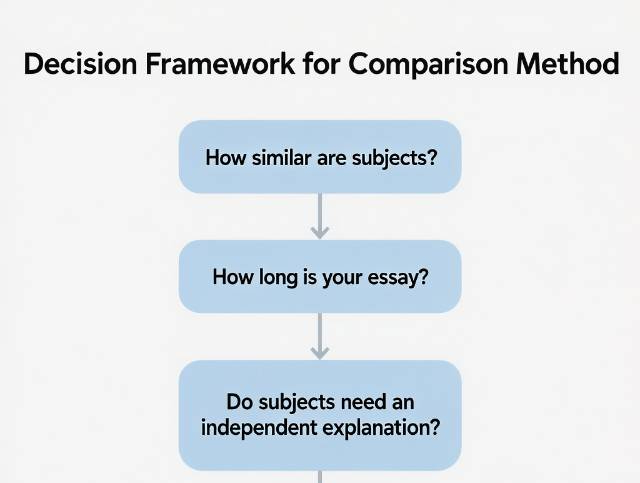
When uncertain, default to point-by-point for academic essays over 1,000 words, as it's more common and explicitly demonstrates comparison at every stage. For examples showing both structures with annotated explanations, study our collection of complete compare and contrast essay examples demonstrating effective use of each method.
Compare and Contrast Essay Templates
Template #1: Point-by-Point Method Outline
Best for: Longer essays (1,000+ words), complex subjects with many comparison points, assignments emphasizing direct comparison
Use when: You want readers to see immediate contrasts between subjects for each criterion
The Framework
I. INTRODUCTION (100-125 words)
Hook (1-2 sentences): [Attention grabbing opening about your subjects]
Background (2-3 sentences): [Essential context readers need to understand comparison]
Thesis Statement (1 sentence): While [similarity between subjects], [Subject A] and [Subject B] differ in [key ways], [making a conclusion/taking a position]
II. BODY PARAGRAPH 1: First Comparison Criterion (125-175 words)
Topic Sentence: [Introduce first comparison point]
Subject A:
- Key point about Subject A for this criterion
- Specific evidence/example
- Brief analysis
Transition: [However, In contrast, Conversely, Unlike Subject A]
Subject B:
- Key point about Subject B for the same criterion
- Specific evidence/example
- Brief analysis
Synthesis: [Explain the significance of this comparison]
III. BODY PARAGRAPH 2: Second Comparison Criterion (125-175 words)
Topic Sentence: [Introduce second comparison point]
Subject A:
- Key point about Subject A for this criterion
- Specific evidence/example
- Brief analysis
Transition: [Similarly, Likewise, In the same way]
Subject B:
- Key point about Subject B for the same criterion
- Specific evidence/example
- Brief analysis
Synthesis: [Explain the significance of this comparison]
IV. BODY PARAGRAPH 3: Third Comparison Criterion (125-175 words)
Topic Sentence: [Introduce third comparison point]
Subject A:
- Key point about Subject A for this criterion
- Specific evidence/example
- Brief analysis
Transition: [Conversely, On the other hand, While]
Subject B:
- Key point about Subject B for the same criterion
- Specific evidence/example
- Brief analysis
Synthesis: [Explain the significance of this comparison]
V. BODY PARAGRAPH 4: Fourth Comparison Criterion (Optional, 125-175 words)
[Repeat the same structure as paragraphs 1-3]
VI. CONCLUSION (100-125 words)
Synthesis (2-3 sentences): [Go beyond summary, what new understanding emerges?]
Thesis Restatement (1 sentence): [Return to main argument with added depth]
Broader Significance (1-2 sentences): [Why does this comparison matter? Implications?]
Final Thought (1 sentence): [Memorable concluding observation]
Template #2: Block Method Outline
Best for: Shorter essays (500-750 words), subjects needing full context before comparison, and fewer comparison points
Use when: Readers benefit from understanding each subject completely before comparing
I. INTRODUCTION (100-125 words)
Hook (1-2 sentences): [Attention grabbing opening about your subjects]
Background (2-3 sentences): [Essential context readers need to understand comparison]
Thesis Statement (1 sentence): While [similarity between subjects], [Subject A] and [Subject B] differ in [key ways], [making a conclusion/taking a position]
II. SUBJECT A: First Criterion (100-150 words)
Topic Sentence: [Introduce first criterion for Subject A]
Analysis:
- Key point about Subject A
- Specific evidence/example
- Explanation of significance
Transition to the next criterion for Subject A
III. SUBJECT A: Second Criterion (100-150 words)
Topic Sentence: [Introduce second criterion for Subject A]
Analysis:
- Key point about Subject A
- Specific evidence/example
- Explanation of significance
Transition to the next criterion for Subject A
IV. SUBJECT A: Third Criterion (100-150 words)
Topic Sentence: [Introduce third criterion for Subject A]
Analysis:
- Key point about Subject A
- Specific evidence/example
- Explanation of significance
Transition to Subject B: [Now examining Subject B reveals different patterns/approaches/characteristics]
V. SUBJECT B: First Criterion (100-150 words)
Topic Sentence: [Introduce the same first criterion for Subject B]
Analysis:
- Key point about Subject B
- Specific evidence/example
- Explicit comparison back to Subject A
Transition: [Unlike Subject A, In contrast to Subject A, While Subject A...]
VI. SUBJECT B: Second Criterion (100-150 words)
Topic Sentence: [Introduce the same second criterion for Subject B]
Analysis:
- Key point about Subject B
- Specific evidence/example
- Explicit comparison back to Subject A
Transition: [Similarly, Like Subject A, Paralleling Subject A...]
VII. SUBJECT B: Third Criterion (100-150 words)
Topic Sentence: [Introduce the same third criterion for Subject B]
Analysis:
- Key point about Subject B
- Specific evidence/example
- Explicit comparison back to Subject A
VIII. CONCLUSION (100-125 words)
Synthesis (2-3 sentences): [Go beyond summary, what new understanding emerges?]
Thesis Restatement (1 sentence): [Return to main argument with added depth]
Broader Significance (1-2 sentences): [Why does this comparison matter? Implications?]
Final Thought (1 sentence): [Memorable concluding observation]
Compare and Contrast Essay Structure Guidelines
Regardless of which compare and contrast essay outline template you choose, effective comparison essays follow similar proportions:
Introduction: 100-125 words (10-12% of essay)
- Hook readers immediately with an interesting observation
- Provide essential background (not everything, just what's needed)
- State the thesis clearly, identifying subjects and argument
Body Paragraphs: 400-600 words total (70-75% of essay)
- 3-5 comparison points depending on essay length
- Roughly equal depth for each criterion
- Balance between description and analysis (60% narrative, 40% interpretation)
Conclusion: 100-125 words (10-12% of essay)
- Synthesize insights beyond a simple summary
- Connect to broader significance or implications
- End with a memorable final observation
Still Unsure How to Write Your Own Essay?
Our professional writers help you move from examples to a polished final draft:
- Personalized topic development
- Clear structure and strong storytelling
- Reflection that admissions officers value
- 100% original, human-written essays
Get support that turns examples into success.
Order NowComparison Essay Format Variations by Length
Essay Length | Best Used For | Structure Adjustments | Recommended Method |
Short Format (500–750 words) | Middle school assignments, brief comparisons, 3-point analysis | Introduction: 75–100 words 3 body paragraphs: 100–150 words each Conclusion: 75–100 words Focus on 3 clear comparison criteria | Block method works best due to simpler organization |
Medium Format (750–1,000 words) | High school assignments, standard college papers, 4-point analysis | Introduction: 100–125 words 4–5 body paragraphs: 125–175 words each Conclusion: 100–125 words Focus on 4 substantial comparison criteria | Block or point-by-point: choose based on subject complexity |
Long Format (1,000–1,500+ words) | Research papers, upper-level college assignments, and in-depth analysis | Introduction: 125–150 words 5–7 body paragraphs: 150–200 words each Conclusion: 125–150 words Focus on 5–6 nuanced comparison criteria | Point-by-point preferred to maintain clarity and focus |
Body Paragraph Structure Template
Each body paragraph should follow this proven framework for maximum clarity:
Point-by-Point Paragraph Pattern
P = Point (Topic Sentence) (1 sentence) E = Evidence for Subject A (2-3 sentences) T = Transition (1 sentence) E = Evidence for Subject B (2-3 sentences) A = Analysis (2-3 sentences) L = Link (1 sentence) |
Block Method Paragraph Pattern
P = Point (Topic Sentence) (1 sentence) E = Evidence (3-4 sentences) A = Analysis (2-3 sentences) C = Comparison (if Subject B paragraph) (1-2 sentences) L = Link (1 sentence) |
Filled Comparison Essay Structure Outline for Your Understanding
Here's what Template #1 (Point-by-Point) looks like when filled in.
Note: This is a completed comparison essay outline with organized notes, not a fully drafted essay.
SUBJECTS: Solar Energy vs. Wind Energy
METHOD: Point-by-Point
COMPARISON CRITERIA: Output consistency, geographic requirements, costs
I. INTRODUCTION
Hook: Renewable energy transition is no longer a future possibility, but a current necessity as climate change accelerates
Background: Solar and wind power dominate renewable discussions, both are commercially viable and carbon free, and both require understanding before strategic deployment
Thesis: While both solar and wind power offer sustainable fossil fuel alternatives, they differ significantly in output consistency, geographic requirements, and economic considerations, suggesting optimal energy policy requires strategic deployment of both rather than exclusive commitment to either source
II. BODY PARAGRAPH 1: Output Consistency
Topic Sentence: Energy output consistency represents the most significant operational difference between solar and wind power
Subject A (Solar):
- Generates only during daylight (4-6 hours of peak production)
- Zero output at night when residential demand remains high
- Predictable daily cycle, but creates grid management challenges
- Evidence: Capacity factors around 20-25% in sunny locations
Transition: Conversely, wind turbines generate electricity regardless of time
Subject B (Wind):
- Operates whenever sufficient wind blows (7-55 mph range)
- Produces power during night hours when solar cannot
- Less predictable intermittency than solar's daily pattern
- Evidence: Capacity factors around 35-45% in windy locations
Synthesis: Neither provides consistent baseload power, but their intermittency patterns differ fundamentally. Solar's predictability aids grid planning, while wind's higher capacity factor produces more total energy
III. BODY PARAGRAPH 2: Geographic Requirements
Topic Sentence: Geographic requirements further distinguish where each technology functions effectively
Subject A (Solar):
- Functions best in high-sunshine regions (Southwest US, deserts, Mediterranean)
- Requires less space per installation when using rooftops
- Cloud-prone regions generate substantially less power
- Evidence: California, Arizona ideal; Pacific Northwest less suitable
Transition: Wind turbines, by contrast, require consistent wind patterns
Subject B (Wind):
- Optimal in coastal areas, elevated terrain, and flat plains
- Requires substantial spacing between turbines (wake effects)
- Offshore locations offer the strongest winds but higher costs
- Evidence: Great Plains, offshore locations ideal; sheltered valleys unsuitable
Synthesis: Solar suits more locations but requires more units per megawatt; wind suits fewer locations but produces more power per installation where conditions are favorable
IV. BODY PARAGRAPH 3: Economic Considerations
Topic Sentence: Installation costs, maintenance requirements, and lifespan create different financial profiles
Subject A (Solar):
- Installation: $2-3 per watt (utility-scale)
- Minimal maintenance (occasional cleaning, inverter replacement)
- 25-30 year lifespan, solid state with no moving parts
- Evidence: LCOE $30-60 per megawatt-hour
Transition: Wind turbines involve higher initial costs and maintenance demands
Subject B (Wind):
- Installation: $3-4 per watt onshore, $5-6 offshore
- Substantial maintenance (gearboxes, generators, mechanical parts)
- 20-25 year lifespan with regular component replacement
- Evidence: LCOE $30-70 per megawatt hour
Synthesis: Solar offers lower lifetime costs through minimal maintenance despite similar LCOE, while wind produces more power per installation when conditions are favorable, potentially offsetting higher maintenance
V. CONCLUSION
Synthesis: These technical and economic differences suggest that effective renewable policy requires deploying both technologies strategically, based on regional conditions, rather than declaring one superior
Thesis Restatement: Solar and wind power's differences in consistency, geography, and costs make each optimal for different applications and locations
Broader Significance: Energy transition success depends on recognizing each technology's strengths and limitations, deploying them where they function most effectively, rather than pursuing a one-size-fits-all approach
Final Thought: Future energy grids will likely combine both sources plus storage, leveraging complementary strengths to address climate challenges
Looking for a complete drafted essay? See our compare and contrast essay examples page for fully written versions.
Why Compare and Contrast Essay Outline Matters
The Strategic Advantages
Compare contrast outline provides five critical advantages that dramatically improve essay quality while reducing total writing time:
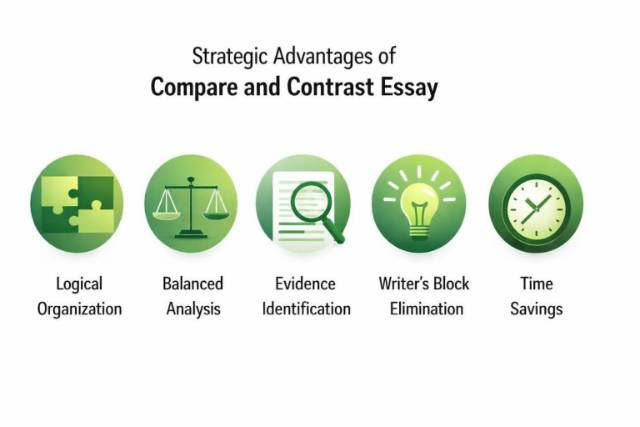
1. Ensures Logical Organization Before Drafting: Discovering organizational problems after writing 1,000 words requires extensive revision or complete rewriting. Discovering the same problems during outlining requires simply reorganizing bullet points, taking minutes rather than hours.
2. Guarantees Balanced Analysis: Outlines make imbalanced analysis immediately visible. If your outline shows three detailed points under Subject A but one vague point under Subject B, you know you need more Subject B research before drafting.
3. Identifies Evidence Gaps Early: Nothing derails drafting faster than reaching a planned point and realizing you lack supporting evidence. Outlines that specify evidence reveal gaps during planning rather than during drafting.
4. Creates a Clear Roadmap, Eliminating Writer's Block: The blank page becomes far less intimidating with a detailed outline. Instead of wondering "what should I write next?" you simply execute the next outlined point.
5. Saves Substantial Time: Spending 30-45 minutes creating detailed compare contrast outline saves 2-3+ hours during drafting and revision. Outlined drafts require minimal structural revision because the organization was planned correctly from the start.
These templates provide clear organizational frameworks, but filling them with sophisticated analysis that balances subjects perfectly while demonstrating deep understanding takes skill that most students develop over multiple essays. Our professional essay writing service specializes in comparison essays, transforming outlined ideas into polished analyses with strong thesis arguments, balanced evidence, and meaningful synthesis.
Downloadable Outline Templates for Compare and Contrast Essay
Still Overwhelmed? We're Here
Our professional writers specialize in comparison essays:
- Zero AI, 100% human-written analysis
- Use specific evidence effectively throughout
- Balance analysis between subjects perfectly
- Organize complex comparisons into logical structures
Thousands of students have trusted us with their most challenging essays. You can too.
Order NowBottom Line
A comparison essay outline prevents organizational disasters and ensures balanced analysis before you invest time in drafting. These three templates, point-by-point for direct comparison, block for full subject context, and shortened for brief essays, provide structured frameworks for any comparison assignment.
Choose your method deliberately based on essay length and subjects, identify 3-5 meaningful comparison criteria, gather specific evidence for each criterion under both subjects, organize into structured sections with planned transitions, and then draft systematically. Thirty minutes of outlining saves hours of mid-draft restructuring and produces stronger final essays. For comprehensive guidance on every stage from initial subject selection through final revision, explore our complete compare and contrast essay guide.