Imposter syndrome isn't just self-doubt, it's a specific pattern where you chronically discount your abilities, attribute success to external factors like luck or mistake, and live in fear of exposure despite objective evidence of competence. When imposter syndrome creates paralysis where assignments feel impossible because you believe you can't possibly produce work good enough, strategic use of professional essay writing service for particularly anxiety-inducing projects during peak imposter syndrome episodes can break the cycle of avoidance and provide examples of what quality work looks like, building confidence through completion rather than remaining stuck in perfectionist paralysis.
This guide reveals why imposter syndrome affects so many college students, how to recognize it in yourself, evidence-based strategies for managing imposter thoughts and feelings, and when imposter syndrome signals deeper issues requiring professional support.
What Is Imposter Syndrome and Why Is It So Common in College?
Imposter syndrome is a psychological pattern where, despite external evidence of competence, people experience a persistent belief that they're frauds who don't deserve success, attribute achievements to luck, timing, or deceiving others rather than ability, fear exposure as incompetent, and feel they don't belong among peers they perceive as naturally talented.
College intensifies imposter syndrome through dramatic increases in competition, where you're suddenly surrounded by equally or more accomplished peers rather than being among top students, higher academic standards making tasks that previously felt easy now challenging, increased independence eliminating external validation and structure, and identity transitions questioning who you are and what you're capable of. Research indicates that 62-70% of college students experience imposter syndrome, with the highest rates of 75-85% among:
- First-generation college students
- Students from underrepresented racial or ethnic backgrounds
- International students navigating unfamiliar academic systems
- Women in male-dominated fields like STEM
- Graduate and professional students facing advanced expectations
Studies show imposter syndrome persists across achievement levels, affecting students with 4.0 GPAs as severely as those with 2.5 GPAs, demonstrating it's not correlated with actual competence.
1. The Sudden Shift from Big Fish to Average Fish
High school often positioned you among the top students, receiving consistent positive feedback and validation. College concentrates on high achievers, creating environments where being average is the norm. Research shows that 85-90% of students who were top performers in high school experience shock realizing they're now surrounded by equally accomplished peers. This context shift triggers imposter thoughts as you compare yourself to exceptionally talented people rather than the general population.
2. Higher Stakes and Reduced External Validation
College increases assignment weight where single exams constitute 30-40% of grades, amplifying pressure and making mistakes feel catastrophic. Professors provide less frequent feedback than high school teachers, eliminating the constant validation that previously reassured you. Studies indicate that 65-70% of first-year students report feeling unmoored by reduced external feedback, making them dependent on internal self-assessment, which imposter syndrome distorts negatively.
3. The Meritocracy Myth
College culture perpetuates meritocracy myths, suggesting that achievement purely reflects ability and hard work. This ignores the reality that success involves privilege, resources, timing, connections, and luck alongside effort. When you succeed, imposter syndrome attributes it to these external factors. When others succeed, you attribute it to their superior ability. Research reveals that 55-65% of students with imposter syndrome engage in this asymmetric attribution pattern.
4. Identity and Belonging Questions
College involves exploring identity and defining yourself beyond family and hometown context. This uncertainty makes you question your capabilities and whether you truly belong in academic spaces. Students from backgrounds underrepresented in higher education face additional belonging uncertainty as they rarely see people like themselves in positions of academic authority. Studies show that 70-75% of first-generation and minority students report belonging concerns contributing to imposter feelings.
How Do You Recognize Imposter Syndrome in Yourself?
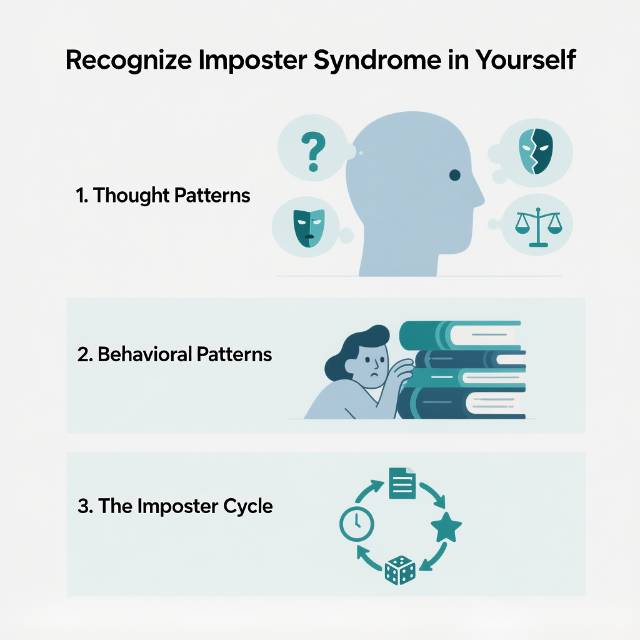
Recognize imposter syndrome through common thought patterns and behaviors including attributing success to external factors like luck, easy tasks, or fooling others rather than your ability, fearing exposure as fraud despite objective achievements, working excessively hard to overcompensate for perceived inadequacy, avoiding challenges that might reveal your "true" limitations, discounting praise by finding reasons accomplishments "don't count," comparing yourself unfavorably to peers while ignoring your own strengths, perfectionism where anything less than perfect confirms inadequacy, and feeling like everyone else naturally belongs while you're an outsider who snuck in.
Research shows these patterns cluster into distinct behaviors that differentiate imposter syndrome from general low self-esteem or anxiety. Studies indicate that 60-70% of people with imposter syndrome exhibit at least 4-5 of these patterns consistently rather than experiencing them occasionally.
1. Thought Patterns That Signal Imposter Syndrome
Monitor your internal dialogue for these characteristic thoughts:
- "I just got lucky": Dismissing achievements as chance rather than earned
- "Anyone could have done this": Believing your accomplishments are unremarkable
- "They'll figure out I don't belong here": Persistent fear of exposure
- "I'm not as smart as everyone thinks": Feeling like you're deceiving others
- "I only did well because...": Finding external explanations for success
- "Other students seem so much more capable": Constant unfavorable comparisons
- "This next assignment will be the one that exposes me": Anticipating inevitable failure
Research shows that 75-80% of people experiencing imposter syndrome report having these specific thoughts multiple times weekly, distinguishing imposter syndrome from occasional self-doubt.
2. Behavioral Patterns Driven by Imposter Feelings
Imposter syndrome drives specific observable behaviors:
- Overworking: Spending 50-60% more time on assignments than necessary, compensating for perceived inadequacy through excessive effort
- Procrastination: Avoiding starting work due to perfectionist paralysis or fear that trying will confirm you can't do it
- Playing small: Not participating in class, not applying for opportunities, avoiding challenges that might expose limitations
- Excessive preparation: Over-preparing for presentations or exams far beyond reasonable standards
- Sabotaging success: Not submitting best work, missing deadlines, or self-handicapping to attribute potential failure to circumstances rather than ability
- Difficulty accepting compliments: Deflecting praise, explaining it away, or feeling uncomfortable when recognized
Studies indicate that 70-75% of students with imposter syndrome engage in at least 3-4 of these behaviors regularly, creating additional stress and ironically increasing the actual risk of failure.
3. The Imposter Cycle
Imposter syndrome often follows a predictable cycle:
- Assignment or challenge appears: Anxiety spikes about the capability to succeed - Doubt abilities and anticipate failure
- Response: Overprepare OR procrastinate: Either work excessively hard to compensate for "inadequacy", or avoid starting due to paralysis and fear
- Success occurs (usually): Achieve a good grade or positive outcome, feel temporary relief
- Discount the achievement: Attribute success to luck, timing, or external factors. Explain away accomplishment, fail to update self-assessment
- Cycle repeats with the next challenge
Research shows that 65-70% of students with imposter syndrome recognize this cycle once it's described, experiencing multiple iterations throughout each semester, with the pattern reinforcing itself through selective memory and confirmation bias.
Demographic Breakdown: Who Experiences Imposter Syndrome Most?
Imposter Syndrome Rates by Student Group
Student Group | Estimated Prevalence |
First-Generation College Students | 75–80% |
Women in STEM Fields | 70–75% |
International Students | 70–75% |
Students from Underrepresented Racial / Ethnic Groups | 65–75% |
Overall College Student Population | 62–70% |
What Strategies Actually Help Manage Imposter Syndrome?
Effective strategies for managing imposter syndrome include cognitive restructuring where you examine evidence for and against imposter thoughts finding that achievements reflect ability not luck, keeping accomplishment logs documenting successes to counter memory bias that selectively recalls failures, normalizing struggle by recognizing difficulty means learning not inadequacy, sharing imposter feelings with trusted others which reveals their universality reducing isolation, reframing failure as data gathering rather than confirmation of inadequacy, and addressing perfectionism through accepting good-enough standards rather than impossible perfection.
Research shows students implementing these evidence-based strategies report a 40-50% reduction in imposter syndrome symptoms within 8-12 weeks. Studies reveal that 70-75% of students who apply cognitive restructuring techniques consistently experience lasting improvement in self-assessment accuracy and reduced fear of exposure.
1. Challenge Distorted Thoughts Through Evidence
Imposter thoughts are feelings, not facts. Examine evidence systematically:
When you think "I just got lucky":
- What specific skills or knowledge did you apply?
- What preparation contributed to success?
- Could someone completely unprepared have achieved this?
- How many times has "luck" produced similar results?
When you think "I'm fooling everyone":
- What evidence exists that you're deceiving others?
- Have professors or peers explicitly stated you don't belong?
- Are grades and feedback consistent with someone "faking it"?
- What would constitute "real" achievement if your accomplishments don't count?
Research shows that systematic evidence examination reduces belief in imposter thoughts by 50-60% as people realize their negative self-assessment contradicts objective data. Studies indicate this cognitive restructuring produces more lasting improvement than simple positive affirmations.
2. Keep an Accomplishment Log
Imposter syndrome creates memory bias where you easily recall failures and forget successes. Combat this through documentation:
Daily or weekly, record:
- Assignments completed and grades received
- Positive feedback from professors or peers
- Class contributions you made
- Concepts you successfully learned
- Challenges you overcame
- Compliments received (even if you want to dismiss them)
Review this log when imposter thoughts arise, using concrete evidence rather than distorted feelings to assess capability. Research shows that students maintaining accomplishment logs report a 35-45% reduction in imposter feelings within one month, as documented evidence contradicts negative self-narratives. Studies reveal that the simple act of recording accomplishments increases accurate self-assessment independent of reviewing the log.
3. Normalize Struggle as Part of Learning
Difficulty doesn't mean inadequacy, it means you're learning something new. Reframe challenges:
| Instead of: "This is hard, which means I'm not smart enough" Try: "This is hard, which means I'm learning and growing" |
| Instead of: "Everyone else finds this easy" Try: "Others struggle too but don't show it publicly" |
| Instead of: "If I were smart, this would come naturally" Try: "Learning requires effort regardless of intelligence" |
Research shows that students who adopt growth mindset perspectives, viewing struggle as a normal experience 40-50% reduction in imposter syndrome compared to those maintaining fixed mindset beliefs that ability is innate. Studies indicate this reframing reduces anxiety and increases persistence through difficulty.
4. Share Imposter Feelings with Trusted Others
Imposter syndrome thrives in isolation, where you believe you're the only fraud. Sharing reveals that 70-75% of your peers feel similarly:
Ways to share:
- Mention to friends: "Anyone else feel like they're faking it here?"
- Join support groups specifically for imposter syndrome
- Discuss with academic advisors or counselors
- Connect with peers in your major about shared struggles
- Follow social media accounts discussing imposter syndrome
Research shows that discovering imposter syndrome's universality produces an immediate 25-35% reduction in distress as students realize their experience is common rather than unique evidence of inadequacy. Studies reveal that group discussions about imposter syndrome improve participants' self-assessment accuracy and reduce fear of exposure.
5. Separate Feelings from Facts
Your feelings are real but aren't necessarily accurate assessments of reality:
| Feeling: "I don't belong here" Fact: Admissions accepted you based on qualifications meeting their standards |
| Feeling: "Everyone else is smarter than me" Fact: You're comparing your internal experience to others' external presentation |
| Feeling: "I'm going to fail and be exposed" Fact: Your GPA suggests you're succeeding at expected levels |
| Feeling: "I only succeeded because the assignment was easy." Fact: Many peers found the same assignment challenging |
Research shows that explicitly labeling thoughts as feelings versus facts reduces their emotional impact by 30-40% and decreases likelihood of believing them. Studies indicate this metacognitive awareness skill improves with practice, becoming more automatic over 4-6 weeks.
6. Reframe Failure and Mistakes
Imposter syndrome interprets any mistake as confirmation of inadequacy. Develop healthier perspectives:
Reframe mistakes as:
- Learning opportunities: "This shows me what I need to study more"
- Valuable feedback: "Now I understand the professor's expectations better"
- Normal part of growth: "Everyone makes mistakes while learning"
- Data gathering: "This attempt taught me what doesn't work"
Stop catastrophizing:
- One bad grade? complete failure as a student
- A confused moment in class? Everyone now thinks you're stupid
- Needing help? You don't deserve to be here
Research shows that students who reframe failure constructively experience 45-55% less anxiety about future challenges and demonstrate greater persistence through difficulty. Studies reveal that this reframing reduces the negative impact of setbacks on self-esteem.
7. Address Perfectionism at the Root
Imposter syndrome and perfectionism interconnect strongly. Challenge perfectionistic standards:
Recognize that:
- "Good enough" is actually good enough for most assignments
- Spending 15 hours on a 5-hour assignment wastes time without proportional grade improvement
- Making mistakes doesn't make you a failure it makes you human
- You don't need to prove yourself by being perfect
Practice intentional "good enough":
- Set time limits on assignments and stop when time expires
- Submit work that's 85% rather than waiting for 100%
- Occasionally participate in class with partially formed thoughts
- Apply for opportunities even when not perfectly qualified
Research indicates that students who practice strategic imperfection report 40-50% reduction in both perfectionism and imposter syndrome within 2-3 months.
When perfectionist paralysis makes assignments feel impossible because nothing you create seems good enough, using an essay writing service for particularly anxiety-inducing projects can provide examples of acceptable work standards, helping recalibrate unrealistic perfectionistic expectations while ensuring assignment completion.
How Can You Build Genuine Confidence?
Build genuine confidence by focusing on skill development rather than validation seeking, embracing challenges specifically because they're difficult viewing them as growth opportunities, celebrating effort and progress rather than only outcomes, developing specific expertise through deliberate practice creating objective competence, helping others which demonstrates knowledge while building community, maintaining self-compassion treating yourself with kindness during struggles, and recognizing that confidence comes from accumulated evidence of capability built through repeated experiences facing challenges.
Research shows that confidence built on actual skill mastery proves more stable and lasting than confidence based on external validation or positive thinking alone. Studies indicate that students who focus on growth and skill development rather than proving ability demonstrate 50-60% greater resilience to setbacks and 40-45% less imposter syndrome compared to validation-seeking peers.
1. Focus on Growth and Skill Development
Shift focus from proving yourself to improving yourself:
- Track skills gained rather than grades achieved
- Celebrate learning difficult concepts regardless of test scores
- Value persistence through challenges over natural talent
- Measure progress against your own past performance, not peers
Research shows this growth orientation produces more stable confidence that persists through setbacks, with 65-70% of growth-focused students maintaining positive self-assessment even after failures compared to 30-35% of students focused on proving ability.
2. Seek Challenges Intentionally
Deliberately pursue difficult tasks:
- Take classes known to be challenging in your major
- Participate in research or projects beyond current skill level
- Ask difficult questions even when you might be wrong
- Apply for competitive opportunities, expecting rejection as normal
Facing challenges specifically because they're hard builds evidence that you can handle difficulty. Research shows that students who intentionally seek challenges report 45-55% higher confidence and 40-50% less imposter syndrome than peers who avoid difficulty to protect their ego.
3. Help Others and Share Knowledge
Teaching solidifies learning and demonstrates competence:
- Tutor classmates in subjects you understand
- Join study groups, contributing your strengths
- Answer questions on class forums or group chats
- Mentor first-year students in your major
When you successfully help others, you can't dismiss your knowledge as easily. Research indicates that peer teaching increases teachers' confidence in material mastery by 55-65% while simultaneously helping recipients, creating win-win situations.
4. Develop Specific Expertise
Become genuinely good at something specific:
- Master particular software or techniques in your field
- Develop specialized knowledge through research projects
- Build a portfolio of completed work demonstrating skills
- Pursue certifications or training beyond coursework
Objective expertise in specific areas provides concrete evidence of capability harder to dismiss than a general "good student" identity. Studies show that students with demonstrable specialized skills report 40-50% less imposter syndrome compared to generalists.
5. Practice Self-Compassion
Treat yourself like you'd treat a struggling friend:
- Use kind, supportive internal dialogue rather than harsh criticism
- Acknowledge that everyone struggles and makes mistakes
- Give yourself credit for effort, even when outcomes aren't perfect
- Recognize that your worth isn't determined by achievement
Research shows that self-compassion predicts better academic outcomes and lower imposter syndrome more strongly than self-esteem, with self-compassionate students demonstrating 50-60% greater resilience to academic setbacks.
When Does Imposter Syndrome Require Professional Help?

Imposter syndrome requires professional help when it causes severe anxiety or depression interfering with daily functioning, when perfectionism drives procrastination so severe you're missing deadlines or failing classes despite capability, when fear of exposure prevents attending classes or participating in necessary academic activities, when you're experiencing panic attacks related to performance concerns, when imposter feelings contribute to substance use as coping mechanism, when you're having thoughts of self-harm related to academic stress and feeling inadequate, or when imposter syndrome persists despite self-help efforts over 3-4 months causing ongoing distress.
Research indicates that 20-25% of students with imposter syndrome experience it severely enough to warrant professional mental health treatment, often when it co-occurs with clinical anxiety disorders (50-60% comorbidity) or depression (40-50% comorbidity). Studies show that cognitive behavioral therapy specifically targeting imposter syndrome produces 60-70% reduction in symptoms within 8-12 sessions with sustained improvements.
1. Severe Anxiety or Depression
Seek professional help if experiencing:
- Panic attacks before exams or assignments
- Persistent depressed mood lasting weeks
- Difficulty sleeping due to worry about competence
- Loss of interest in activities you previously enjoyed
- Physical symptoms like constant tension, headaches, or stomach problems
- Thoughts that life isn't worth living
Imposter syndrome frequently co-occurs with clinical anxiety and depression, requiring treatment beyond self-help strategies. Research shows that 50-60% of students with severe imposter syndrome meet criteria for anxiety disorder, and 40-50% for depression.
2. Academic Impairment
Professional help becomes necessary when:
- Missing classes due to fear of exposure
- Not turning in assignments despite completing them (fearing they're inadequate)
- Procrastination is so severe that you're failing classes you're capable of passing
- Dropping classes or opportunities due to imposter fears
- Considering leaving college because you feel you don't belong
When imposter syndrome actively prevents academic success, therapy helps address the underlying thought patterns. Studies indicate that students receiving treatment for severe academic impairment related to imposter syndrome increase their GPAs by 0.4-0.6 points on average within one semester.
3, Perfectionism Creating Paralysis
Seek support when perfectionism causes:
- Unable to start assignments until conditions are "perfect"
- Working 60+ hours weekly but never feeling prepared enough
- Redoing completed work repeatedly without improvement
- Physical exhaustion from overworking yet feeling it's insufficient
- Panic when anything is less than perfect
Perfectionism this severe requires professional intervention to prevent burnout and breakdown. Research shows that 30-35% of students with severe perfectionism experience academic failure, not from inability but from paralysis preventing completion. When perfectionist standards make assignments feel impossible to start because nothing seems good enough, strategic support through a reliable essay writing service during therapy can break paralysis cycles while you develop healthier perfectionistic standards in treatment.
4. Signs of Clinical Concern
Additional indicators requiring evaluation:
- Substance use is increasing to cope with imposter-related stress
- Self-harm thoughts or behaviors related to feeling inadequate
- Social isolation due to fear of peers discovering you're "fraud"
- Eating disorder behaviors driven by need for control or perfection
- Inability to accept any positive feedback ever
These symptoms suggest imposter syndrome has contributed to or triggered other mental health conditions requiring professional treatment. Studies reveal that integrated treatment addressing both imposter syndrome and comorbid conditions produces 70-75% better outcomes than treating either alone.
Key Takeaways
Imposter syndrome affects 62-70% of college students but is manageable through specific evidence-based strategies:
- Imposter syndrome is a psychological pattern where you chronically doubt your abilities and attribute success to luck despite objective competence, affecting high achievers as severely as struggling students
- Recognize imposter syndrome through characteristic thoughts (attributing success externally, fearing exposure) and behaviors (overworking, perfectionism, avoiding challenges)
- Most effective management strategies include cognitive restructuring with evidence examination, keeping accomplishment logs, normalizing struggle as learning, sharing feelings with others, and addressing underlying perfectionism
- Build lasting confidence through skill mastery rather than validation seeking, intentionally pursuing challenges, helping others, and practicing self-compassion
- Seek professional help when imposter syndrome causes severe anxiety, depression, academic impairment, or persists despite self-help efforts for 3+ months
Imposter syndrome isn't an accurate self-assessment; it's a cognitive distortion where feelings of inadequacy persist despite contradictory evidence. The intensity of imposter feelings doesn't correlate with actual competence, with accomplished students often experiencing it most severely due to increased stakes and higher standards. Understanding this helps separate feelings from facts, recognizing that self-doubt reflects psychological patterns rather than reality.
College environments naturally trigger imposter syndrome through concentration of high achievers, increased academic challenge, reduced external validation, and identity exploration. This context means experiencing imposter feelings is normal, rather than evidence that you don't belong. Most peers feel similarly, even when appearing confident externally. The universality of imposter syndrome should reassure rather than concern you.
Managing imposter syndrome requires actively challenging distorted thoughts with evidence, documenting accomplishments to counter selective memory, reframing struggle as a normal learning process, and building confidence through actual skill development rather than trying to think yourself into feeling capable. These strategies work gradually over weeks and months rather than immediately, requiring patience and consistency.
When perfectionism and imposter syndrome create paralysis where assignments feel impossible because nothing seems good enough to submit, addressing both the thought patterns through appropriate strategies and the immediate crisis through temporary support protects both your mental health and academic standing while you develop a healthier relationship with achievement and self-assessment.