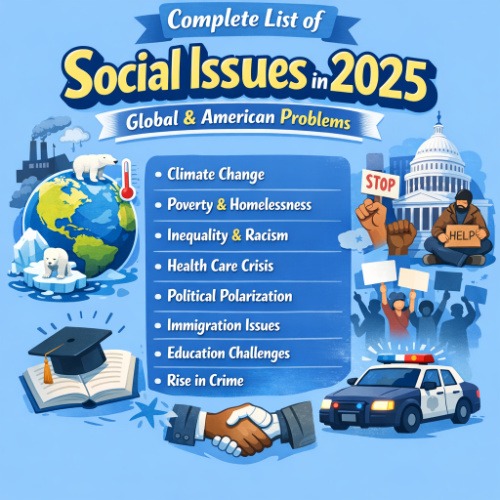
Understanding Social Issues in 2025
A social issue is a problem that affects many people within a society and requires collective action to address. Unlike personal problems, social issues stem from systemic factors, policies, economic structures, cultural norms, or institutional practices that create widespread harm.
1. Why 2025 Is a Critical Year Regarding Social Issues
The 2025 global landscape is shaped by three major forces converging simultaneously:
Post Pandemic Aftermath: Five years after COVID 19, societies continue grappling with educational gaps, economic disruption, and lasting mental health impacts, particularly among youth who experienced critical developmental years in isolation.
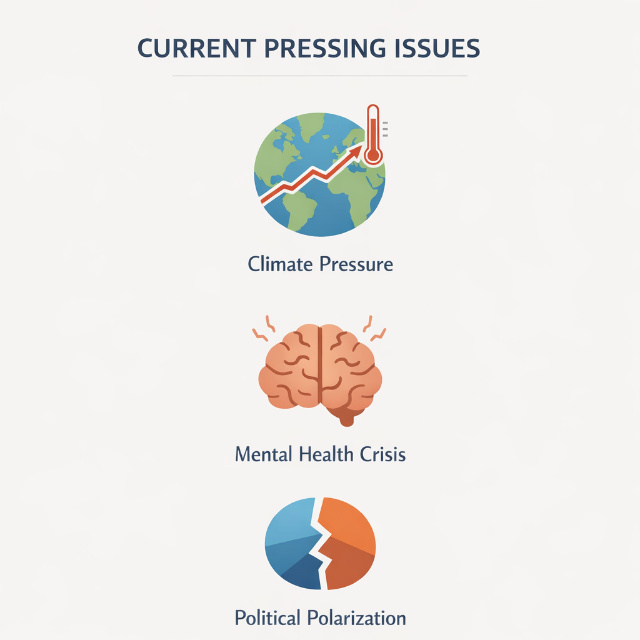
Climate Tipping Points: 2025 marked the third warmest year on record globally, with average temperatures 1.47°C above pre industrial levels. The past three years (2023-2025) represent the first time a three year period has exceeded the 1.5°C Paris Agreement limit.
Political Polarization: Across 30 countries surveyed, political extremism ranks as the #2 concern (27% of respondents), with only economic issues ranking higher. The trust gap between citizens and institutions has widened to historic levels.
2. How Social Issues Are Ranked
This list draws from five authoritative 2025 sources:
- Ipsos "What Worries the World" (30 countries, 20,000+ adults)
- Revolt's "Causes That Count Index" (50 critical issues, 5 year trend data)
- Yale Climate Communication Survey (1,040 U.S. adults)
- UN World Social Report 2025
- American Communities Project Survey (5,400 Americans)
Rankings reflect both perceived importance (what people say matters most) and measurable impact (statistical evidence of harm).
Pick a Social Issue. Get a Clear Essay Plan.
I’ll help you turn any issue from this list into a focused, high scoring argument.
- Strong, specific thesis statement (no vague topics)
- Clear outline + paragraph by paragraph direction
- Best angles to argue (causes, impacts, solutions)
- Quick feedback to strengthen clarity and logic
Original thinking. Zero confusion. Just a clean plan.
Order NowTop 25 Global Social Issues (Ranked by 2025 Data)
| Rank | Issue | Global Concern % | Trend Since 2020 |
|---|---|---|---|
| 1 | Poverty, Hunger & Homelessness | 31% | Rising |
| 2 | Cost of Living / Inflation | 48% | Stable High |
| 3 | Government Corruption | 54% | Rising |
| 4 | Climate Change | 29% | Declining |
| 5 | Crime & Violence | 35% (#1 in 30 countries) | Rising |
| 6 | Healthcare Access | 32% | Stable |
| 7 | Political Extremism | 27% | Stable High |
| 8 | Mental Health Crisis | 40% (youth) | Rising |
| 9 | Unemployment & Job Security | 28% | Stable |
| 10 | Immigration Control | 18% | Rising |
| 11 | Education Quality & Access | 24% | Stable |
| 12 | Income Inequality | 23% | Stable |
| 13 | Gender Inequality | 19% | Declining |
| 14 | Racism & Discrimination | 16% | Declining |
| 15 | Drug Abuse & Addiction | 22% | Rising |
| 16 | Housing Affordability | 26% | Rising |
| 17 | Food Insecurity | 21% | Stable |
| 18 | Social Media Harms | 29% (youth) | Rising |
| 19 | Terrorism & Extremism | 15% | Declining |
| 20 | Human Rights Violations | 14% | Stable |
| 21 | War & Armed Conflict | 18% | Fluctuating |
| 22 | Child Welfare | 12% | Stable |
| 23 | Elder Abuse & Care | 11% | Rising |
| 24 | Water Scarcity | 13% | Rising |
| 25 | Digital Privacy | 17% | Rising |
Key Insight: Economic issues dominate top concerns globally, while awareness of climate change has paradoxically declined despite accelerating impacts, dropping to its lowest level since June 2021 at just 13% mentioning it as a top concern.
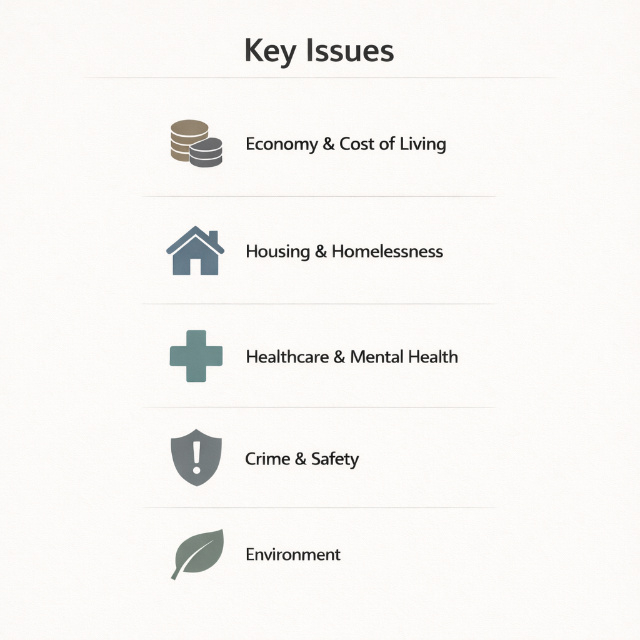
Social Issues Related to Economic and Poverty
1. Poverty, Hunger, and Homelessness (#1 Global Concern)
The Reality: Ranked as the #1 concern for three consecutive years. Over one third of the global population (2.6+ billion people) lives on between $2.15 and $6.85 per day, meaning even minor setbacks can push them into extreme poverty.
2025 Statistics:
- 58% of global workers remain in informal employment with no safety nets
- In South Africa, 80% of people experienced poverty at least once between 2008-2015
- U.S. homelessness became highly visible in major cities, with retail stores keeping basic goods locked due to theft concerns
Why It Matters: The UN's World Social Report 2025 warns that 60% of the world's population reports feeling they're struggling, with 12% actively suffering. Economic insecurity isn't improving despite overall GDP growth; the benefits aren't reaching those who need them most.
Related Essay Topics: Causes of poverty in America, homelessness solutions, food insecurity impacts, wealth gap analysis
2. Cost of Living and Inflation (#2 U.S. Concern)
The Reality: 48% of Americans say they're "very worried" about the cost of living, the #2 concern behind only government corruption. Inflation has dominated as a top issue for three consecutive years (2023-2025).
2025 Statistics:
- U.S. inflation remained persistent despite the Federal Reserve's actions
- Housing costs increased 8-12% year over year in major metro areas
- Grocery prices stabilized but remained 25% higher than 2020 levels
Why It Matters: Even with new presidential administration changes, people across all political divides cite inflation as their primary economic concern. It cuts through partisan divisions because everyone experiences it directly.
Related Essay Topics: Inflation causes and effects, living wage debates, consumer price impacts, economic policy analysis
3. Unemployment and Job Insecurity
The Reality: While official unemployment rates appear manageable, job security anxiety remains high. The nature of work has fundamentally shifted, with the gig economy, AI automation, and remote work creating uncertainty.
2025 Statistics:
- 28% globally cite unemployment/job security as a top 3 concern
- Youth unemployment (ages 15-24) remains double the adult rate in most countries
- "Fair wages" entered the top 10 concerns for the first time in 2025
Why It Matters: Economic insecurity creates cascading effects, delaying family formation, reducing consumer spending, increasing mental health problems, and fueling political instability.
Related Essay Topics: Gig economy impacts, automation and jobs, minimum wage debates, worker rights evolution
Social Issues Related to Health and Wellbeing
4. Mental Health Crisis (Top Youth Concern)
The Reality: Youth mental health has reached public health emergency status. The Surgeon General declared it a national crisis, with unprecedented rates of anxiety, depression, and suicidal ideation.
2025 Statistics: The Numbers Are Staggering:
- 40% of high school students report persistent sadness or hopelessness
- 43% of teen girls report feeling hopeless (all time high)
- 18% of teens experienced major depression in 2023
- 10% of high school students attempted suicide in the past year
- Suicide rates among ages 10-19 increased 85.3% between 2007-2017
- 60% of youth with major depression receive NO treatment
- Emergency department visits for youth mental health crises increased 31% (2019-2020) and remained elevated
Why It Matters: This isn't temporary pandemic fallout, it's a fundamental shift in how young people experience adolescence. Contributing factors include social media exposure, academic pressure, political uncertainty, climate anxiety, and inadequate access to mental health services.
Related Essay Topics: Social media and mental health, teen suicide prevention, school counseling gaps, therapy accessibility
5. Healthcare Access and Affordability
The Reality: 32% globally cite healthcare as a primary worry. In the U.S., healthcare costs remain the leading cause of bankruptcy despite insurance coverage expansion.
2025 Statistics:
- 27 million Americans remain uninsured
- Average family health insurance premiums exceed $23,000 annually
- Rural areas face physician shortages, with some counties having zero mental health providers
Why It Matters: Healthcare access directly determines life expectancy, quality of life, and economic stability. Disparities create two tier systems where outcomes depend on income, not medical need.
Related Essay Topics: Universal healthcare debates, rural healthcare access, medical debt impacts, insurance system reform
6. Drug Abuse and Addiction
The Reality: The opioid crisis evolved into a fentanyl crisis. Deaths from drug overdoses among 15-19 year-olds surged during and after COVID 19, largely due to fentanyl contamination.
2025 Statistics:
- 22% of people cite drug abuse as a major concern
- Fentanyl is now found in counterfeit pills of all types
- Overdose deaths remain near 100,000 annually in the U.S.
Why It Matters: Addiction doesn't discriminate by income, race, or geography. It devastates families, burdens healthcare systems, and feeds crime cycles. Treatment infrastructure remains grossly inadequate compared to the need.
Related Essay Topics: Opioid epidemic causes, addiction as disease vs. choice, harm reduction strategies, decriminalization debates
Social Issues Related to Environmental and Climate
7. Climate Change (#4 Global Issue, Despite Declining Concern)
The Reality: The paradox of 2025, climate impacts accelerate while public concern drops to the lowest levels since 2021 (only 13% mention it as a top worry, down from 15% in 2024).
2025 Climate Statistics: The Science Is Alarming:
- 2025 was the 3rd warmest year on record (only 0.13°C cooler than record breaking 2024)
- Global temperature is 1.47°C above pre industrial levels
- The past 11 years (2015-2025) are the 11 warmest on record
- 2023-2025 three year average exceeded 1.5°C, the first time ever
- 91% of the globe experienced above average temperatures
- Arctic sea ice extent hit its lowest winter maximum on record
- U.S. climate pollution rose 2.4% in 2025
Why It Matters: We're approaching irreversible tipping points while public attention shifts to immediate economic concerns. Climate change multiplies other social issues, driving migration, increasing food insecurity, worsening health outcomes, and straining government resources.
Related Essay Topics: Climate change solutions, environmental justice, carbon tax debates, renewable energy transition
8. Environmental Degradation and Pollution
The Reality: Beyond climate change, local environmental problems, air quality, water pollution, deforestation, and plastic waste affect daily life immediately and disproportionately harm low-income communities.
2025 Statistics:
- 13 of the 20 most polluted cities globally are in India
- Ocean plastic will exceed fish weight by 2050 if trends continue
- Deforestation increased in the Amazon and Congo basins
Why It Matters: Environmental degradation creates direct health impacts (respiratory illness, cancer, birth defects) and economic costs (contaminated water, loss of agricultural land, declining tourism).
Related Essay Topics: Plastic pollution solutions, air quality and health, deforestation causes, environmental racism
Social Issues Related to Justice and Inequality
9. Racial Discrimination and Systemic Racism
The Reality: Concern about race relations declined from #24 to #34 in global rankings since 2021, despite ongoing systemic disparities in criminal justice, healthcare, education, and economic opportunity.
2025 Statistics:
- Black Americans are 3x more likely to be killed by police
- Wealth gap: Median white family wealth is 8x that of Black families
- School segregation has increased since 1990 in many regions
Why It Matters: Systemic racism isn't just historical; it's embedded in present day institutions through policies, practices, and unconscious biases that perpetuate disadvantage across generations.
Related Essay Topics: Police reform, systemic racism in education, racial wealth gap, mass incarceration impacts
10. Gender Inequality and Women's Rights
The Reality: The gender pay gap has narrowed by only 3 percentage points since 1995. While awareness exists, structural change remains slow.
2025 Statistics:
- Women earn 84 cents for every dollar men earn (U.S.)
- 58% of global workers are in informal employment, disproportionately women
- Women hold 27% of parliamentary seats worldwide (up from 11% in 1995, slow progress)
Why It Matters: Gender inequality limits economic growth, perpetuates poverty, reduces innovation, and wastes human potential. It intersects with nearly every other social issue.
Related Essay Topics: Pay equity solutions, maternal healthcare access, workplace discrimination, reproductive rights
11. LGBTQ+ Rights and Discrimination
The Reality: Mental health statistics reveal severe disparities. LGBTQ+ youth, especially transgender teens, face dramatically higher rates of depression, anxiety, and suicidal ideation.
2025 Statistics:
- 45% of LGBTQ+ youth seriously considered suicide in the past year
- Transgender youth face double the discrimination rates
- Over 500 anti-LGBTQ+ bills introduced in U.S. state legislatures (2023-2024)
Why It Matters: Discrimination creates measurable health harms, educational barriers, employment challenges, and family rejection trauma, all preventable through policy and cultural change.
Related Essay Topics: Transgender rights debates, conversion therapy bans, LGBTQ+ youth mental health, discrimination protections
Social Issues Related to Technology and Digitalization
12. Social Media Harms (Top Youth Concern)
The Reality: The Surgeon General's 2025 advisory confirms that teens scrolling 3+ hours daily double their risk of depression and anxiety. Social media isn't neutral, its design intentionally exploits psychological vulnerabilities.
2025 Statistics: Digital Impact on Youth:
- 29% of teens cite social media as a major personal worry
- 25% of teens used ChatGPT for schoolwork (doubled from 13% in 2023)
- Average teen screen time: 7+ hours daily
- 60% of teens experience cyberbullying
- Instagram automatically sets under 18 accounts to private (new 2025 policy)
Why It Matters: Social media shapes identity formation, social skills, attention spans, and mental health during the most vulnerable developmental period. Platform design prioritizes engagement over well being.
Related Essay Topics: Social media regulation, cyberbullying solutions, digital addiction, platform accountability
13. Digital Privacy and Surveillance
The Reality: 17% of people worry about digital privacy, yet nearly half of teens don't care that tech companies collect their data. The disconnect between risk and awareness is stark.
2025 Statistics:
- The average person has data stored by 500+ companies
- Data breaches exposed billions of personal records
- 27% of teens are careful about what they post to avoid future regrets
Why It Matters: Once privacy is lost, it can't be recovered. Data collected today will follow individuals for decades, affecting job prospects, insurance rates, loan approvals, and personal safety.
Related Essay Topics: Data privacy laws, surveillance capitalism, AI and privacy, digital rights
Get a Better Essay, Without the Stress
Smart students outsource. I’ll deliver a polished, well-structured paper that reads naturally.
- Topic-to-final essay writing, fully handled
- Clear arguments + strong structure in every section
- Plagiarism-free writing with proper formatting
- On-time delivery with 24/7 support
Zero stress. Just results.
Get Expert Help NowSocial Issues Related to Education and Youth Challenges
14. Education Quality and Access Gaps
The Reality: 24% globally cite education access as a top concern. The pandemic created learning loss equivalent to 1-2 years of schooling, disproportionately affecting low income students.
2025 Statistics:
- 61% of teens feel intense pressure to achieve top grades
- Only 3-5% acceptance rates at top universities (Harvard, Stanford)
- 53% of teens feel they must be "extraordinary" to succeed
- College costs have increased 180% since 2000 (adjusted for inflation)
Why It Matters: Education remains the primary pathway to economic mobility, yet access to quality education increasingly depends on family wealth, perpetuating inequality across generations.
Related Essay Topics: Student loan crisis, learning loss recovery, standardized testing debates, education equity
15. Academic Pressure and Student Stress
The Reality: The pressure to achieve has reached crisis levels. Students report school stress exceeding concerns about physical appearance or social acceptance.
2025 Statistics:
- 61% of teens cite grade pressure as their #1 stressor
- 25% of teens use AI tools like ChatGPT for schoolwork
- Test optional college policies increased competition rather than reducing it
- More teens are choosing trade schools and gap years over traditional 4 year colleges
Why It Matters: Chronic stress during adolescence has lasting neurological effects, increases mental health risks, and ironically decreases actual learning and creativity.
Related Essay Topics: Grade inflation, college admissions pressure, alternative education paths, stress management programs
Social Issues Related to Politics and Governance
16. Government Corruption (#3 Global Concern)
The Reality: 54% of Americans are "very worried" about government corruption, the #1 concern in 2025, jumping from 14% (2024) to 23% (2025).
2025 Statistics:
- Trust in government institutions is at a historic low
- Corporate lobbying spending exceeded $4 billion annually in the U.S.
- Perception of corruption increased across both major political parties
Why It Matters: When citizens don't trust institutions to act in the public interest, democracy itself erodes. Policy becomes captured by special interests rather than serving collective welfare.
Related Essay Topics: Campaign finance reform, lobbying regulation, political accountability, institutional trust
17. Political Polarization (#2 National Concern)
The Reality: 27% of people cite political extremism as a major concern. The U.S. has become more divided on nearly every political issue compared to two decades ago.
2025 Statistics:
- 23 of 30 countries believe their nation is "heading in the wrong direction"
- France recorded the lowest optimism (10% say "right direction")
- Political violence incidents increased year over year
Why It Matters: Extreme polarization makes compromise impossible, gridlocks government, fuels misinformation, and increasingly normalizes political violence as acceptable.
Related Essay Topics: Media polarization, political violence, democratic backsliding, civic engagement decline
18. Immigration and Border Control
The Reality: 18% globally mention immigration as a top worry, rising from 16% (January 2025) to 18% (December 2025), hitting an 8 year high of 19% in November.
2025 Statistics:
- Great Britain saw immigration concern rise from 35% to 41% (now #1 issue)
- Europe experiences higher immigration anxiety than other regions
- U.S. border encounters fluctuated with policy changes
Why It Matters: Immigration debates intersect with economic anxiety, national identity, security concerns, and humanitarian obligations, creating complex tensions with no simple solutions.
Related Essay Topics: Immigration reform, refugee crisis, border security, citizenship pathways
Social Issues Related to Crime, Violence, and Safety
19. Crime and Violence (#1 in 30 Countries)
The Reality: Crime ranked #1 across 30 countries surveyed despite actual crime rates declining. The perception reality gap reveals people feel unsafe regardless of statistics.
2025 Statistics:
- 35% globally cite crime as a primary concern
- U.S. homicide rates decreased from pandemic peaks
- Retail theft and visible disorder increased in major cities
- Voters passed stricter sentencing laws in California and Arizona
Why It Matters: Whether crime is statistically up or down matters less than whether people feel safe in their communities. Visible disorder, homelessness, drug use, vandalism, drives fear that influences voting, housing choices, and daily behavior.
Related Essay Topics: Criminal justice reform, sentencing policy, community policing, root causes of crime
20. Gun Violence and Mass Shootings (U.S. Specific)
The Reality: Gun violence remains a uniquely American problem among developed nations, with mass shootings occurring regularly while policy remains gridlocked.
2025 Statistics:
- 600+ mass shootings in 2024 (averaging 1.6 per day)
- Firearms are the leading cause of death for American children and teens
- Gun suicides account for over half of all gun deaths
Why It Matters: Gun violence affects schools, workplaces, public spaces, and homes. It creates pervasive fear and trauma and represents a preventable public health crisis that's unique among peer nations.
Related Essay Topics: Gun control legislation, Second Amendment debates, school safety measures, suicide prevention
Additional Critical Social Issues
21. Housing Crisis and Homelessness
26% of Americans cite housing affordability as a major concern. "Housing, housing, housing is on people's minds," reports the NewDEAL network of Democratic officials.
22. Food Insecurity and Hunger
21% globally worry about famine and food insecurity. Climate change, supply chain disruptions, and economic inequality drive food access problems even in wealthy nations.
23. Aging Population and Elder Care
11% mention elder abuse/care concerns, rising as populations age. Long term care costs, caregiver shortages, and social isolation affect millions of elderly people.
24. Water Scarcity
13% cite water scarcity as a major issue. Climate change exacerbates existing shortages. Western U.S. faces ongoing drought. Developing nations face acute drinking water crises.
25. Child Welfare and Protection
12% mention child welfare. Issues include child poverty, abuse, neglect, inadequate foster care systems, and a lack of childcare support for working families.
How Social Issues Interconnect
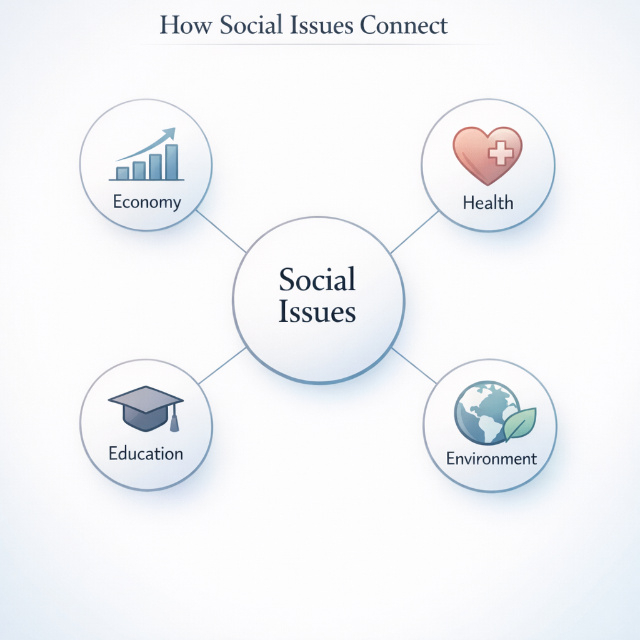
Understanding social issues requires recognizing that they don't exist in isolation; they create cascading effects and compound each other:
Example: Climate is linked to Migration and Political Tension
- Climate change reduces agricultural productivity
- Food insecurity drives migration from affected regions
- Immigration increases in destination countries
- Political polarization intensifies around immigration policy
- Social services become strained
- Economic inequality worsens
Example: Poverty is related to Education and Employment
- Childhood poverty limits education quality
- Lower education reduces employment opportunities
- Unemployment perpetuates poverty
- Next generation faces the same barriers
- Cycle continues across generations
Example: Social Media is linked to Mental Health and Academic Performance
- Excessive social media use increases anxiety/depression
- Mental health problems reduce school engagement
- Academic struggles increase stress
- Stress drives more social media escapism
- Mental health deteriorates further
The takeaway: Effective solutions must address root causes and systemic connections, not just surface symptoms.
Regional Differences: Global vs. American Priorities
| Issue | Global Rank | U.S. Rank | Difference |
|---|---|---|---|
| Government Corruption | #3 | #1 | Higher U.S. concern |
| Climate Change | #4 | #10 | Lower U.S. concern |
| Crime & Violence | #5 | #3 | Similar |
| Healthcare Access | #6 | #4 | Similar |
| Immigration | #10 | #7 | Higher U.S. concern |
| Mental Health | #8 | #2 (youth) | Higher youth concern |
Key Insight: Americans prioritize governance issues (corruption, polarization) over environmental issues (climate) compared to global averages. Economic concerns dominate regardless of region.
Using This List for Research
For Students Writing Essays
Choose issues that:
- Have abundant current data (easier research)
- Affect your community directly (personal connection)
- Have clear stakeholders and competing perspectives (nuanced analysis)
- Offer specific, actionable solutions to discuss
Strong essay topics from this list:
- Teen mental health crisis and social media regulation
- Climate change solutions and political resistance
- Gun violence prevention and constitutional rights
- Immigration policy and humanitarian obligations
- Government corruption and campaign finance reform
For Activists and Advocates
Use this data to:
- Identify which issues have growing vs. declining public awareness
- Understand regional variations in concern levels
- Connect your issue to related problems people already care about
- Frame solutions using data driven evidence
- Counter misconceptions with current statistics
For Policymakers
This list reveals:
- Perception reality gaps (crime rates down, fear up)
- Issues where awareness lags behind urgency (climate)
- Cross cutting concerns that transcend political divides (inflation)
- Youth specific challenges requiring targeted intervention
- Geographic variations requiring localized approaches
If you’re unsure how to narrow your focus or structure a strong argument, our trusted essay writing service can help with topic refinement, updated research, and academic formatting.
Taking Action: What You Can Do
Understanding social issues is step one. Action is step two.
Individual Level:
- Educate yourself beyond surface level social media understanding
- Volunteer with organizations addressing issues you care about
- Vote in every election (local matters as much as national)
- Reduce personal contribution to problems (consume responsibly, reduce waste)
- Have conversations that challenge echo chambers
Community Level:
- Support local organizations with donations or time
- Attend city council or school board meetings
- Organize community discussions on specific issues
- Partner with neighbors on grassroots solutions
- Amplify the voices of those directly affected
Systemic Level:
- Contact elected representatives about specific policies
- Support policy organizations researching solutions
- Vote for candidates with track records on priority issues
- Join advocacy groups pushing for structural change
- Use your professional skills to contribute expertise
Remember: Every major social change, civil rights, environmental protection, and labor rights, started with individuals recognizing problems and taking action.
Data Sources:
- CDC Youth Risk Behavior Survey (mental health, violence data)
- Pew Research Center (social trends, demographics)
- UN World Social Report (global development issues)
- Ipsos "What Worries the World" (monthly global polling)
Action Organizations:
- Local community foundations (find via local search)
- Issue specific nonprofits (NAACP, Sierra Club, ACLU, etc.)
- United Way (connects volunteers to causes)
- Volunteer Match (database of opportunities)
Get Hours Back. Get a Better Essay
Smart students outsource. Our writers deliver higher-quality work in less time.
- Research, writing, and formatting — all done for you
- Plagiarism-free guarantee on every paper
- 24/7 support and direct writer communication
- On-time delivery or your money back
Zero AI. Zero stress. Just results.
Get Expert Help NowConclusion: From Awareness to Action
2025's social issues feel overwhelming because they ARE overwhelming. Climate tipping points, mental health epidemics, political polarization, and economic inequality aren't small problems with easy fixes.
But overwhelming doesn't mean hopeless.
Every major social change in history started with people recognizing problems, understanding their causes, and taking action, individually and collectively. Abolition. Civil rights. Environmental protection. Labor laws. Public health advances. All seemed impossible until it wasn't.
Your role matters, whether you're:
- A student researching an essay (education is the first step to change)
- A citizen trying to understand the world (awareness enables informed choices)
- An advocate working for solutions (grassroots movements drive policy)
- A policymaker analyzing priorities (data should guide decisions)
Use this list as a starting point, not an ending point. Pick one issue that resonates with you. Learn more. Take one action. Then another.
Social change happens when enough people decide that the way things are is not the way things have to be.