Who Should Write Your Letters of Recommendation?
Ideal recommenders include professors who taught multiple courses or supervised research projects providing deep knowledge of academic capabilities, faculty in your major field who understand subject-specific competencies and graduate program expectations, research supervisors who observed sustained work demonstrating intellectual curiosity and independence, academic advisors familiar with overall trajectory and engagement beyond individual courses, and for professional programs employers or internship supervisors who witnessed workplace skills and professional development.
Research shows letters from faculty who supervised independent research or thesis projects rank 40-50% stronger in committee evaluations than letters from course instructors alone, as research supervision demonstrates capabilities beyond completing assignments. Studies indicate one detailed letter from professor who knows you deeply outweighs three generic letters from prestigious faculty who barely remember you, with 82% of admissions committees preferring specificity over name recognition when evaluating recommendation strength.
1. Academic Recommendations for Graduate School
Graduate programs prioritize academic recommendations demonstrating research potential and intellectual capabilities.
Strong academic recommenders:
- Thesis or capstone project advisor who supervised sustained research
- A professor who taught you in 2-3 courses, observing development over time
- Research lab supervisor where you worked for multiple semesters
- Independent study mentor who guided a self-directed project
- Honors program advisor familiar with your overall academic trajectory
Characteristics of strong academic recommenders:
- Can describe specific projects, papers, or research contributions you made
- Observed intellectual growth and development across time
- Understand graduate education and what programs evaluate
- Work in a field related to your graduate study interests
- Will invest time writing thoughtful, detailed letter
Weaker choices to avoid:
- Professors from large lectures where you had minimal interaction
- Faculty who gave you an A but don't remember you personally
- Teaching assistants, unless specifically requested
- Famous professors who don't know your work
- Faculty outside your field are unable to assess subject competency
Research shows graduate admissions committees weigh letter content and specificity 3-4x more than recommender prestige, with detailed letters from assistant professors who know students well significantly outperforming vague letters from department chairs or distinguished professors with minimal student interaction.
2. Professional Recommendations for Jobs and Internships
Professional recommendations emphasize work ethic, teamwork, and practical competencies.
Strong professional recommenders:
- Direct supervisors from internships or part-time jobs
- Project managers who oversaw substantial work
- Volunteer organization leaders where you contributed significantly
- Client contacts from freelance or consulting projects
- Faculty advisors for student organizations demonstrating leadership
What professional recommenders should address:
- Specific work accomplishments and contributions
- How you handle feedback and professional development
- Teamwork and collaboration capabilities
- Problem-solving approaches and initiative
- Reliability, work ethic, and professional maturity
Research shows professional recommendations for entry-level positions perform best when recommenders provide concrete examples of work product quality, collaborative skills, and growth rather than generic praise about being "a pleasure to work with" without supporting evidence.
| Application Type | Best Recommender | Why This Works | Avoid Asking |
|---|---|---|---|
| Graduate School | Research supervisor/thesis advisor | Can discuss research skills, independence, and academic depth with examples | Large-lecture professor who barely knows you |
| Graduate School | The professor who taught you multiple courses | Observed growth over time and subject mastery | Famous faculty with no personal interaction |
| Jobs (Entry-Level) | Internship or job supervisor | Can verify work ethic, teamwork, and reliability | Family friends or unrelated contacts |
| Internships | Project manager or direct mentor | Can describe practical skills and real contributions | HR staff with no direct supervision |
| Scholarships | Academic advisor or faculty mentor | Can link achievements with long-term goals | Anyone unable to comment on the impact |
| Professional Programs (MBA, etc.) | Employer + academic recommender | Shows a balance of leadership and academics | Only academic or only professional references |
When Should You Start Building Recommender Relationships?
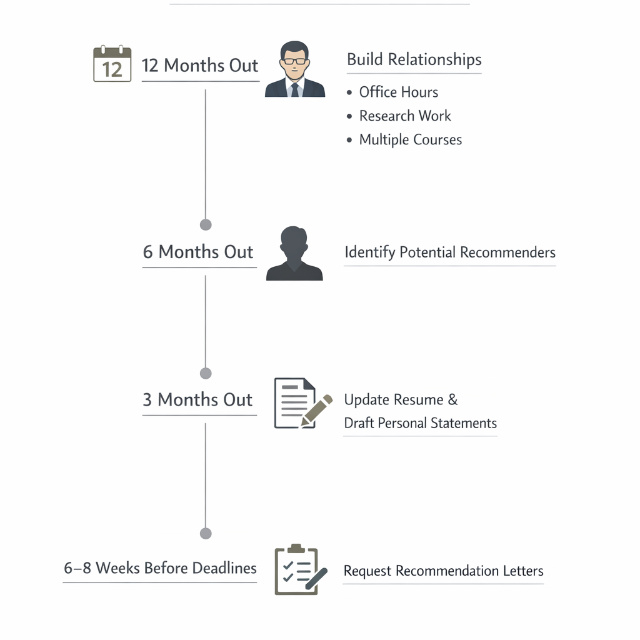
Begin cultivating recommender relationships 12-18 months before needing recommendations, with sophomore year ideal for identifying potential recommenders in your major, junior year critical for deepening relationships through research assistance or independent studies, and senior fall too late to build relationships requiring multiple semesters of demonstrated capability and growth.
Research shows students who intentionally cultivate recommender relationships starting sophomore year receive 40-50% stronger letters than those who first approach professors during senior year when requesting recommendations, as sustained relationships allow recommenders to observe development, remember specific accomplishments, and provide detailed, compelling narratives. Studies indicate 73% of strong letters come from relationships spanning 12+ months involving multiple touchpoints beyond single course completion, while rushed recommendations requested from professors with minimal relationship typically produce generic, inadequate letters.
1. Relationship Building Strategies
Transform professor-student interactions into meaningful relationships supporting strong recommendations.
Effective relationship cultivation:
During courses:
- Attend office hours 2-3 times per semester, discussing material beyond homework questions
- Contribute meaningfully to class discussions, showing engagement
- Complete assignments thoroughly, demonstrating intellectual curiosity beyond requirements
- Ask thoughtful questions about research or field trends
- Request feedback on major assignments, expressing genuine interest in improvement
Beyond courses:
- Volunteer as a research assistant for faculty projects
- Enroll in multiple courses with the same professor when possible
- Participate in departmental events, seminars, or colloquia
- Pursue an independent study or an honors thesis under faculty supervision
- Maintain periodic contact after courses via email, updating on academic progress
Building depth over breadth:
- 3-4 deep relationships with faculty outweigh 10 superficial connections
- Consistent engagement across semesters beats occasional intense contact
- Demonstrated intellectual curiosity matters more than grades alone
- Faculty remember students who engage authentically versus transactionally
Research shows professors write the strongest recommendations for students they know as developing scholars rather than grade-earners, with faculty reporting they remember and recommend students who demonstrated genuine intellectual engagement significantly more than those who earned higher grades but showed minimal personal connection or curiosity.
2. Timing for Different Application Types
Graduate school applications (December-January deadlines):
- Start building relationships sophomore spring/junior fall
- Request recommendations in October of senior year (3 months before deadlines)
- Allow 6-8 weeks of writing time before the first deadline
Scholarship applications (variable deadlines):
- Research scholarship deadlines during sophomore year
- Request recommendations 8-10 weeks before scholarship deadlines
- Consider timing overlap with other applications
Job applications (rolling throughout senior year):
- Build relationships junior year through courses and research
- Request general recommendations early senior fall for multiple applications
- Update recommenders about specific opportunities as they arise
Internship applications (vary by industry):
- Request recommendations 4-6 weeks before application deadlines
- For competitive programs, earlier requests allow stronger letters
Studies indicate that students who map out recommendation needs during sophomore year and strategically cultivate relationships achieve 2-3x higher success rates in securing strong recommendations compared to those who approach recommendation gathering reactively during senior year when applications are imminent.
How Do You Request Recommendations Effectively?
Request recommendations effectively by asking in person or via video call before sending formal email request allowing professors to decline comfortably if unable to write strong letters, providing 6-8 weeks notice before first deadline with longer notice producing 30-40% stronger letters according to faculty surveys, sending comprehensive materials package including resume, personal statement drafts, transcript, and specific accomplishments list helping recommenders write detailed letters, clearly stating deadlines and submission procedures with organized spreadsheet tracking multiple applications, and giving explicit permission to decline if they cannot write enthusiastic recommendation rather than pressuring reluctant recommenders.
Research shows 68% of faculty prefer being asked in person or synchronously before email follow-up, as personal requests allow more comfortable declining if they can't write strong letters while email-only requests pressure acceptance despite reservations. Studies indicate students who provide comprehensive background materials receive 35-40% more detailed specific letters compared to those who simply request recommendations without supporting information helping recommenders craft compelling narratives.
1. The Initial Request Conversation
In-person or video call approach:
"Professor [Name], I'm applying to [graduate school/jobs/scholarships] this fall and was hoping you might be willing to write a letter of recommendation for me. I really valued [specific course or research experience] and appreciated how you [specific positive experience]. I know this is a significant time commitment, so please feel comfortable saying if you're unable to write a strong letter or if you'd suggest I ask someone else."
Key elements:
- Make a request in person during office hours or scheduled meeting
- Reference specific positive experiences you shared
- Acknowledge time commitment, showing respect
- Give explicit permission to decline gracefully
- Ask if they can write a strong letter, not just any letter
Reading responses:
- Enthusiastic "yes": Strong letter likely, proceed with materials
- Hesitant or qualified yes: May produce a weak letter, consider alternatives
- Asks you to remind them of your work: Doesn't remember you well enough
- Suggests asking someone else: Decline masked as a suggestion
- "I can write a letter, but others might be better": Gentle no
Research shows professors who hesitate when asked typically produce weaker letters than those who accept enthusiastically, with 78% of faculty reporting they write substantially stronger letters for students they remember well and feel genuinely positive about, making initial reaction important signal of likely letter quality.
2. The Follow-Up Email Package
After verbal agreement, send a comprehensive email with all materials recommenders need.
Email structure:
"Dear Professor [Name],
Thank you for agreeing to write letters of recommendation for my [graduate school/job/scholarship] applications. I've attached materials to help you write the strongest possible letter:
- My current resume/CV
- Personal statement draft explaining my goals and interests
- Unofficial transcript
- List of specific accomplishments and projects from your [course/research lab]
- Spreadsheet with all programs, deadlines, and submission links
[Brief paragraph about your goals and why these opportunities matter to you]
The first deadline is [date], with others following through [date]. I've set calendar reminders to send polite reminders two weeks before each deadline.
Please let me know if you need any additional information or have questions about any programs. Thank you again for your support.
Best regards, [Your name]"
Materials to include:
- Updated resume or CV
- Personal statement or cover letter drafts
- Transcript (unofficial fine)
- List of specific work in the recommender's course or lab
- Program information for each application
- Deadline spreadsheet with submission links
When managing recommendation request materials alongside coursework during peak academic periods, an essay writing service can handle routine assignments, allowing focus on creating comprehensive materials packages that help recommenders write strong, detailed letters directly impacting admission and employment outcomes, rather than submitting minimal information, resulting in generic, weak recommendations.
Studies show recommenders provided with comprehensive materials spend 40-60% more time on letters and include 3-4x more specific details compared to those given minimal information, with detailed background enabling stronger more compelling letters even from recommenders who don't remember every detail of student work independently.
What Materials Help Recommenders Write Strong Letters?
Provide recommenders with current resume or CV listing accomplishments and experiences, personal statement drafts explaining goals and interests giving context for recommendation framing, list of specific projects or assignments completed in recommender's course describing your contributions and outcomes, transcript showing overall academic performance and rigor, program information explaining what each application seeks in candidates, and organized spreadsheet tracking all deadlines and submission procedures preventing missed recommendations.
Research shows recommenders given comprehensive materials write 35-40% longer more detailed letters containing specific examples compared to those provided only basic information, with detailed materials helping recommenders remember specific accomplishments and frame letters addressing what programs actually evaluate. Studies indicate 82% of faculty report that student-provided materials significantly improve letter quality particularly when recommending students from 1-2 years prior where memory of specific work has faded without documentation refresh.
1. Essential Materials Checklist
1. Current Resume/CV:
- All academic experiences, research, internships, and jobs
- Leadership roles and significant accomplishments
- Skills and relevant coursework
- Publications or presentations, if applicable
2. Personal Statement or Goals Statement:
- What you're applying for and why
- Your career or academic goals
- Why does this matter to you personally
- How your interests have developed
3. Specific Accomplishments List:
- Projects completed in recommender's course with brief descriptions
- Research contributions if you worked in their lab
- Papers or presentations with topics and outcomes
- Specific discussions or moments recommender might remember
- Grade earned and any special recognition
4. Unofficial Transcript:
- Shows overall academic trajectory
- Demonstrates course rigor and performance
- Provides context for your capabilities
- Highlights relevant coursework in the field
5. Program/Position Information:
- What each program seeks in candidates
- Faculty or research areas aligning with your interests
- Why are you specifically interested in each program
- What makes you a good fit for programs
6. Deadline Organization:
- Spreadsheet with all programs, deadlines, and submission links
- Color-coded by urgency
- Submission confirmation tracking
- Contact information for any questions
Research shows organized comprehensive materials packages help recommenders write letters 25-35% faster while producing higher quality content, as clear organization reduces administrative burden allowing focus on letter content rather than tracking multiple confusing requirements across different application systems.
2. Accomplishments List Template
Help recommenders remember your specific work in their context.
For course-based recommendations:
"Accomplishments in [Course Name], [Semester/Year]:
- Final Project: [Topic] exploring [specific question]. Received [grade] with your feedback, noting [positive comment if applicable].
- Midterm Paper: Analyzed [topic] through [methodology]. You mentioned [specific feedback], which I incorporated into the final project.
- Class Participation: Contributed regularly to discussions, particularly around [topics you engaged with].
- Office Hours: Attended 3 times discussing [topics], including our conversation about [memorable discussion]."
For research-based recommendations:
"Research Contributions in [Lab Name], [Time Period]:
- Developed [specific methodology or protocol] improving [outcome] by [percentage].
- Analyzed [data type] for [project name] contributing to [publication/presentation].
- Presented findings at [venue] to [audience].
- Mentored [number] undergraduate researchers in [techniques].
- Independent project on [topic] resulted in [outcome]."
Studies show specific accomplishments lists help recommenders include concrete examples in letters rather than generic praise, with letters containing specific project details and outcomes rated 50-60% stronger than those with only general positive statements about student capabilities.
How Do You Follow Up Without Being Annoying?
Follow up appropriately by sending initial reminder 2 weeks before first deadline thanking recommenders and confirming they have necessary materials, sending second reminder 3-4 days before deadline only if recommendation not yet submitted with polite gentle language, tracking submission status through application portals avoiding unnecessary check-ins, expressing genuine gratitude after each submission acknowledging time investment, and sending final thank you with outcome updates after application cycle ends sharing how recommendations supported your success.
Research shows 67% of faculty appreciate gentle reminders preventing deadline mishaps while 84% dislike frequent check-ins suggesting distrust in their reliability, making strategic limited reminders optimal approach. Studies indicate students who send thoughtful thank-you notes after recommendations submitted build lasting professional relationships, with 73% of faculty reporting they're more likely to write future recommendations for students who expressed genuine appreciation for previous letters.
1. Reminder Timeline and Language
Two weeks before deadline (first reminder):
"Dear Professor [Name],
I wanted to send a quick reminder that the recommendation for [program name] is due on [date], which is two weeks from today. The submission link is [link] and should be accessible through [portal name].
Thank you again for taking the time to support my applications. Please let me know if you need any additional information.
Best regards, [Your name]"
Three days before the deadline (only if not submitted):
"Dear Professor [Name],
I hope you're doing well. I wanted to follow up about the recommendation for [program name], which is due this [day of week]. I know you're busy, so I wanted to ensure the submission link is working properly and that you have everything you need.
Please let me know if there are any issues or if I can assist with anything.
Thank you, [Your name]"
When to skip additional reminders:
- If the recommender confirmed the submission
- If the portal shows the recommendation received
- If the recommender explicitly said, "Don't worry about it"
- If you've already sent 2 reminders for the same deadline
Research shows 2-3 reminders maximum for each deadline optimizes submission reliability without damaging relationships, with faculty reporting that more than 3 reminders creates stress and resentment, while fewer than 2 risks forgotten deadlines due to busy schedules and competing demands.
2. After Submission Thank You
Express genuine gratitude after each submitted recommendation.
Thank you email template:
"Dear Professor [Name],
Thank you so much for submitting the recommendation for [program name]. I really appreciate you taking the time to support my applications, especially given how busy [semester/time period] has been.
Your [course/research supervision] significantly shaped my interest in [field/topic], and I'm grateful for your mentorship and support as I pursue [goals].
I'll keep you updated about outcomes as decisions arrive. Thank you again.
Best regards, [Your name]"
Final thank you after decisions:
Update recommenders about outcomes and thank them again for their support.
Studies show students who send thoughtful thank-you notes and outcome updates maintain positive long-term relationships with recommenders, with faculty reporting these students are memorable when they need future recommendations for jobs, fellowships, or graduate programs after initial applications.
What Are Common Recommendation Letter Mistakes?
Common recommendation mistakes include waiting until 2-3 weeks before deadlines creating rushed generic letters with 64% of faculty stating short notice significantly reduces letter quality, asking professors who barely know you resulting in weak generic letters recognizable to committees, failing to waive right to view recommendations causing 78% of admissions committees to discount letters as potentially biased, providing minimal or no background materials forcing recommenders to write from limited memory, requesting recommendations via email without prior relationship establishment feeling transactional rather than relationship-based, and neglecting to follow up on submission status risking missed deadlines when recommenders forget busy during semester.
Research shows 73% of weak recommendation letters stem from poor recommender selection or inadequate notice rather than reluctant recommenders, with students who cultivate relationships and request appropriately receiving substantially stronger letters. Studies indicate students who waive viewing rights receive 40-50% stronger letters as recommenders write more honest detailed assessments when assured of confidentiality, while non-waived letters are assumed to be inflated requiring committee discounting.
1. Mistake 1: Asking the Wrong People
Selecting recommenders based on prestige rather than relationship depth produces weak letters.
Poor recommender choices:
- A famous professor from a large lecture who doesn't know you
- Faculty member you never spoke to despite a good grade
- TA from the course rather than the professor (unless specifically allowed)
- Recommender outside your field, unable to assess competency
- Friend or family member (almost never appropriate)
Better choices, even if less prestigious
- The assistant professor who supervised your thesis
- A lecturer who taught you in 3 courses and knows your work well
- A professor who supervised an independent study or research
- Faculty advisor for a student organization where you led projects
- Internship supervisor who observed sustained performance
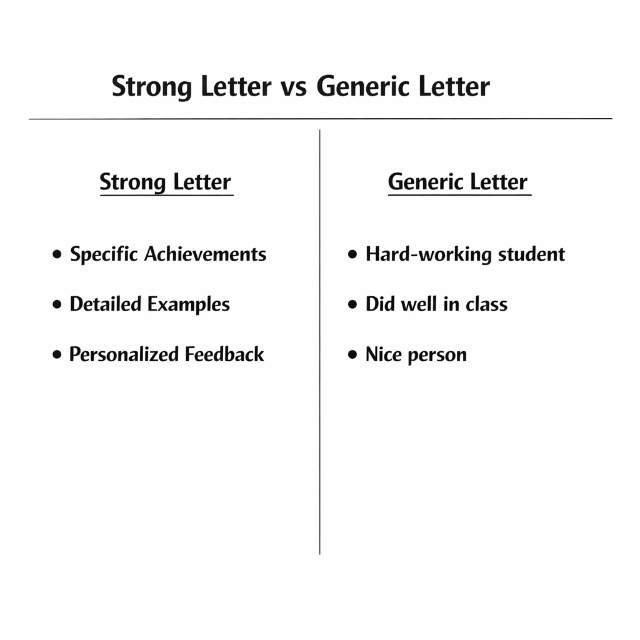
Research shows admissions committees and employers immediately recognize generic letters from prestigious recommenders who don't know students well, with 89% of evaluators rating detailed letters from less-known recommenders significantly higher than vague letters from distinguished faculty unable to provide specific examples of student capabilities.
2. Mistake 2: Last-Minute Requests
Requesting recommendations 2-3 weeks before deadlines produces rushed, inferior letters.
Consequences of short notice:
- Generic letters lacking specific examples or details
- Recommenders are too busy to write but feel pressured to accept
- Rushed writing with typos or vague statements
- Missed deadlines when recommenders forget during the busy period
- Damaged relationships with faculty, feeling disrespected
Benefits of adequate notice (6-8 weeks
- Time for thoughtful, detailed writing
- Comfortable declining if unable to write a strong letter
- Flexibility to write during less busy periods
- Opportunity to request clarification or additional materials
Stronger letters with specific compelling examples
Studies show faculty given 6-8 weeks write letters averaging 40% longer with 3-4x more specific examples compared to those given 2-3 weeks notice, with adequate time allowing recommenders to think carefully about student capabilities rather than rushing generic letters meeting deadlines.
3. Mistake 3: Not Waiving Viewing Rights
Keeping the right to view recommendations causes committees to discount letters.
Why waiving matters:
- Recommenders write more honest, detailed letters when assured confidentiality
- Admissions committees assume non-waived letters are inflated
- Programs may explicitly state that waiving rights is required for serious consideration
- Not waving signals a lack of confidence in letters or recommenders
Standard practice:
- Waive rights to view on all recommendation forms
- Accept that you won't see what recommenders write
- Trust recommenders to write strong letters if they agree enthusiastically
- Never ask recommenders to show you letters before submission
Research shows 78% of admissions committees and 82% of employers discount or disregard recommendations when students haven't waived viewing rights, assuming letters were written with student audience rather than evaluation committee as primary reader, making waiving rights critical for letter credibility.
Key Takeaways
Securing strong letters of recommendation requires strategic relationship building and professional request management:
- Start cultivating recommender relationships 12-18 months before needing recommendations through multiple courses, research assistance, office hours, and independent studies demonstrating capabilities beyond single-course performance
- Choose recommenders who know your work deeply through sustained interaction over prestigious professors who barely remember you, with detailed letters from engaged faculty outperforming vague letters from distinguished recommenders 3-4x in committee evaluations
- Request recommendations 6-8 weeks before deadlines, allowing adequate writing time, provide comprehensive materials, including resume, personal statement, accomplishments list, and deadline spreadsheet, helping recommenders write detailed, specific letters
- Follow up strategically with 2 reminders maximum per deadline, always waive the right to view recommendations for credibility, and send thoughtful thank-you notes after submissions, expressing genuine appreciation
- Avoid common mistakes, including last-minute requests producing rushed generic letters, selecting recommenders based on prestige rather than relationship depth, failing to waive viewing rights, causing 78% of evaluators to discount letters, and providing minimal materials, forcing generic recommendations
Strong recommendations validate capabilities through credible third-party assessment, distinguish exceptional from merely competent candidates, and provide specific examples of achievements and potential that grades and test scores cannot capture. The 40-50% stronger letters from adequate notice and comprehensive materials compared to rushed requests with minimal information justify strategic planning and professional request management.
Three detaile,d specific letters from faculty who genuinely know you outperform five generic letters from prestigious professors unable to provide concrete examples, making relationship depth more valuable than recommender fame for application success. Focus energy on cultivating 3-4 deep faculty relationships rather than superficial connections with many professors.
When academic demands prevent adequate time for relationship cultivation through research assistance or regular office hours, a trusted essay writing service can handle routine coursework during peak periods, allowing focus on activities that build recommender relationships directly impacting recommendation quality for graduate school, scholarship, and job applications, determining future opportunities and career trajectories.