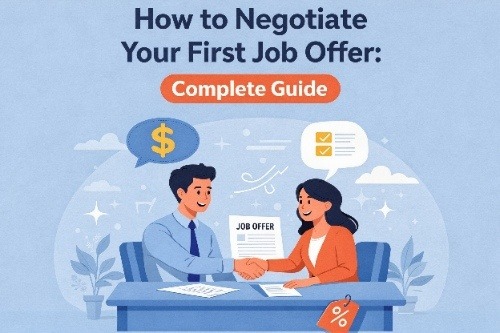
What Can You Negotiate Besides Salary?
Beyond base salary, you can negotiate signing bonuses ($3,000-$10,000 common for entry-level), start dates allowing completion of current commitments, remote work flexibility (2-3 days weekly increasingly standard), additional vacation days (3-5 days above standard), professional development budgets ($1,000-$3,000 annually), relocation assistance ($2,000-$8,000), performance review timing (earlier first review for faster raise eligibility), and title adjustments reflecting actual responsibilities.
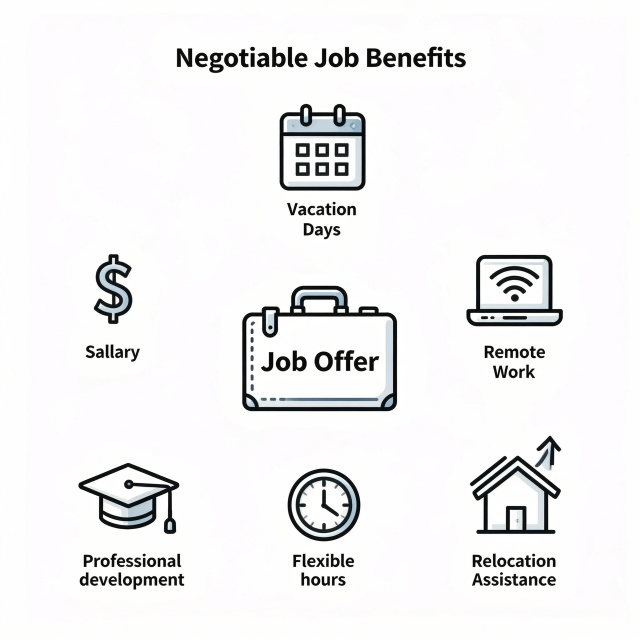
Comprehensive Negotiation Package
Smart negotiators view total compensation holistically rather than fixating solely on base salary, which may have limited flexibility.
Financial compensation elements:
- Base salary: Annual compensation (most obvious but not only lever)
- Signing bonus: One-time payment offsetting lower base or relocation costs
- Performance bonuses: Annual or quarterly bonuses based on goals
- Stock options/RSUs: Equity compensation (tech and startups)
- Relocation assistance: Moving costs, temporary housing, travel
- Student loan repayment: $1,000-$5,000 annually (growing benefit)
Work-life elements:
- Remote work flexibility: 2-3 days weekly remote increasingly negotiable
- Flexible hours: Core hours rather than strict 9-5
- Additional vacation days: 3-5 days above standard offer
- Start date flexibility: Delay start for current commitments or rest
- Compressed work weeks: Four 10-hour days versus five 8-hour days
Professional development:
- Training budget: $1,000-$3,000 annually for courses, conferences
- Conference attendance: Industry events with funding and time off
- Certification reimbursement: CPA, PMP, or field-specific credentials
- Tuition assistance: Graduate school or continuing education
- Mentorship programs: Formal development relationships
Other valuable elements:
- Title adjustment: Reflects actual responsibilities accurately
- Performance review timing: Earlier first review for faster raises
- Equipment upgrades: Better laptop, monitor, or tech tools
- Parking or commute benefits: Transit passes or parking reimbursement
- Gym membership: Wellness benefits
If base salary has limited flexibility due to standardized pay bands, shift focus to signing bonus, additional vacation, or remote work flexibility. These alternatives often provide significant value with less organizational constraint.
When managing job negotiations alongside coursework and other commitments, consider using a professional essay writing service for routine assignments during offer periods, allowing complete focus on negotiation research, strategy development, and professional communication that directly determines your starting salary and career trajectory.
How Do You Research Fair Market Compensation?
Research fair market compensation using salary databases like Glassdoor, PayScale, and Levels.fyi (tech roles), government data from Bureau of Labor Statistics providing industry benchmarks, university career services salary reports for your major and graduation year, professional association surveys publishing annual compensation data, and informational interviews with recent graduates in similar roles revealing real-world ranges.
Reliable Salary Research Sources
Online salary databases:
- Glassdoor: Self-reported salaries with filters for location, experience, company
- PayScale: Detailed compensation reports by role, location, education
- Salary.com: Industry-specific benchmarks with cost-of-living adjustments
- Levels.fyi: Tech industry compensation including equity (most accurate for tech)
- LinkedIn Salary: Crowdsourced data from member profiles
- Indeed Salary Search: Job posting data aggregation
Government and institutional data:
- Bureau of Labor Statistics: Occupational Employment Statistics by industry
- National Association of Colleges and Employers (NACE): Annual salary surveys
- University career services: School-specific graduate salary reports
- Professional associations: Field-specific compensation surveys (AMA, IEEE, AICPA)
Networking sources:
- Alumni informational interviews about starting salaries
- Industry professionals willing to share general ranges
- Recruiters specializing in your field and region
- Recent graduates from your program in similar roles
Calculating Your Target Range
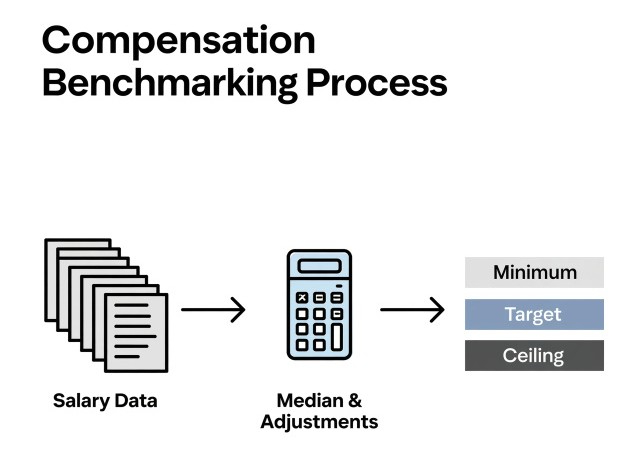
Research produces data ranges requiring synthesis into your specific negotiation range.
Developing your target:
- Gather 10-15 data points from multiple sources
- Calculate median and remove extreme outliers
- Adjust for your location's cost of living (use calculators like NerdWallet)
- Factor in your specific qualifications (relevant internships, skills, coursework)
- Set three numbers: minimum acceptable, target, and optimistic ceiling
Example calculation:
- Research shows $55,000-$70,000 for marketing coordinator roles
- Location adjustment: Your city is 8% below national average
- Adjusted range: $50,600-$64,400
- Your minimum: $52,000 (bills covered, lifestyle maintained)
- Your target: $58,000 (comfortable with savings)
- Your ceiling: $62,000 (best-case scenario)
Never reveal your minimum to employers. Lead with your target or slightly above, leaving room for compromise while staying above your actual minimum threshold.
When Should You Start Negotiating a Job Offer?
Start negotiating after receiving a written offer with specific compensation details, not during initial interviews or verbal offer discussions. Wait 24-48 hours before responding to review thoroughly and prepare negotiation strategy. Express enthusiasm for the role first, then introduce your negotiation points. Employers expect 2-5 day response times for standard offers, allowing adequate preparation without appearing indecisive.
The Negotiation Timeline
During interview process (DON'T negotiate yet):
- If asked about salary expectations: "I'm flexible and want to learn more about the full role and responsibilities first. What range does this position typically offer?"
- Deflect specific numbers until offer stage
- Never reveal current salary if legally avoidable
- Focus on fit, interest, and qualifications, not compensation
Verbal offer stage:
- Thank them enthusiastically for the offer
- Request written offer with full compensation details
- "I'm very excited about this opportunity. Could you send the full offer in writing so I can review all the details?"
- Do NOT negotiate on the phone during verbal offer call
Written offer received (NOW negotiate):
- Review thoroughly for 24-48 hours
- Research market rates and prepare specific requests
- Draft negotiation email or request phone call
- Present requests professionally with supporting rationale
Negotiation conversation:
- Lead with enthusiasm and appreciation
- Present 2-4 specific requests with justification
- Use collaborative language ("Is there flexibility on...?")
- Be prepared for yes, no, or counteroffers
- Request 24-48 hours to consider counteroffers
Final decision:
- Accept final offer verbally then in writing
- Confirm start date, onboarding details, and next steps
- Maintain professionalism even if declining offer
The 24-48 hour waiting period demonstrates thoughtfulness, not indecision. Hasty acceptance suggests desperation, while extended delays (5+ days without explanation) appear uncommitted. Two days is the sweet spot for serious consideration.
What Are Effective Negotiation Scripts and Email Templates?
Effective negotiation scripts express genuine enthusiasm for the role, cite specific market research supporting requests, frame negotiation as collaborative problem-solving rather than adversarial demands, present 2-4 specific requests with clear justification, and maintain professional gracious tone throughout. Successful negotiation emails average 150-250 words balancing brevity with substance.
Email Negotiation Template
Use this structure for written negotiation, adapting details to your situation:
Subject: [Your Name] - [Job Title] Offer Discussion
Dear [Hiring Manager Name],
Thank you so much for extending the offer for the [Job Title] position at [Company Name]. I'm genuinely excited about the opportunity to join [Team/Department] and contribute to [specific project or goal discussed during interviews].
After carefully reviewing the offer and researching market rates for similar positions in [Location], I'd like to discuss a few components of the compensation package:
Base Salary: Based on my research using [Glassdoor, PayScale, etc.], comparable roles in our market typically range from $[X] to $[Y]. Given my [relevant experience, skills, or accomplishments], I was hoping we could discuss a base salary of $[target number], which represents a [percentage]% increase from the initial offer.
[Additional element]: [Brief justification]. Would there be flexibility to [specific request]?
I want to emphasize that I'm very committed to this opportunity and confident I'll deliver significant value to the team. I'm hopeful we can arrive at a package that reflects both my qualifications and the market rate for this role.
Would you be available for a brief phone call this week to discuss these points? I'm also happy to continue the conversation via email if that's more convenient.
Thank you again for this opportunity. I look forward to working together to finalize the details.
Best regards,
[Your Name]
[Phone Number]
Phone Negotiation Script
If negotiating via phone (often preferable for maintaining rapport), follow this structure:
Opening (express enthusiasm): "Thank you so much for the offer. I'm really excited about joining [Company] and contributing to [specific team or project]. The conversations I've had throughout the interview process have only reinforced my enthusiasm for this role." Transition to negotiation: "I've reviewed the offer details carefully, and I was hoping we could discuss a couple of components to make sure we're aligned on the compensation package." Present requests with justification: "Based on my research of comparable roles in [location] using industry salary data, I was hoping we could discuss a base salary of $[target]. This reflects the market rate for someone with [specific qualifications, experience, or skills you bring]." "Additionally, I noticed the offer includes [X] vacation days. Given that I'm relocating for this position and have some commitments to wrap up, would there be flexibility to add [2-3] additional days or to adjust the start date to [specific date]?" Collaborative framing: "I want to emphasize that I'm really committed to this opportunity. I'm hoping we can work together to arrive at a package that feels right for both sides. What are your thoughts on these points?" Listen and respond: Allow them to respond fully. They may say yes, no, or offer alternatives. Be prepared for each scenario. Closing: "I really appreciate you taking the time to discuss this with me. Can I take [24-48 hours] to review [whatever they've offered/changed] and get back to you with a final decision?" |
What Are Common Negotiation Mistakes to Avoid?
Common negotiation mistakes include accepting the first offer immediately without discussion (forfeiting $7,500 average), making demands without supporting justification appearing entitled, negotiating before receiving written offer wasting leverage, revealing your minimum acceptable salary providing lower anchoring point, being overly aggressive or apologetic rather than professionally assertive, and focusing only on salary ignoring total compensation value.
Mistake #1: Accepting Immediately Without Negotiation
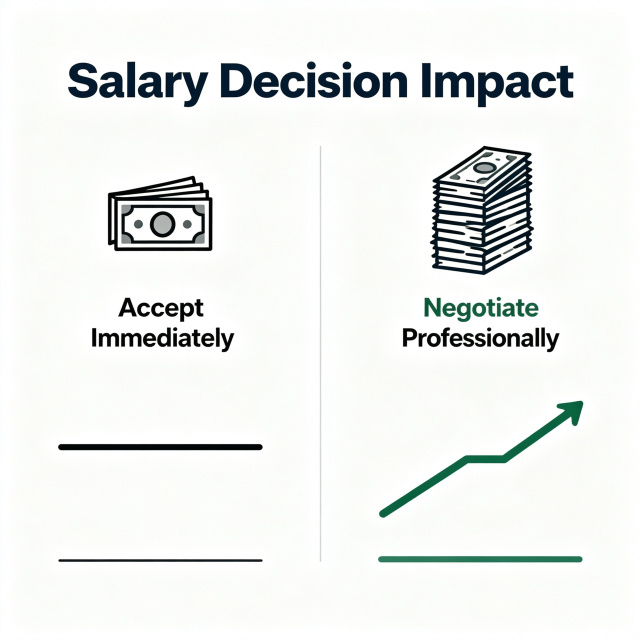
The most costly mistake is accepting the first offer without any discussion. Employers expect negotiation and build flexibility into initial offers specifically anticipating candidates will negotiate.
Why immediate acceptance hurts you:
- Leaves $5,000-$10,000 on the table on average
- Signals desperation or lack of market knowledge
- Compounds over career ($600,000 lifetime impact)
- Misses opportunity to optimize total package
- Employers actually expect you to negotiate
| What to do instead: Always request 24-48 hours to review any offer, even if planning to accept. Use this time to research, consult mentors, and prepare thoughtful response addressing any concerns or requesting minor adjustments. |
Mistake #2: Negotiating Without Supporting Data
Vague requests like "I was hoping for more" or "Can you do better?" appear entitled without justification. Employers need rationale for adjusting offers.
Weak negotiation approach: "I was really hoping for a higher salary. Is there any flexibility on that number?" Strong negotiation approach: "Based on research using PayScale and conversations with recent graduates in similar roles, comparable positions in this market typically range from $55,000-$65,000. Given my internship experience at [Company] and specialized skills in [specific area], I was hoping we could discuss a salary of $60,000." |
Specific data and personal qualifications justify requests, transforming negotiation from asking favors to collaborative market-rate discussion.
Mistake #3: Revealing Your Current Salary or Minimum
Many employers ask "What are you currently making?" or "What's your salary requirement?" These questions disadvantage candidates by anchoring negotiations to potentially underpaid current salary rather than market value.
How to deflect salary questions: "I'm currently earning [amount], but I understand this role has different responsibilities and scope. I'm more focused on finding the right fit and fair market rate for this specific position." Or simply: "I'm flexible on salary and want to learn more about the full role first. What range does this position typically offer?" |
Some states and cities legally prohibit salary history questions. Know your location's laws and leverage them when applicable.
Mistake #4: Being Too Aggressive or Too Apologetic
Negotiation tone matters significantly. Aggressive demands alienate hiring managers, while excessive apologizing undermines your position.
Too aggressive (hurts you): "I won't accept anything less than $65,000, and I need 4 weeks vacation and full remote work." Too apologetic (weakens position): "I'm sorry to even ask this, and I totally understand if you can't do it, but I was wondering if maybe there might be any possibility of discussing salary? Again, really sorry to bring this up." Professionally assertive (effective): "I'm very excited about this opportunity. Based on my research and qualifications, I'd like to discuss a base salary of $62,000. Is there flexibility on the initial offer?" |
Confidence without aggression demonstrates professionalism and self-advocacy, both qualities employers value in hires.
Mistake #5: Making Multiple Rounds of Requests
Don't negotiate piecemeal by making one request, receiving response, then introducing additional requests. This appears inconsiderate of recruiter's time and suggests you're not serious.
| Present all requests simultaneously: "I'd like to discuss three aspects of the offer: base salary, start date, and professional development budget." |
Bundle requests in single conversation allowing employer to evaluate full package adjustment at once rather than feeling nickel-and-dimed through multiple exchanges.
How Do You Handle Different Employer Responses?
Handle employer responses by graciously accepting improved offers that meet your minimum requirements, requesting 24-48 hours to evaluate counteroffers that partially meet requests, professionally declining offers that don't meet minimum even after negotiation, and asking for clarity on rigid components while exploring flexibility on other elements when initial requests are denied.
Response Scenario 1: They Say Yes
When employer agrees to your requests, accept professionally and confirm details in writing.
| Your response: "That's wonderful—thank you so much for working with me on this. I'm thrilled to accept the offer at $[final number] with [other agreed terms]. Could you send updated offer letter reflecting these changes? I'm excited to get started on [start date]." |
Follow up with formal written acceptance within 24 hours confirming all agreed terms.
Response Scenario 2: They Meet You Partway
Employers often counteroffer meeting some but not all requests.
Example employer response: "We can increase base salary to $58,000 [you asked for $60,000] and add an extra vacation day, but we can't adjust the start date or add a signing bonus."
Your response options:
Option A (Accept if meets minimum): "I appreciate your flexibility on salary and vacation. That works well for me. I'm happy to accept the offer at those terms." Option B (Try once more if below minimum): "Thank you for increasing the salary and adding the vacation day—I really appreciate that. Given that the start date and signing bonus aren't flexible, would it be possible to meet at $59,000 for base salary? That would help bridge the gap and make this work perfectly." Option C (Request time to consider): "I appreciate your flexibility on these points. Could I take 24 hours to review this updated package and get back to you tomorrow with my decision?" |
Response Scenario 3: They Say No
Some employers maintain firm offers, particularly for standardized entry-level programs with strict pay bands.
Employer response: "Unfortunately, this is our standard offer for entry-level [role], and we don't have flexibility on compensation. However, you'll be eligible for your first performance review in 6 months with opportunity for increase."
Your response options:
Option A (Accept if reasonable): "I understand the constraints around the standard program. I'm still very excited about the opportunity and happy to accept at the offered terms. I look forward to demonstrating my value and earning that 6-month review." Option B (Explore alternatives): "I understand the salary structure. Would there be any flexibility on other elements like start date, remote work days, or professional development budget?" Option C (Decline professionally): "I appreciate your time and consideration. After reflection, I don't think this compensation package aligns with my current needs. Thank you again for the opportunity." |
Declining offers should be done gracefully, maintaining relationship for potential future opportunities.
Response Scenario 4: Extended Timeline Request
Some negotiations require hiring manager escalation or approvals, extending timeline.
Employer response: "I need to check with my director about the salary adjustment. Can I get back to you early next week?" Your response: "Absolutely, I understand these decisions involve multiple stakeholders. I'm happy to wait for your response. Just to confirm, you'll follow up by [specific day]?" |
Request specific follow-up timing preventing indefinite delays while showing patience for their process.
What If You Have Multiple Job Offers?
Having multiple job offers significantly strengthens negotiation position. Handle competing offers professionally by notifying your preferred employer of timeline pressure, requesting expedited decision or improved offer, and avoiding explicit leverage language that appears manipulative. Research shows candidates with multiple offers negotiate 23% higher compensation on average through implied competition.
Leveraging Multiple Offers Ethically
Professional approach: "I want to be transparent with you—I've received another offer with a decision deadline of [date]. [Your Company] remains my first choice because of [specific reasons], but I need to respond to the other offer by [date]. Is there any possibility of expediting your process or discussing whether there's flexibility on the compensation to help me make this decision?"
Avoid saying: "Company X offered me $[amount]. Can you beat that?"
This appears transactional and damages relationships. Instead, create urgency through timeline pressure while reaffirming genuine preference for your first-choice company.
Comparing Total Compensation
When evaluating multiple offers, calculate total value beyond base salary.
Comparison framework:
| Factor | Company A | Company B | Notes |
|---|---|---|---|
| Base Salary | $58,000 | $55,000 | Company A higher |
| Signing Bonus | $0 | $5,000 | Company B offsets |
| Annual Bonus | 5% ($2,900) | 10% ($5,500) | Company B higher |
| 401k Match | 3% | 6% | Company B better |
| Health Insurance Cost | $150/month | $50/month | Company B cheaper |
| Vacation Days | 15 | 20 | Company B more |
| Remote Work | No | 3 days/week | Company B flexible |
| Total First Year Value | $60,100 | $64,900 | Company B actually better |
Don't fixate on base salary alone. Total compensation including benefits, bonuses, quality of life, and growth opportunities matters more than single number.
Key Takeaways
Negotiate your first job offer successfully using these evidence-based strategies:
Always negotiate professionally as 84% of employers expect it and only 1-2% rescind offers for reasonable negotiation. Successful negotiators earn $7,500 more annually on average, compounding to $600,000 over careers, while only 37% of entry-level candidates negotiate leaving money on table.
Research thoroughly before negotiating using salary databases (Glassdoor, PayScale, Levels.fyi), government data, university salary reports, and informational interviews. Calculate your minimum, target, and ceiling numbers based on market data adjusted for location and qualifications.
View total compensation holistically negotiating signing bonuses, remote work flexibility, vacation days, start dates, professional development budgets, and other elements beyond base salary when pay bands have limited flexibility. Alternative benefits often provide significant value.
Wait 24-48 hours after receiving written offers to review thoroughly and prepare specific data-supported requests. Present 2-4 bundled requests simultaneously with clear justification using collaborative rather than demanding language demonstrating professionalism.
Avoid common mistakes including accepting immediately without discussion, negotiating without supporting market data, revealing current salary or minimum numbers, being too aggressive or apologetic, and making multiple rounds of piecemeal requests appearing inconsiderate.
The lifetime financial impact of negotiating your first offer justifies the temporary discomfort of professional negotiation conversations. The 13% higher earnings five years into careers for negotiators versus non-negotiators demonstrates lasting advantage of advocating for yourself professionally from career start.
When managing job negotiations during final semester alongside coursework, graduation preparations, and other commitments, consider using a trusted essay writing service for routine assignments, allowing complete focus on offer evaluation, negotiation strategy, and professional communication determining your financial trajectory and career success for decades to come.