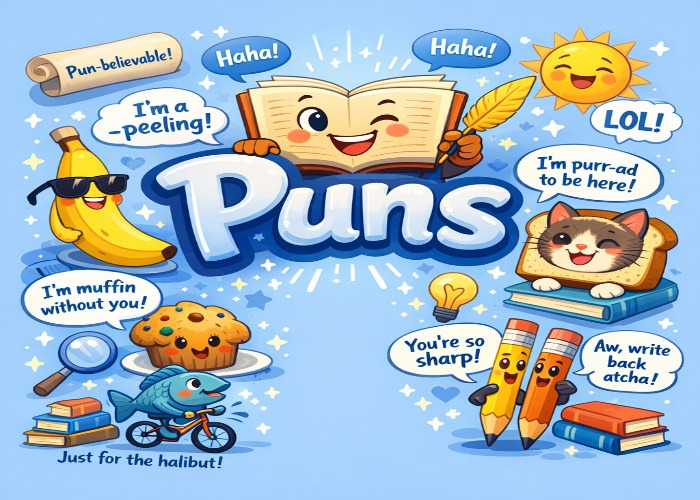
What Makes Something a Pun?
A pun exploits multiple meanings of a word or similar sounding words to create humor or insight. The same sound produces different meanings.
The quick test: Does the joke work because one word/sound has two meanings? That's a pun.
Examples:
- "Time flies like an arrow; fruit flies like a banana" (flies = verb/noun)
- "I used to be a banker, but I lost interest" (interest = attention/money)
- "A bicycle can't stand on its own because it's two tired" (tired/two tired)
What's NOT a pun:
- Simple rhyming ("cat in the hat")
- Metaphor without wordplay ("time is money")
- Jokes that don't rely on double meanings
Types of Puns
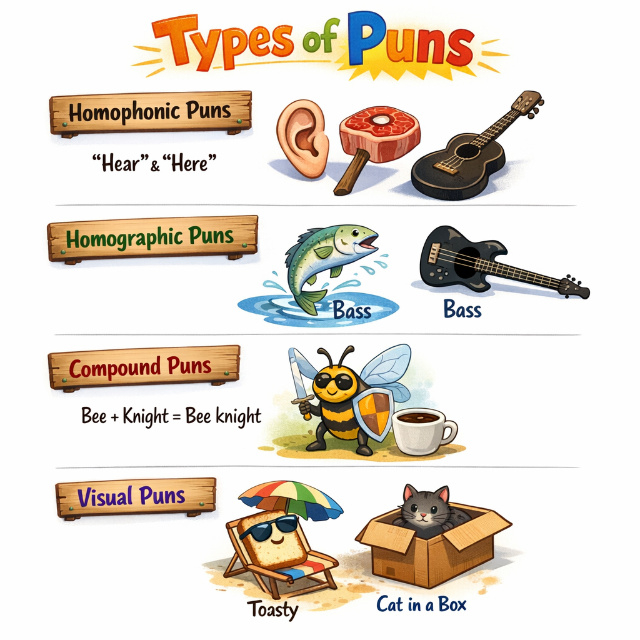
Homophonic Puns
Same sound, different spelling and meaning.
Examples:
- "I used to be a banker, but I lost interest" (interest = attention/money)
- "A bicycle can't stand on its own because it's two tired" (tired/two tired)
How they work: Sound similarity creates the connection.
Homographic Puns
Same spelling, different meanings.
Examples:
- "Time flies like an arrow; fruit flies like a banana" (flies = verb/noun)
- "The dump was so full, it had to refuse refuse" (refuse = deny/garbage)
How they work: One spelling, multiple definitions.
Compound Puns
Multiple layers of wordplay in one phrase.
Example: "A vulture boards a plane carrying two dead raccoons. The flight attendant says, 'I'm sorry, only one carrion per passenger.'"
The layers: "Carrion" sounds like "carry on" AND means dead animals.
Why they work: Multiple meanings compound the humor.
Visual Puns
Rely on appearance or spelling.
Examples:
- Road signs: "Employees must wash hands" (whose hands?)
- "Why was six afraid of seven? Because 7 8 9" (ate/eight)
How they work: Visual similarity or spelling tricks create meaning.
NEED YOUR WRITING TO BE CLEVER, NOT CORNY?
Our experts craft sharp, context-perfect puns that add wit and memorability without missing the mark.
- Intelligent wordplay tailored to your topic and audience
- Enhancing presentations, articles, or creative writing with humor
- Balancing cleverness with clarity and purpose
- Witty Wordplay Service
Don't just inform, entertain and engage with a perfectly placed pun.
Get Started NowWhen Puns Work vs When They Fail
When Puns Create Impact
| Shakespeare's plays: Reveal character, intelligence, and wit Comedy: Primary source of humor Casual conversation: Create a connection through shared cleverness Memorable names: Make businesses and brands stick |
When Puns Undermine Credibility
| Academic writing: Appear unprofessional Serious speeches: Trivialize important topics Formal business: Seem immature Overuse: Become exhausting rather than clever |
How to Use Puns Effectively
Step 1: Know Your Audience
Pun friendly contexts:
- Comedy writing
- Creative fiction (dialogue)
- Advertising
- Social media
Pun averse contexts:
- Academic papers
- Formal reports
- Serious journalism
Step 2: Don't Announce the Pun
Wrong: "I'm about to make a pun: I used to be a banker but I lost interest. Get it?"
Right: "I used to be a banker but I lost interest." (Let them discover it)
Trust your audience to catch wordplay.
Step 3: Embrace the Groan
Good puns make people groan while smiling. That's success, not failure.
Step 4: Layer Meaning
Weak pun: "I'm a big fan" (just states being a fan)
Strong pun: "I'm a big fan of air conditioning" (fan = enthusiast/cooling device)
Make the double meaning work on both levels.
Step 5: Know When to Stop
One pun per conversation/paragraph. Constant puns become irritating.
Puns vs Related Devices
Pun vs Malapropism
Pun: Intentional wordplay exploiting multiple meanings
Malapropism: Accidental word substitution (usually sounds similar)
Example:
- Pun: "Time flies like an arrow" (intentional)
- Malapropism: "He's the pineapple of politeness" (meant pinnacle accidental)
Pun vs Double Entendre
Pun: Any double meaning
Double Entendre: Specifically, sexual double meaning
Example:
- Pun: "I lost interest" (attention/money)
- Double Entendre: "That's what she said" (innocent phrase with sexual meaning)
Note: All double entendres are puns, but not all puns are double entendres.
Pun vs Spoonerism
Pun: Exploits multiple meanings
Spoonerism: Swaps initial sounds ("you have hissed my mystery lectures" = missed my history lectures)
Different wordplay types.
Common Pun Examples
These wordplay jokes appear constantly in everyday humor.
Homophone Puns (Same Sound, Different Meaning)
Examples:
- "I'm reading a book about anti gravity. It's impossible to put down."
- "Did you hear about the guy who got hit in the head with a can of soda? He was lucky it was a soft drink."
- "I'd tell you a chemistry joke but I know I wouldn't get a reaction."
- "The graveyard is so crowded, people are dying to get in."
Example breakdown: "Dying to get in" literally means dead people enter graveyards, but the idiom "dying to" means "eager to." The pun works on both levels.
Homograph Puns (Same Spelling, Different Meaning)
Examples:
- "Time flies like an arrow; fruit flies like a banana."
- "I used to be a banker, but I lost interest."
- "A boiled egg in the morning is hard to beat."
- "I'm reading a book on teleportation. It's bound to take me places."
Example breakdown: "Lost interest" means both stopped caring (attention) and lost money (financial interest). Same spelling, dual meaning.
Visual Puns
Examples:
- "7 ate 9" (seven/ate sound alike)
- "I before E except after C" (rule about spelling becomes wordplay)
- "Why was 6 afraid of 7? Because 7 8 9" (eight/ate)
Example breakdown: Numbers pronounced like words create the pun.
Pun Examples from Shakespeare
Shakespeare was the master of multilayered wordplay.
Romeo and Juliet
"Ask for me tomorrow, and you shall find me a grave man."
The pun: "Grave" means both serious and dead/in a grave. Why it works: Mercutio jokes even while dying. The pun shows his wit persists despite mortal wounds; humor masks pain. |
"Is love a tender thing? It is too rough, too rude, too boisterous, and it pricks like thorn."
The pun: "Pricks" refers both to thorn piercing and Cupid's arrow (sexual innuendo). Why it works: Shakespeare layers innocent plant imagery over sexual meaning. Romeo's confusion about love operates on multiple levels. |
Hamlet
Gravedigger: "What is he that builds stronger than either the mason, the shipwright, or the carpenter?"
Other: "The gallows maker, for that frame outlives a thousand tenants."
The pun: "Frame" means both gallows structure and body; "tenants" means both occupants and those who are hanged. Why it works: Dark humor about death through wordplay. The pun's distance from horror while acknowledging it. |
"A little more than kin, and less than kind."
The pun: "Kind" means both family relation (kin/kind) and kindness/nature. Why it works: Hamlet acknowledges Claudius as family ("more than kin," now stepfather and uncle) but implies he's not kind or natural. |
Much Ado About Nothing
Beatrice: "I wonder that you will still be talking, Signior Benedick: nobody marks you."
Benedick: "What, my dear Lady Disdain! Are you yet living?"
The pun: "Marks" means both notices and targets (archery). Why it works: Their wit warfare uses wordplay as weapons intelligence displayed through double meanings. |
ANALYZING PUNS IN LITERATURE, ADS, OR SPEECHES?
We’ll write your expert analysis on how wordplay creates humor, meaning, and persuasive impact.
- Exploration of double meanings, homophones, and contextual humor
- Insight into how puns reveal character, theme, or rhetorical strategy
- A polished essay that takes wordplay seriously
- Expert Wordplay Analysis
Understand how a play on words plays with your mind.
Get Started NowPun Examples from Literature
Writers use wordplay for humor and depth.
"Alice's Adventures in Wonderland" by Lewis Carroll
"And how many hours a day did you do lessons?"
"Ten hours the first day, nine the next, and so on."
"What a curious plan!"
"That's the reason they're called lessons because they lessen from day to day."
The pun: "Lessons" sounds like "lessen" (decrease). Why it works: Carroll's logic puzzles exploit language's flexibility. The absurd explanation follows sound rather than sense. |
"The Importance of Being Earnest" by Oscar Wilde
The entire plot puns on the title:
- Ernest = the name
- Earnest = being serious/sincere
The pun: Jack pretends to be "Ernest," but the play asks if anyone is truly "earnest." Why it works: The title pun contains the play's theme; Victorian society values appearance (the name Ernest) over authenticity (being earnest). |
"A Midsummer Night's Dream" by Shakespeare
"I have a reasonable good ear in music. Let's have the tongs and the bones."
The pun: "Ass" (Bottom's head) has good ears, and "tongs and bones" are both musical instruments and references to his donkey body. Why it works: Bottom doesn't realize he's punning on his own transformation, dramatic irony through wordplay. |
Pun Examples from Comedy
Comedians build careers on wordplay.
Stand Up Comedy Puns
Steven Wright:
- "I intend to live forever. So far, so good."
- "I stayed up all night to see where the sun went. Then it dawned on me."
The puns: "Dawned on me" = realized/sunrise appeared. Why it works: Deadpan delivery makes the wordplay sneaky; you groan after processing the double meaning. |
Mitch Hedberg:
- "I'm against picketing, but I don't know how to show it."
- "I used to do drugs. I still do, but I used to, too."
The pun: "Used to" means both past habit and utilized. Why it works: Simple language hides clever wordplay—the joke reveals itself slowly. |
Dad Jokes (Pun Heavy Humor)
Examples:
- "I'm reading a book about anti gravity. It's impossible to put down."
- "Did you hear about the restaurant on the moon? Great food, no atmosphere."
- "I would avoid the sushi if I was you. It's a little fishy."
- "Want to hear a joke about construction? I'm still working on it."
Why they work (or don't): Dad jokes embrace groan worthy puns. The eye roll IS the punchline.
Pun Examples in Advertising
Marketers use wordplay to make brands memorable.
Business Name Puns
Examples:
- "Lawn and Order" (landscaping service)
- "The Codfather" (fish and chips shop)
- "Curl Up and Dye" (hair salon)
- "Thai Tanic" (Thai restaurant)
- "Planet of the Grapes" (wine shop)
Why they work: Clever names get attention and stick in memory. The pun makes the business stand out.
Advertising Slogans
Examples:
- "We're raising the steaks" (steakhouse)
- "Life is brew-tiful" (coffee shop)
- "Sofa so good" (furniture store)
- "Beer: helping ugly people have sex since 1862" (Budweiser, controversial)
Why they work: Wordplay makes slogans shareable. People repeat clever puns.
Product Marketing
Examples:
- "Orange you glad we're here?" (juice company)
- "Donut worry, be happy" (bakery)
- "Let's give them something to taco bout" (Mexican restaurant)
Why they work: Playful language creates positive associations. Puns make brands feel friendly and clever.
Common Pun Mistakes
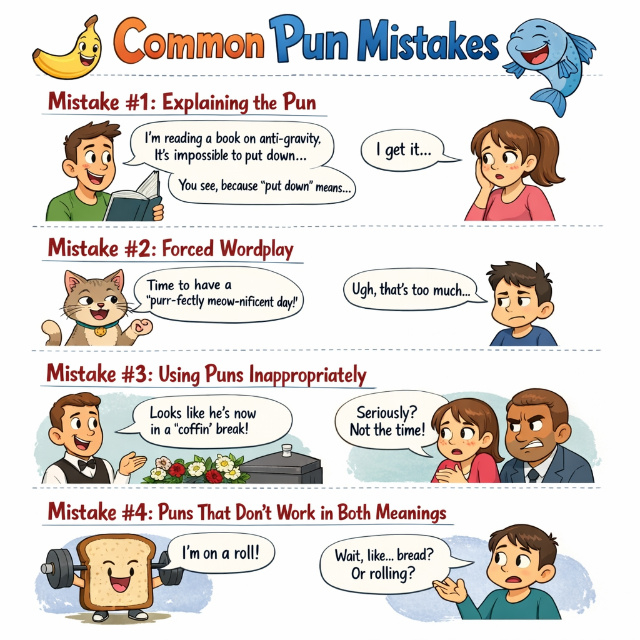
Mistake #1: Explaining the Pun
Wrong: "I lost interest, get it? Interest means both attention and money!"
Right: "I lost interest." (Trust the audience)
Explaining kills the humor.
Mistake #2: Forced Wordplay
Forced: "I wanted to become a baker because I knead dough and I need dough."
Natural: "I wanted to become a baker, I knead the dough."
One pun is enough.
Mistake #3: Using Puns Inappropriately
Wrong context: Using puns in eulogies, trauma narratives, or serious academic work.
Right context: Comedy, casual writing, advertising.
Mistake #4: Puns That Don't Work in Both Meanings
Broken: "I'm outstanding in my field" (only works if actually in a field)
Working: "I'm outstanding in my field" (said by Scarecrow)
Both meanings must make sense.
Writing about Shakespeare's wordplay? Our professional essay writing service provides analysis showing exactly how puns reveal character and create layered meaning.
Downloadable Resource
STUCK WITHOUT A WITTY HOOK OR HEADLINE?
Get fast, expert-generated puns to captivate your audience before your deadline.
- Rapid brainstorming of multiple pun options for your specific topic
- Seamless integration into your existing content or title
- Express service for last-minute creative inspiration
- Urgent Pun Generation
Break through writer’s block with a flash of wordplay genius.
Get Started NowThe Bottom Line
Puns exploit language's flexibility, one sound, multiple meanings. By playing with homonyms, homophones, and double meanings, writers create humor, reveal intelligence, and add layers to seemingly simple phrases.
The best puns work on multiple levels. Shakespeare's "grave man" is both funny and tragic. The wordplay contains emotional depth, not just cleverness.
Master pun analysis, and you understand how language creates meaning through sound.
Want more wordplay devices? Explore our complete literary devices guide with examples.