
What Are the Most Profitable Side Hustles for College Students?
The most profitable college side hustles include freelance writing and content creation earning $25-75 per hour for blog posts, articles, and web content with 58% of student freelance writers making $500+ monthly, tutoring and academic coaching generating $25-60 hourly in high demand subjects like math, science, and test prep with 68% of tutors earning $400-800 monthly from 10-15 hours weekly, social media management for local businesses and startups paying $300-1500 monthly for content creation and posting with minimal time investment, graphic design and video editing commanding $50-150+ per project as skills develop, and ecommerce through reselling, print-on-demand, or dropshipping generating $200-1500+ monthly with flexible time commitment.
Research indicates skills-based side hustles earn 2-3x higher hourly rates than traditional campus jobs, with student freelancers averaging $32 per hour compared to $13-15 for campus employment. Studies show that students focusing on 1-2 side hustles rather than attempting many simultaneously earn 40-60% more while maintaining better work-life balance and academic performance.
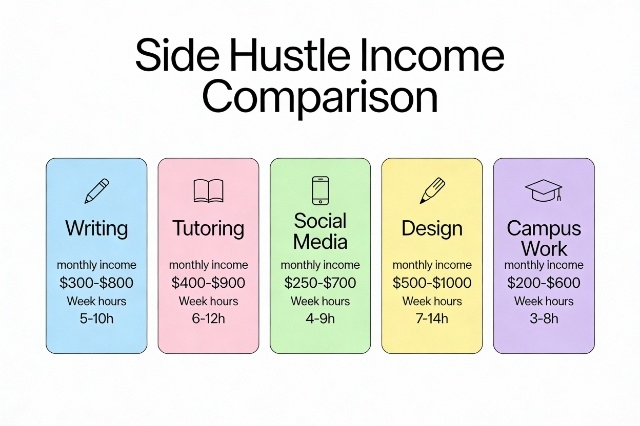
| Side Hustle Type | Avg. Monthly Income | Time Required (Weekly) | Skill Level | Best For |
|---|---|---|---|---|
| Freelance Writing | $500–$1,500 | 8–15 hrs | Beginner–Intermediate | Strong writers, humanities majors |
| Tutoring | $400–$800 | 8–12 hrs | Intermediate | STEM & high GPA students |
| Social Media Management | $600–$2,000 | 6–10 hrs | Intermediate | Marketing & business students |
| Graphic Design / Video Editing | $500–$1,500 | 6–12 hrs | Intermediate–Advanced | Creative & media students |
| Campus Services | $300–$800 | 5–10 hrs | Beginner | Students needing quick income |
1. Freelance Writing and Content Creation
Writing pays well for students with strong communication skills. Businesses need blog posts, website copy, social media content, and marketing materials continuously.
Income potential: $20-75 per hour, depending on experience and niche. Beginner writers earn $25-40 hourly, while experienced writers with specialized knowledge command $50-75+.
Time commitment: Flexible. Complete projects during free time between classes, weekends, or breaks. Most articles require 2-4 hours for research and writing.
How to start:
- Create profiles on Upwork, Fiverr, or Contently
- Build portfolio with 3-5 writing samples (create spec pieces if needed)
- Start with lower rates ($0.05-0.10 per word) to gain reviews
- Raise rates as you gain experience and testimonials
- Specialize in niches matching your major or interests
Research shows 58% of student freelance writers earn $500+ monthly within 3 months of starting, with 72% increasing rates by 50-100% after completing 20-30 projects and building a reputation.
2. Tutoring and Academic Coaching
Leverage your academic strengths to help other students. High demand subjects include calculus, physics, chemistry, statistics, economics, and standardized test prep.
Income potential: $25-60 per hour. General tutoring earns $25-35 hourly, while specialized subjects like organic chemistry or GMAT prep command $45-60+.
Time commitment: 8-15 hours weekly, typically. Schedule sessions around your classes, offering evening or weekend availability when students need help most.
How to start:
- Register on Wyzant, Tutor.com, or Varsity Tutors
- Advertise services through campus bulletin boards and student groups
- Offer the first session at a reduced rate to gain reviews
- Specialize in courses you've excelled in (A or A- minimum recommended)
- Create supplemental materials like study guides or practice problems
Studies indicate 68% of college tutors earn $400-800 monthly from 10-15 hours weekly, with consistent students providing reliable recurring income without constant client acquisition effort.
3. Social Media Management
Small businesses and local shops need a social media presence but lack time or expertise. You create content, schedule posts, engage with followers, and manage online presence.
Income potential: $300-1500 monthly per client. Beginners earn $300-500 per client, experienced managers handle 2-4 clients, earning $1200-3000 total.
Time commitment: 10-15 hours monthly per client. Batch content creation during free time, schedule posts in advance, and respond to comments daily in 10-15 minute sessions.
How to start:
- Approach local coffee shops, boutiques, gyms, or restaurants
- Offer a free one month trial to gain testimonials and a portfolio
- Create content calendars and posting schedules
- Learn platform analytics to demonstrate value through engagement metrics
- Use scheduling tools like Buffer or Hootsuite for efficiency
Research shows 64% of student social media managers secure their first client within one month of starting outreach, with 80% retaining clients for 6+ months, creating a stable, recurring income.
4. Campus Based Services
Provide services directly to fellow students, leveraging campus presence and understanding student needs.
High demand services:
- Resume writing and career documents: $40-100 per resume
- Note taking services for popular lectures: $50-150 per course
- Proofreading and editing: $20-40 per hour
- Event photography: $100-300 per event
- Moving and hauling services: $25-50 per hour
Income potential: $300-800 monthly with 8-12 hours weekly time commitment depending on service type and pricing strategy.
How to start:
- Advertise through student Facebook groups and campus forums
- Create flyers for campus bulletin boards
- Offer student discounts to build an initial client base
- Collect testimonials from satisfied customers
- Partner with student organizations needing specific services
Studies show campus-based side hustles provide the fastest path to first income, with 82% of students earning their first payment within two weeks of launching services due to immediate access to the target audience and lower competition compared to online platforms.
How Do You Start a Side Hustle with No Experience?
Start a side hustle with no experience by selecting skills based hustles matching existing strengths from academics or hobbies rather than learning entirely new skills, creating 3-5 portfolio samples demonstrating capabilities even without paid work history, offering discounted rates or free trials for first 5-10 clients to gain testimonials and reviews, starting on beginner friendly platforms like Fiverr or TaskRabbit with lower barriers to entry, investing 20-30 hours learning fundamentals through free online resources before launching, and managing only one hustle initially to build competence before expanding.
Research indicates students starting with experience-matched hustles earn their first income 3-4x faster than those attempting skills requiring significant learning, with 76% of students making their first $100 within three weeks when leveraging existing capabilities. Studies show students who complete 5-10 low-paid or free projects to build portfolios charge 2-3x higher rates subsequently compared to those attempting to command high rates immediately without demonstrated work.
1. Choosing the Right Side Hustle
Match side hustles to your strengths, interests, and constraints rather than chasing the highest income potential.
Decision factors:
- Skills: What can you do better than an average student? Writing, math, design, organization, social media?
- Time: How many hours weekly can you consistently dedicate? 5 hours? 15 hours? Variable commitment?
- Investment: Can you start with zero upfront cost, or do you have $50-200 for tools/supplies?
- Interest: Will this work feel engaging or become another dreaded obligation?
- Career relevance: Does this hustle build skills for a future career or just generate income?
Research shows students selecting hustles matching at least 3 of these factors earn 50-70% more within the first six months compared to those choosing solely based on income potential, as enjoyment and natural ability accelerate skill development and client satisfaction.
2. Building Initial Portfolio
Create a portfolio demonstrating capabilities before landing the first paid client. Portfolio matters more than credentials for most side hustles.
Portfolio building strategies:
- Writers: Create 3-5 blog posts or articles on topics you know well, publish on Medium or your personal blog
- Designers: Design logos, social media graphics, or website mockups for fictional businesses or nonprofits
- Tutors: Create sample lesson plans, practice problems, or study guides for subjects you'll tutor
- Social media managers: Manage mock business account for 2-3 weeks, showing content calendar and posts
- Editors: Edit publicly available articles, improving clarity, fixing errors, and showing before/after samples
Studies indicate students with even basic portfolios receive 4-5x more client responses than those with empty profiles or resumes alone, as portfolios prove capability rather than claiming it.
3. Landing First Clients
Getting the first 3-5 clients is the hardest part. Use these strategies to overcome the experience barrier.
First client tactics:
- Offer the first project at a 50% discount or free in exchange for a testimonial and a portfolio piece
- Start on platforms like Fiverr, where beginners succeed through competitive pricing initially
- Reach out to student organizations, campus groups, or local small businesses needing help
- Ask professors or advisors if they know anyone needing your services
- Post in student Facebook groups offering services at student friendly rates
Research shows 67% of students land their first client within 3-4 weeks using a discount strategy, with 88% raising rates after completing the first 10 projects, as reviews and portfolio eliminate the experience barrier.
How Do You Balance Side Hustles with Academic Success?
Balance side hustles with academics by treating classes as priority and hustles as flexible income rather than reversing importance, scheduling hustle work during natural low demand academic periods like weekends and breaks rather than competing with study time, setting strict hourly limits preventing hustle work from exceeding 12-15 hours weekly during regular semesters, building buffer income during breaks allowing reduced hustle work during midterms and finals, communicating availability honestly with clients about academic schedule constraints, and recognizing when to pause client work temporarily during peak academic periods.
Research shows students limiting hustle work to 10-15 hours weekly during regular semesters maintain GPAs 0.3-0.5 points higher than those working 20+ hours while earning similar income through higher hourly rates from skills-based work. Studies indicate 73% of successful student hustlers report that flexible schedules allowing work-intensity adjustment around academic demands are more valuable than total income potential when maintaining academic performance.
1. Time Management Strategies
Structure hustle work, preventing academic sacrifice while maintaining income.
Effective scheduling:
- Reserve 2-3 hour blocks on weekends for hustle work rather than daily scattered time
- Use breaks between classes for quick tasks like responding to emails or scheduling
- Batch similar work together for efficiency, write multiple articles in one session, edit several documents consecutively
- Front load hustle work early in the semester when academic demands are lighter
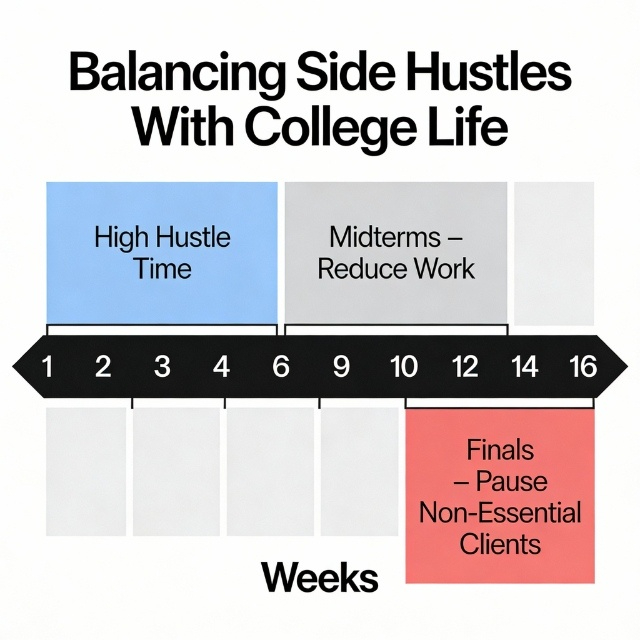
- Scale back significantly during midterms and finals, warning clients in advance
Semester planning:
- Weeks 1-4: Build hustle momentum, take more clients, work 12-15 hours weekly
- Weeks 5-7: Maintain steady state, consistent clients, 10-12 hours weekly
- Weeks 8-10 (Midterms): Reduce to essential clients only, 5-8 hours weekly
- Weeks 11-13: Resume moderate pace, 10-12 hours weekly
- Weeks 14-16 (Finals): Minimal hustle work, 3-5 hours weekly for critical clients only
Research shows students following intentional semester planning patterns earn 85-90% of the income they'd generate working consistently while maintaining 15-20% higher GPAs compared to those working uniform hours regardless of academic demands.
3. Setting Client Expectations
Communicate clearly about availability and academic constraints before accepting clients. When assignment deadlines temporarily prevent adequate focus on both hustle commitments and coursework, professional essay writing can handle routine academic work, allowing you to maintain client relationships and income streams during peak demand periods rather than losing income or disappointing clients through missed deadlines.
Client communication practices:
- State upfront that you're a full time student with variable availability
- Provide honest turnaround times (3-5 days rather than 24-48 hours)
- Build a 20-30% buffer into deadlines, accounting for unexpected academic demands
- Warn clients 1-2 weeks before finals about reduced availability
- Offer to extend projects or pause work during exam periods
Studies indicate clients preferring student freelancers for lower rates accept schedule constraints when communicated clearly in advance, with 78% of students reporting zero client complaints when setting expectations proactively, versus 52% experiencing conflicts when hiding student status or overpromising availability.
What Are Common Side Hustle Mistakes to Avoid?
Common side hustle mistakes include attempting too many hustles simultaneously spreading effort thin and building no expertise in any area with 64% of students trying 4+ hustles earning less than those focusing on 1-2, underpricing services due to imposter syndrome leaving $200-500 monthly on table from artificially low rates, accepting every client opportunity without screening leading to difficult clients and scope creep, neglecting taxes and recordkeeping creating problems during tax filing with average $300-800 in missed deductions, overcommitting to hustle work during academic peak periods resulting in grade damage worth thousands in scholarship loss, and failing to leverage college resources like career centers offering free business consultations and networking.
Research shows students making these mistakes earn 40-60% less than those avoiding common pitfalls while reporting higher stress and lower satisfaction. Studies indicate students who raise rates after the first 10-15 projects increase income by 50-100% for the same time investment, yet 68% of student hustlers maintain beginner rates for 6+ months, unnecessarily limiting earnings.
1. Mistake 1: Underpricing Your Services
Students consistently charge too little due to inexperience or imposter syndrome, leaving significant income on table.
Pricing realities:
- Campus jobs pay $13-15 hourly; your hustle should exceed this significantly for skilled work
- Client willingness to pay matters more than your experience level
- Underpricing attracts the worst clients who don't value your work
- Starting at $25-30 hourly for skilled work is reasonable, even as a beginner
- Raise rates every 10-15 projects or every 3 months, whichever comes first
Research shows students who raise rates after the first 10 projects increase income by 50-100% for the same time investment, with 92% reporting no decline in client acquisition despite higher prices.
2. Mistake 2: No Client Screening
Accept only clients who respect your time and constraints. Bad clients create stress and consume time without proportional payment.
Red flags:
- Clients asking for a "quick favor" before formal engagement
- Unrealistic deadlines given your stated student availability
- Requests for significantly discounted rates after initial discussion
- Unclear project scope or constantly changing requirements
- Disrespectful communication or ignoring your boundaries
Studies indicate dropping the bottom 20% of clients by revenue or difficulty improves income by 15-25% as freed time allows focus on better-paying, respectful clients.
3. Mistake 3: Ignoring Taxes and Recordkeeping
Side hustle income is taxable. Track income and expenses from day one to avoid tax surprises and maximize deductions.
Essential practices:
- Record all income immediately, even small payments
- Track business expenses (software, supplies, mileage, home office percentage)
- Set aside 25-30% of income for taxes in a separate savings account
- Use a simple spreadsheet or app like QuickBooks Self Employed
- Understand self employment tax obligations and quarterly payments
Research shows students tracking expenses from start deduct average $800-1500 annually in legitimate business expenses, while those attempting to reconstruct records later miss 60-70% of deductible expenses due to incomplete documentation.
Key Takeaways
Side hustles provide valuable income and experience for college students when managed strategically:
- Most profitable hustles for students include freelance writing ($25-75/hour), tutoring ($25-60/hour), social media management ($300-1500 monthly per client), and campus based services leveraging student networks and understanding student needs
- Typical students earn $300-1500 monthly from side hustles, depending on hustle type and hours worked, with 62% earning $400-800 monthly from 10-15 weekly hours while maintaining academic performance
- Start with experience matched hustles leveraging existing skills rather than learning entirely new capabilities, build a portfolio through 5-10 discounted or free projects, gaining testimonials, and focus on one hustle initially, building competence before diversifying
- Balance academics and hustles by limiting hustle work to 10-15 hours weekly during regular semesters, scheduling intensive hustle periods during breaks when academic demands are low, and communicating availability constraints clearly with clients upfront
- Avoid common mistakes, including underpricing services, leaving hundreds monthly on the table, accepting difficult clients without screening, attempting too many hustles simultaneously, preventing expertise development, and neglecting tax tracking, resulting in missed deductions
Side hustles offer more than income; they build portfolios, develop marketable skills, and demonstrate self direction, which is valuable for post graduation careers. The flexibility to work during low demand academic periods while pausing during exams makes hustles superior to traditional fixed schedule jobs for many students.
Success requires matching hustles to your strengths and constraints, starting with realistic income expectations, and protecting academic performance by treating classes as a priority and hustles as flexible supplementary income. Students who focus on 1-2 hustles, raise rates regularly, and communicate boundaries clearly with clients earn 40-60% more while maintaining better work life balance than those attempting everything simultaneously.
When side hustle commitments temporarily conflict with academic deadlines during unavoidable peak periods, recognizing limits and seeking strategic support through a reliable essay writing service for routine coursework allows you to maintain client relationships and income streams rather than choosing between financial stability and academic success during temporary crunch periods.