
What Makes a Study Schedule Actually Work?
A study schedule that actually works balances three elements: fixed time commitments, realistic energy management, and adaptive flexibility.
Most failed schedules ignore at least one of these critical components, creating systems that look perfect on paper but collapse under real-world pressure.
The first element involves accurately mapping your non-negotiable time commitments. Classes, work shifts, team practices, and essential personal time create the framework around which study time must fit. Students who skip this foundational step create fantasy schedules that schedule study sessions during times they're physically in chemistry lab or at their campus job.
Energy management represents the second critical factor. Your brain doesn't perform equally well at all hours. Cognitive research demonstrates that most people experience peak mental performance during specific windows that vary by chronotype. Scheduling challenging coursework during your lowest-energy periods wastes time and produces poor results.
A 2024 study tracking 1,200 college students found that those who scheduled difficult subjects during their peak alertness hours achieved 31% higher grades compared to peers studying the same hours but at misaligned times. Your schedule must respect your natural rhythms rather than fighting them.
Flexibility forms the third essential element. Perfect schedules that allow zero disruption fail immediately when you get sick, an assignment takes longer than expected, or life happens. Effective schedules include buffer time and recovery mechanisms that absorb shocks without total collapse.
How to Create Your Study Schedule (Step by Step)
Build your study schedule in five distinct phases: audit your time, calculate study needs, map your energy patterns, assign study blocks strategically, and implement adaptive systems.
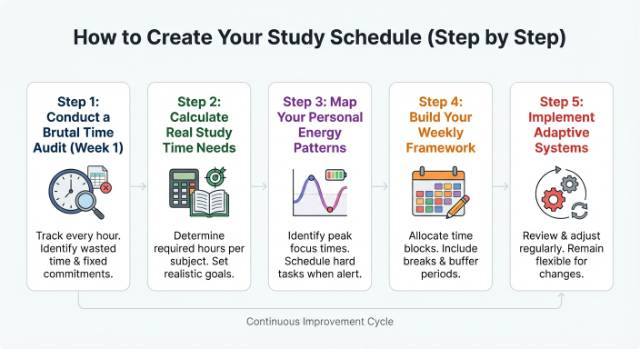
This systematic approach prevents the common error of starting with study blocks before understanding the constraints and resources that determine success.
Step 1: Conduct a Brutal Time Audit (Week 1)
Track every hour for one complete week without changing your behavior.
Most students dramatically overestimate their available study time because they've never measured where time actually goes. This audit reveals the truth about your schedule capacity.
Use a simple tracking method:
- Set phone reminders every 2 hours
- Record what you did the previous 2 hours in 30-minute blocks
- Include everything: meals, commutes, social time, phone scrolling
- Be honest; you're not being graded on this data
After seven days, calculate your true available hours. Most students discover they have 35-45 hours weekly of genuinely available time after accounting for sleep, classes, work, meals, commuting, and essential personal maintenance.
Common time audit discoveries:
- 8-12 hours weekly disappears to untracked phone use
- Meals and getting ready consume 10-14 hours weekly
- Social commitments take 8-15 hours weekly
- Commuting uses 3-8 hours weekly
Step 2: Calculate Real Study Time Needs
Use the 2:1 rule as your baseline: two hours of study time per hour of class time for standard courses.
Adjust this multiplier based on course difficulty, your current performance level, and specific course requirements. A 3-credit lecture course typically requires 6 hours of weekly study time.
Course-specific adjustments:
- STEM courses: 3:1 ratio (heavy problem sets and practice)
- Foreign languages: 2.5:1 ratio (daily practice required)
- Reading-heavy humanities: 2:1 ratio (extensive reading loads)
- Discussion-based seminars: 1.5:1 ratio (less outside work)
For a typical 15-credit semester, expect to need 30-45 hours of study time weekly. This explains why college students working 20+ hours weekly struggle with math: it doesn't work without either reducing their course load or making strategic time trade-offs.
Step 3: Map Your Personal Energy Patterns
Identify your three daily energy tiers: peak performance windows, moderate energy periods, and low-function times.
Schedule your most challenging study tasks during peak windows, routine work during moderate periods, and administrative tasks during low-energy times.
Energy mapping process:
- For one week, rate your mental alertness hourly (1-10 scale)
- Note when you feel sharpest and when you struggle to focus
- Identify your chronotype (morning person, night owl, or intermediate)
- Track how energy changes after meals, exercise, and sleep patterns
Typical energy patterns by chronotype:
- Morning chronotypes (25% of students) peak between 7am-11am.
- Evening chronotypes (30% of students) perform best from 7pm-midnight.
- Intermediate chronotypes (45% of students) excel during 10am-1pm and 4pm-7pm windows.
Match difficult coursework to your peak windows. Schedule organic chemistry problem sets during your sharpest hours, not because the library is quiet at 2am. Students who align study tasks with energy levels complete assignments 40% faster with better comprehension.
Step 4: Build Your Weekly Framework
Start with fixed commitments in your calendar, then add study blocks in strategic positions around your energy patterns.
This approach creates realistic schedules that account for immovable constraints while optimizing flexible time.
Framework construction:
- Block all class times, work shifts, and recurring commitments
- Mark your sleep schedule (7-8 hours for most students)
- Add meal times and commute blocks
- Identify remaining continuous time blocks of 90+ minutes
- Assign these blocks to courses based on energy patterns
Study block placement rules:
- Minimum 90-minute blocks for deep work
- Schedule challenging courses during peak energy windows
- Group related subjects when possible
- Include 10-minute breaks every hour within long blocks
- Leave buffer time between blocks
Use the 70% rule: only schedule 70% of your available study time. The remaining 30% serves as a buffer for assignments that take longer than expected, makeup time when you're sick, and flexibility for inevitable surprises.
Step 5: Implement Adaptive Systems
Build flexibility mechanisms into your schedule that prevent single disruptions from destroying your entire week.
Rigid perfection fails; adaptive systems succeed.
Adaptive mechanisms to include:
- Flex blocks: 2-3 hours weekly marked "flex time" for overflow work
- Course priority hierarchy: Know which course can slip if time gets tight
- Task time estimates: Track how long assignments actually take
- Weekly reset ritual: Sunday evening review to adjust coming week
The weekly reset matters enormously. Spend 30 minutes each Sunday reviewing what worked, what didn't, and how to adjust. Students who conduct weekly reviews maintain schedule adherence rates 3x higher than those who set-and-forget their plans.
What Are Common Study Schedule Mistakes to Avoid?
The three most destructive mistakes are overestimating available time, ignoring energy patterns, and creating no-slack systems with zero buffer capacity.
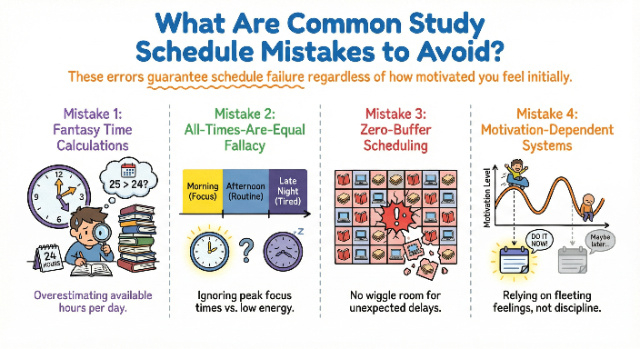
These errors guarantee schedule failure regardless of how motivated you feel initially.
Mistake 1: Fantasy Time Calculations
Students routinely schedule 60-70 hours of study time weekly without accounting for reality. You can't study productively for 10 hours daily when you have classes, need to eat, commute, sleep, and maintain basic life functions. The math doesn't work.
Calculate honestly. If you have 40 hours of genuinely available time after all commitments, don't schedule 50 hours of study. Build schedules around reality, not aspirations.
Mistake 2: All Times Are Equal Fallacy
Scheduling advanced calculus at 10pm when you're exhausted wastes those hours. You'll spend three hours accomplishing what would take 90 minutes during your peak performance window. Time quality matters more than time quantity.
Match task difficulty to energy levels. Use low-energy times for administrative work like organizing notes, formatting citations, or reviewing flashcards. Save peak hours for learning new material and solving complex problems.
Mistake 3: Zero Buffer Scheduling
Packing every available hour with scheduled activities creates systems that collapse at the first disruption. When an assignment takes 5 hours instead of the planned 3 hours, zero-buffer schedules have no absorption capacity.
Build slack into your system. Schedule study time for 70% of your available hours, leaving 30% as a buffer. This margin prevents small disruptions from cascading into major schedule failures.
Mistake 4: Motivation Dependent Systems
Schedules that require constant motivation to maintain fail within weeks. You won't always feel motivated, especially during midterm season or when you're tired or stressed. Effective schedules work even when motivation is low.
Create systems based on habits and structure rather than feelings. Study at the same times on the same days regardless of motivation levels. Consistency matters more than inspiration.
A 2024 survey of 2,800 college students found that 71% who built realistic, flexible schedules maintained them throughout the semester, compared to just 18% who created detailed rigid plans.
Study Schedule Templates for Different Student Types
Different situations require different scheduling approaches. Your optimal schedule depends on your course load, work commitments, and living situation.
Choose the template format that best fits your planning style:
| Format | Best For | Key Features | Access Needed |
|---|---|---|---|
| Printable PDF | • Pen-and-paper planners • Visual learners who like to highlight • Distraction-free studying | • Ready to print and use • Color-coding guide included • Includes instructions on page | Printer or tablet for viewing |
| Editable Google Sheet | • Digital planners • Collaborative study groups • On-the-go updates via phone | • Edit and color-fill digitally • Access anywhere with internet • Auto-saves | Google account (free) |
| Microsoft Excel File | • Advanced customizers • Offline access preferrers • Formula and automation users | • Full control over formatting • Works without internet • Use formulas to track time | Excel or compatible software |
Many students use a hybrid approach: plan digitally in Google Sheets for easy edits, then print the final PDF version to avoid screen distractions during study sessions.
Full Time Student (15 Credits, No Job)
Available study time: 45-50 hours weekly
- Morning peak (9am-12pm): Hardest course study blocks.
- Afternoon moderate (1pm-4pm): Medium-difficulty coursework.
- Evening moderate (7pm-9pm): Reading, review, lighter tasks.
Protected weekend with Saturday mostly free and Sunday review session.
Key features include 3-hour study blocks with built-in breaks, Friday afternoons completely free for mental reset, and 15 hours of weekly buffer time.
Working Student (12 Credits, 20 Hours Work)
Available study time: 25-30 hours weekly
- Early morning (6:30am-8:30am): Study before work/class.
- Lunch breaks (30-45 min): Quick review, flashcards.
- Evening blocks (8pm-10pm): Focused study sessions.
Weekend intensive with Saturday 4-hour block and Sunday 3-hour block.
Key features include shorter focused sessions (90-120 minutes), maximized small time pockets throughout the day, and 20% buffer built into estimates.
Commuter Student (15 Credits, 1-Hour Each Way)
Available study time: 35-40 hours weekly
- Commute time recovers 10 hours weekly through audio lectures and flashcard apps.
- Campus gaps between classes become 2-3 hour library study blocks.
- Home evening handles lighter review and reading.
Key features maximize campus library time, convert commute to productive learning, and batch campus days to reduce total commute time.
Conclusion
Creating a study schedule that actually works requires honest assessment of your available time, strategic alignment with your natural energy patterns, and built-in flexibility to absorb inevitable disruptions.
Key takeaways for schedule success:
- Conduct a week-long time audit before building any schedule, fantasy time calculations guarantee failure
- Use the 2:1 rule to calculate realistic study needs: two hours of study per hour of class time
- Map your personal energy patterns and schedule difficult courses during peak performance windows
- Apply the 70% rule: schedule only 70% of available time, leaving 30% as buffer capacity
- Implement weekly Sunday reviews to adjust what's working and fix what isn't.
Start implementing these principles this Sunday by conducting your time audit and building your first realistic framework. Track what works for two weeks, then refine based on actual data rather than assumptions.
Students who build evidence-based schedules rather than aspirational ones maintain 71% adherence rates throughout the semester.
The difference between successful students and perpetual planners comes down to realistic systems that respect human limitations while optimizing available resources. When you face periods of genuine schedule impossibility, multiple major deadlines coinciding with exams, professional essay writing provides strategic support that prevents complete academic collapse while you maintain your sustainable long-term systems.
Download our free Study Schedule Template Pack with customizable frameworks for full-time students, working students, and commuter students, plus weekly planning worksheets.