-20022.jpg)
What Is a Synthesis Essay?
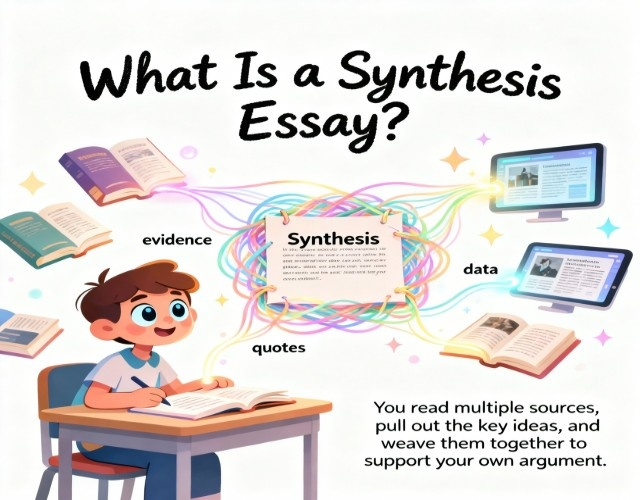
A synthesis essay brings together information from multiple sources to form a new perspective, argument, or understanding. Unlike a summary (which just retells what sources say), synthesis combines different viewpoints to create something original.
The Three Essential Elements
1. Multiple sources: You'll typically work with 3-6 sources (articles, studies, essays)
2. Your argument: You take a position and use the sources to support it
3. Synthesis (not summary): You connect the sources to each other and to your thesis; you don't just list what each one says
What Makes Synthesis Different?
| Summary: "Source A says X. Source B says Y. Source C says Z." |
| Synthesis: "While Source A emphasizes X and Source B focuses on Y, when we consider these alongside Source C's perspective on Z, a pattern emerges that reveals..." |
| See the difference? Synthesis demonstrates connections between ideas. |
Short on Time? We’ll Handle the Writing
Research overload doesn’t have to tank your deadline.
- Research collection & summarization
- Argument mapping & outline creation
- Paragraph development & synthesis
- Final editing and proofreading
Submit confidently, our synthesis essay writing service makes it easy.
Order NowWhat Is Synthesis Writing?
Synthesis writing means combining information from various sources to create a unified argument. It's a critical thinking skill that goes beyond simply gathering facts; you're analyzing how different perspectives relate to each other and to your central point.
Key characteristics of synthesis writing
- Combines multiple viewpoints into one coherent argument.
- Shows connections between sources.
- Maintains your voice while integrating others' ideas.
- Supports a clear thesis with evidence from various texts.
Types of Synthesis Essays
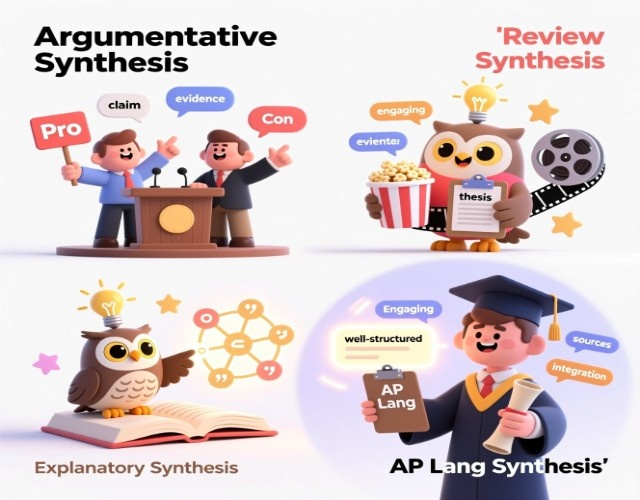
Synthesis essays come in several forms. Here's where to learn about each
1. Argumentative Synthesis: Takes a position and defends it with sources.
2. Explanatory Synthesis: Explains a topic objectively without arguing.
3. Review Synthesis: Evaluates existing research on a topic.
4. AP Lang Synthesis: Specific format for the AP exam with provided sources.
Most academic synthesis essays are argumentative; you'll make a claim and use sources to prove it.
How to Write a Synthesis Essay (Step by Step)
Writing a synthesis essay doesn't have to be overwhelming. Here's the process, broken into manageable steps.
Step 1: Understand Your Assignment
Before you start, make sure you know what's expected.
Questions to ask
- What type of synthesis is required? (Argumentative vs. Explanatory).
- How many sources must you use?
- Are sources provided, or do you find your own?
- What's the page length and deadline?
- What format? (MLA, APA, Chicago)
Look for keywords in the prompt
- "Take a position" = Argumentative synthesis.
- "Explain how sources address" = Explanatory synthesis.
- "Synthesize material from at least three sources" = You must integrate multiple sources, not just cite them separately
Step 2: Choose Your Angle
If you're selecting your own sources, you need a clear angle first.
How to find an arguable position
- Look for topics with multiple perspectives.
- Avoid questions with obvious yes/no answers.
- Find issues where sources disagree or approach from different angles
What makes a good synthesis angle
- Specific enough to support with 3 to 6 sources.
- Broad enough to find quality research.
- Genuinely debatable (not a settled fact).
Need topic ideas? See our synthesis essay topics for inspiration.
Step 3: Gather and Read Your Sources
For AP Lang, sources are provided. For other assignments, you'll research.
What to look for
- Credible sources (academic journals, reputable publications)
- Different perspectives on your topic
- Recent publications (last 5 to 10 years for most topics)
- Sources that actually support or challenge your angle
As you read, annotate
- Main argument of each source.
- Key evidence or data
- How this source relates to others.
- Quotes you might use
Step 4: Create Your Thesis
Your thesis is the argument you'll prove by synthesizing sources.
Formula for synthesis thesis:
[Position] because [reason supported by sources] and [reason supported by sources]
Your thesis should
- Take a clear position
- Preview how sources will be used
- Be specific, not vague
- Be arguable, not obvious
Step 5: Synthesis Essay Structural Framework
Organize your sources and arguments before you write.
Basic structure
Introduction
- Hook
- Context
- Thesis statement
Body Paragraph 1
- Point supporting thesis
- Evidence from Source A
- Evidence from Source B
- Synthesis: how sources connect and support the point
Body Paragraph 2
- Next point supporting thesis
- Evidence from multiple sources
- Synthesis showing relationships
Body Paragraph 3
- Counterargument
- Evidence acknowledging opposing view
- Refutation using your sources
Conclusion
- Restate thesis (new words)
- Synthesize key insight
- Broader implications
For a detailed template, grab our synthesis essay outline and fill in the blanks.
Step 6: Write Your First Draft
Now you actually write. Here's how:
Introduction tips
- Start with a compelling hook (surprising fact, provocative question, relevant quote)
- Provide brief context on your topic
- End with your clear thesis
Body paragraph formula (PEEL)
| Point: Topic sentence stating your claim |
| Evidence: Information from multiple sources |
| Explanation: Your analysis connecting sources to your point |
| Link: Transition to next paragraph |
Synthesis (not summary):
Incorrect: "Smith argues X. Johnson argues Y. Brown argues Z." Correct: "Smith's emphasis on X reveals a pattern that Johnson's research on Y confirms, though Brown's findings suggest Z complicates this relationship." |
Citation requirements
|
Step 7: Revise and Strengthen
First draft done? Now make it better.
Revision checklist:
Thesis strength
- Does every paragraph support your thesis?
- Is your position clear throughout?
Synthesis quality
- Are you connecting sources, not just listing them?
- Do you show relationships between different perspectives?
- Is your voice dominant, with sources supporting?
Source integration
- Have you used all required sources?
- Are sources cited correctly?
- Do you explain how each source supports your argument?
Organization
- Does each paragraph focus on one clear point?
- Are transitions smooth between ideas?
- Does the essay flow logically?
Struggling to synthesize ideas from multiple readings
Professional writing assistance tailored to your needs
- Thesis development & central argument
- Organizing research and supporting evidence
- Integrating sources without summary dumping
- MLA/APA citations and formatting
You bring the sources, our synthesis essay experts bring cohesion.
Order NowHow to Start a Synthesis Essay
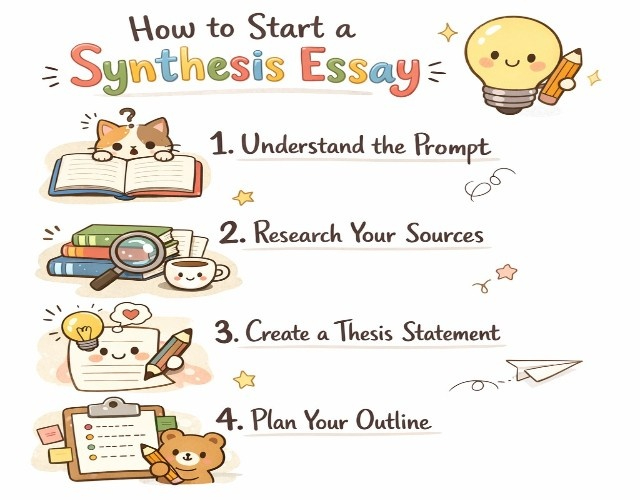
Your introduction either hooks the reader or loses them. Here's how to start strong.
Opening Strategies That Work
1. Start with a surprising statistic
"Teen anxiety rates have doubled since 2010, the exact period when smartphones became ubiquitous."
2. Open with a thought-provoking question
"What if the technology we designed to connect us is actually making us more isolated?"
3. Begin with a relevant quote
"'We shape our tools, and thereafter our tools shape us,' Marshall McLuhan wrote in 1964. He couldn't have predicted social media, but his insight has never been more relevant."
4. Set the scene with context
"In 2023, the average teenager spent 7 hours daily on screens, more time than they spent sleeping, in school, or with family combined."
What to Include in Your Introduction
Hook (1-2 sentences): Grab attention |
| Context/background (2-4 sentences): Explain why this topic matters and provide the necessary background |
| Thesis statement (1 sentence): Your clear argument that synthesizes the sources |
Common Mistakes to Avoid
- Starting with "In this essay, I will..."
- Dictionary definitions ("Webster's Dictionary defines synthesis as...")
- Too much background before getting to your thesis
- Announcing your structure ("First, I will discuss... Then I will explain...")
Want to see how the pros do it? Check our synthesis essay examples to see effective introductions in action.
Synthesis Essay Layout
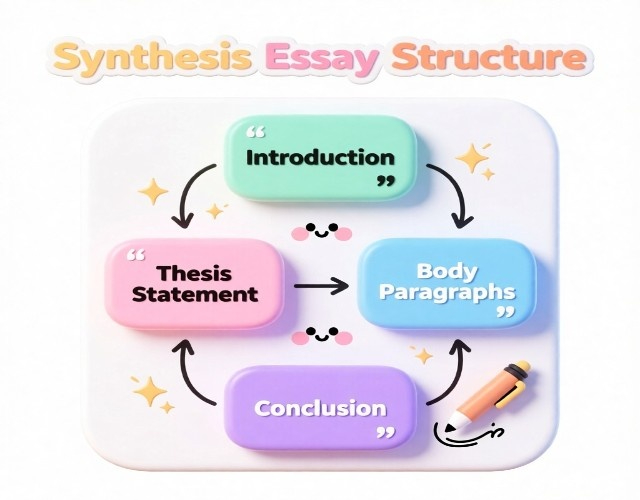
Every synthesis essay follows the same basic structure. Here's what each part does.
Introduction (10-15% of essay)
Purpose: Present your thesis and establish why your synthesis matters Components:
Length guide:
|
Body Paragraphs (70-80% of essay)
Purpose: Prove your thesis by synthesizing source material Structure for each paragraph: Topic sentence: State the point you're making Source integration: Present evidence from multiple sources Synthesis: Show how sources relate to each other and your point Analysis: Explain why this matters for your thesis Transition: Connect to next paragraph |
How many body paragraphs?
| Short essay (3-5 pages): 3-4 body paragraphs |
| Standard essay (5-8 pages): 4-6 body paragraphs |
| Long essay (10+ pages): 6-8 body paragraphs |
Organization strategies:
1. Point by point: Organize by ideas/themes, using multiple sources per paragraph 2. Source by source: Discuss each source separately, then synthesize (less common, less effective) 3. Comparison/contrast: Show how sources agree or disagree on specific points Most effective: Point by point with strong synthesis |
Conclusion (10-15% of essay)
Purpose: Reinforce your synthesis and show broader significance What to include
What NOT to do
|
Want a ready to use template? Grab our synthesis essay outline and structure your essay in minutes.
Still stuck? Get synthesis essay help from our professional essay writing service experts: thesis, synthesis, citations, all of it handled for you.
How to Write a Conclusion for a Synthesis Essay
Your conclusion should bring your synthesis together and show why it matters.
What a Synthesis Conclusion Should Do
1. Restate your thesis (but reframe it, don't copy-paste)
|
2. Synthesize your main points
Briefly connect the key insights from your body paragraphs, showing how they work together to prove your thesis.
3. End with broader significance
Answer the "so what?" question
|
Formula for Strong Conclusions
|
Weak vs. Strong Conclusion
Weak Conclusion: "In conclusion, social media has both positive and negative effects. Smith, Johnson, and Brown all discussed this topic. Social media is an important issue that affects many people." Strong Conclusion: "The pattern emerging from current research is clear: social media platforms systematically prioritize engagement over well being, creating measurable psychological harm among teenage users. While Smith's analysis of addiction mechanisms, Johnson's longitudinal data on mental health outcomes, and Brown's examination of the algorithmic amplification approach the issue from different angles, they converge on a troubling reality: we've conducted a massive, unregulated experiment on adolescent psychology, and the results demand immediate policy intervention. Until platforms redesign features with teen wellbeing as the priority, the mental health crisis will continue to intensify." |
Need a Cohesive Synthesis Essay?
Let our academic writers structure and write your essay.
- Source evaluation & relevance
- Counterarguments & rebuttals
- Logical transitions between ideas
- Draft polishing for clarity and flow
Get a polished synthesis essay that reads smoothly and earns higher grades.
Order NowBottom Line
A synthesis essay is your chance to show you can think critically about multiple sources, not just summarize them. Focus on connecting ideas, support your thesis with evidence from various perspectives, and always explain the "so what."
Whether you write it yourself or get help, the key is turning in something you're proud of. Good luck.