
How Do You Prioritize Multiple Essay Deadlines?
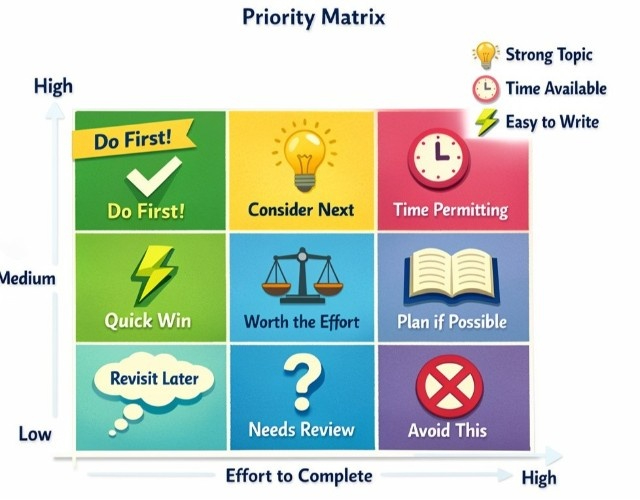
Prioritize multiple essays using a three-factor matrix: deadline urgency, complexity/length, and grade weight.
The mistake most students make is working in pure chronological order (earliest deadline first) without considering that a simple 2-page reflection due Tuesday might take 3 hours while a complex 10-page research paper due Thursday requires 20+ hours.
Start by mapping all essays on a priority grid. List each assignment with its due date, estimated hours needed, and percentage of your final grade. Essays that are due soon, require substantial time, and carry heavy grade weight rise to the top. Those due later, requiring less time, or worth fewer points, receive lower priority.
The Priority Calculation Formula:
Create a priority score for each essay:
- Urgency: Days until due (fewer days = higher urgency).
- Time requirement: Estimated hours needed.
- Weight: Percentage of final grade
A 15-page research paper worth 40% of your grade, due in 7 days, requires immediate attention despite not being the earliest deadline. A 3-page response paper worth 10% due in 5 days can wait if you're juggling higher-stakes assignments.
However, never completely ignore lower-priority essays. The biggest trap is focusing 100% on top-priority assignments while letting others slide until they suddenly become emergencies. Use a rotation system where you advance all essays incrementally rather than completing them sequentially.
The 60-30-10 Time Allocation Rule:
Distribute your available essay-writing time across priorities:
- 60% on highest-priority essay (deadline + complexity + weight).
- 30% on medium-priority essays (2-3 assignments).
- 10% on lowest-priority essays (maintain forward progress).
This approach ensures your highest-stakes work gets primary focus while preventing lower-priority essays from becoming last-minute crises. A 2024 study tracking 1,400 college students found that those using proportional time allocation submitted 89% of assignments on time compared to 54% for students working purely sequentially.
Calculate complexity honestly. Research papers requiring source evaluation take longer than argumentative essays using familiar course material. First-time essay types in unfamiliar formats need extra time for learning the structure. Don't let optimistic time estimates destroy your schedule.
What Is the Best System for Breaking Down Multiple Essays?
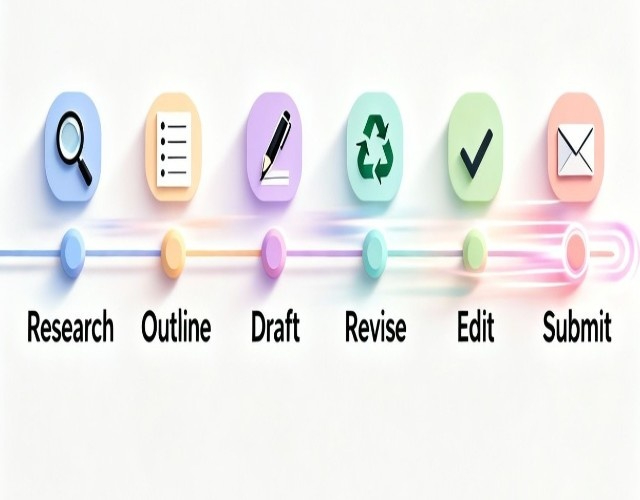
Break each essay into six discrete phases: research (25% of total time), outlining (15%), first draft (30%), revision (20%), editing (8%), and final polish (2%). This decomposition allows you to work on different phases of different essays simultaneously, maximizing cognitive variety and preventing burnout.
Phase-Based Essay Management
The phase system prevents the common mistake of trying to research, draft, and edit Essay A completely before touching Essays B and C. Your brain functions better switching between different cognitive tasks than grinding the same task type for 8 hours straight.
Monday morning: Research for Essay A (peak energy for complex thinking).
Monday afternoon: First draft Essay B (moderate energy for production).
Monday evening: Edit Essay C (lower energy for mechanical tasks)
This rotation provides cognitive variety while ensuring all essays progress incrementally. You're never stuck in research hell for three days straight, which destroys motivation and creates scheduling bottlenecks.
Time Allocation by Phase
| Essay Phase | Time Allocation | Key Tasks | Best Working Conditions | Example (10-Hour Essay) |
|---|---|---|---|---|
| Research | 25% | Gather sources, evaluate credibility, and take notes | High-energy hours (morning); 2–3 sessions | 2.5 hours |
| Outlining | 15% | Develop thesis, organize arguments, structure paragraphs | Focused, clear-thinking session | 1.5 hours |
| First Draft | 30% | Write continuously without editing | Multiple shorter sessions over days | 3 hours |
| Revision | 20% | Improve arguments, organization, and add evidence | Fresh perspective; after a 24-hour break | 2 hours |
| Editing | 8% | Fix grammar, flow, clarity, and wordiness | Low-energy periods; read aloud | 50 minutes |
| Final Polish | 2% | Formatting, citations, final proofread | Quick mechanical check | 12 minutes |
This breakdown allows you to work on Essay A's draft while Essay B is in the research phase and Essay C awaits revision. The cognitive variety prevents fatigue while ensuring steady progress across all assignments.
When you're managing this complex juggling act and one essay proves more demanding than estimated, professional essay writing can handle the overflow assignment with expert quality, preventing the domino effect where one delayed essay causes all others to fall behind schedule.
Creating Your Master Timeline
Work backward from each due date, scheduling phases in reverse order. If Essay A is due Friday at 5pm, your timeline looks like:
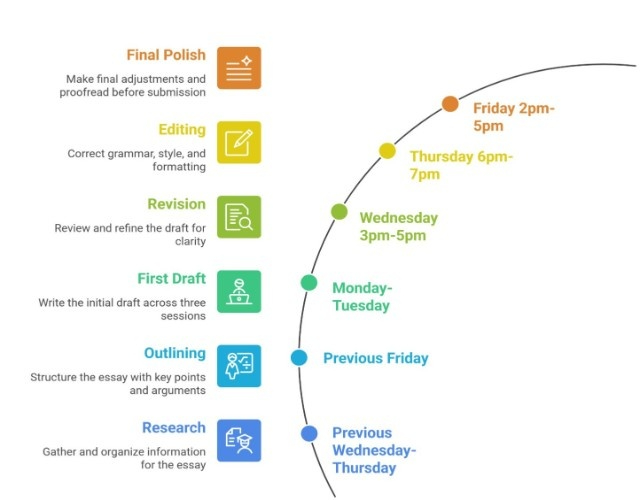
Plot all essays on a single calendar, showing which phase of which essay you're working on each day. Color-code by assignment to visualize your workload distribution. This master timeline reveals conflicts early, like three essays entering the draft phase simultaneously, allowing you to adjust before crises develop.
How Can You Create Buffer Time in Your Essay Schedule?
Build buffer time by estimating task duration, then multiplying by 1.5 to account for planning fallacy, the universal tendency to underestimate how long tasks actually take. This "time cushion" absorbs inevitable delays without destroying your entire schedule when one essay takes longer than expected.
The planning fallacy affects nearly everyone. You estimate a draft will take 4 hours based on how long it should take under perfect conditions. Reality includes interruptions, harder-than-expected research, writer's block, and mental fatigue. The draft actually takes 6 hours, and suddenly you're behind on everything.
The 1.5x Rule for Essay Time Estimates:
If you think research will take 3 hours, schedule 4.5 hours. If outlining feels like a 1-hour task, allocate 90 minutes. This multiplier accounts for normal working conditions rather than fantasy productivity.
A 2023 study of 950 college students found that those using 1.5x time multipliers submitted 81% of essays on or before deadlines, compared to 52% for students using unpadded estimates. The buffer didn't make them slower; it made their schedules realistic.
Strategic Buffer Placement
- Daily buffers: Leave 30-60 minutes unscheduled each day for tasks running over estimates. Don't pack every hour with scheduled work.
- Phase buffers: Add an extra session between major phases. After finishing your draft, schedule a 2-hour buffer before starting revision. If the draft took longer than planned, the buffer absorbs the overrun. If you finish early, use buffer time for other essays.
- Deadline buffers: Set personal deadlines 24-48 hours before actual due dates. This creates emergency capacity if everything goes wrong. Finishing "early" by your internal deadline means you actually finish on time by the real deadline when problems occur.
- Emergency buffers: Identify 4-6 hours weekly that you can convert to essay work in true emergencies. This might be social time, non-essential activities, or low-priority tasks you can skip if needed. Know where this emergency time exists before you need it.
The Two-Track System
Maintain two schedules: your working schedule (with buffers and realistic times) and your deadline schedule (actual due dates). Work from your internal schedule daily. The gap between your schedule and real deadlines is your safety margin.
Students using two-track systems report 63% lower stress levels during heavy deadline periods because they maintain confidence that they can handle unexpected problems. The buffer provides psychological relief beyond its practical scheduling benefits.
What Should You Do When Multiple Essays Have the Same Deadline?
When facing simultaneous deadlines, complete the highest-weighted essay fully first, then execute a strategic triage on remaining essays based on minimum acceptable outcomes. Trying to perfect three essays due the same day guarantees all three suffer. Focus produces one excellent essay and two solid efforts, beats three mediocre submissions.
Same-Day Deadline Strategy
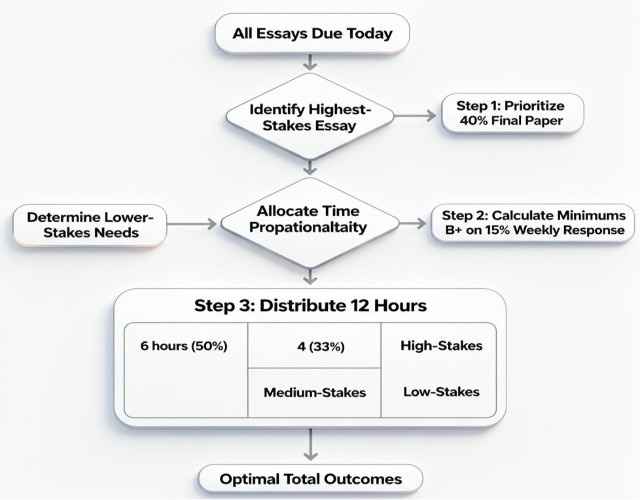
Step 1: Identify the highest-stakes essay
Which assignment has the greatest impact on your grade? A final paper worth 40% of your course grade takes priority over a weekly response worth 5%. Complete the high-stakes essay to your full capability.
Step 2: Determine minimum acceptable outcomes for lower-stakes essays
For the remaining essays, calculate what grade you can afford based on your current standing. If you have an A- average with one paper worth 15% remaining, a B+ on that paper still keeps you at A- for the course. This isn't encouraging poor work; it's realistic resource allocation.
Step 3: Allocate time proportionally
If you have 12 hours for three simultaneous essays:
- 6 hours for the highest-stakes essay (50%).
- 4 hours for a medium-stakes essay (33%).
- 2 hours for lowest-stakes essay (17%).
This distribution produces better total outcomes than 4 hours each across all three.
The Rapid-Draft Method for Time Pressure
When time runs critically short, use the rapid-draft protocol:
Hour 1: Research and outline (combined phase)
- Skim 3-4 strong sources, take targeted notes.
- Create a quick outline with a thesis and main points.
Hours 2-3: Power draft
- Write continuously without editing.
- Aim for getting ideas down, not perfect sentences.
- Skip citations initially, mark spots to add them.
Hour 4: Essential revision and editing
- Strengthen the weakest arguments only.
- Fix obvious errors and add citations.
- Format correctly.
This 4-hour emergency protocol produces B-range work when properly executed, acceptable for lower-stakes assignments when facing impossible time constraints. Reserve this method for genuine emergencies, not regular practice.
A 2024 analysis of 2,100 student essays found that focused time on fewer essays with strategic triage on others produced higher average grades (3.42 GPA) compared to equal time across all essays (3.18 GPA) when facing concurrent deadlines. Quality beats equal mediocrity.
Conclusion
Successfully juggling multiple essay deadlines requires strategic prioritization, phase-based decomposition, realistic time estimation with buffers, and cognitive triage when facing impossible time constraints.
Key strategies for managing concurrent essays:
- Use the three-factor priority matrix (urgency + complexity + grade weight) to allocate time proportionally rather than working purely chronologically.
- Break each essay into six phases (research, outline, draft, revise, edit, polish), allowing cognitive variety and progress across multiple assignments.
- Apply the 1.5x multiplier to all time estimates, building buffer capacity that absorbs delays without cascading failures.
- Distribute time using the 60-30-10 rule: 60% on the highest-priority essay, 30% on medium-priority, 10% maintaining progress on the lowest-priority.
- When facing same-day deadlines, complete the highest-stakes essay fully and execute strategic triage on remaining assignments.
- Create personal deadlines 24-48 hours before actual due dates, establishing emergency capacity for unexpected problems
Start implementing these strategies by creating a master timeline for your current essays. Map all deadlines, break each essay into phases, and schedule specific phases on specific days with 1.5x time buffers. Students who plan strategically before crises report 63% lower stress and 73% better on-time submission rates.
The difference between students who thrive under deadline pressure and those who collapse comes down to systematic planning that respects cognitive limits and builds realistic flexibility. While developing these time management systems, a reliable essay writing service can provide expert support on strategic assignments when genuine time constraints exceed available capacity, preventing academic crisis while you build the skills that ensure long-term success.
Download our free Multiple Essay Timeline Planner with phase-tracking templates, priority calculators, and buffer planning worksheets for managing 3-5 concurrent essay deadlines.