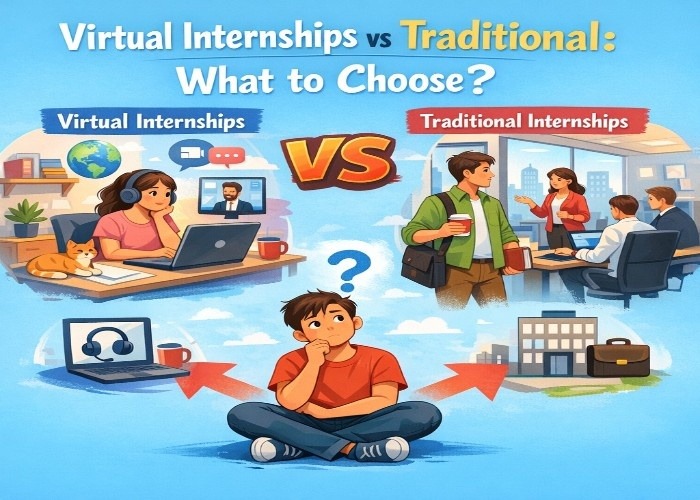
What Are the Key Differences Between Virtual and Traditional Internships?
Key differences include work environment (remote home office versus company headquarters), networking opportunities (scheduled video calls versus casual hallway conversations), mentorship structure (formal check-ins versus drop by questions), skill development focus (technical and digital collaboration versus in-person communication and relationship building), geographic flexibility (work from anywhere versus location-restricted), and daily structure (self directed time management versus office routine and social cues).
Side by Side Comparison
| Factor | Virtual Internships | Traditional In-Person Internships |
|---|---|---|
| Location | Work from anywhere with internet | Must relocate or commute to office |
| Networking | Scheduled video meetings, less spontaneous | Organic hallway conversations, coffee chats, team lunches |
| Mentorship | Formal scheduled check-ins via video | Drop-by questions, impromptu guidance, shadowing |
| Costs | Zero commute/relocation ($0 to 500) | Housing, transportation, meals ($3,000 to 8,000) |
| Work Environment | Home office setup, self-managed | Professional office, structured routine |
| Company Culture | Limited exposure to daily dynamics | Full immersion in workplace culture |
| Flexibility | Often flexible hours within deadlines | Fixed office hours (typically 9 to 5) |
| Technical Skills | High emphasis on digital tools | Balanced technical and interpersonal |
| Self-Discipline | High requirement (self-motivation critical) | External structure provides accountability |
| Geographic Access | Access companies anywhere globally | Limited to commutable locations |
| Collaboration | Digital tools (Slack, Zoom, Asana) | In-person meetings, whiteboarding |
| Full Time Conversion | 58% conversion rate | 67% conversion rate |
Common Misconceptions About Virtual Internships
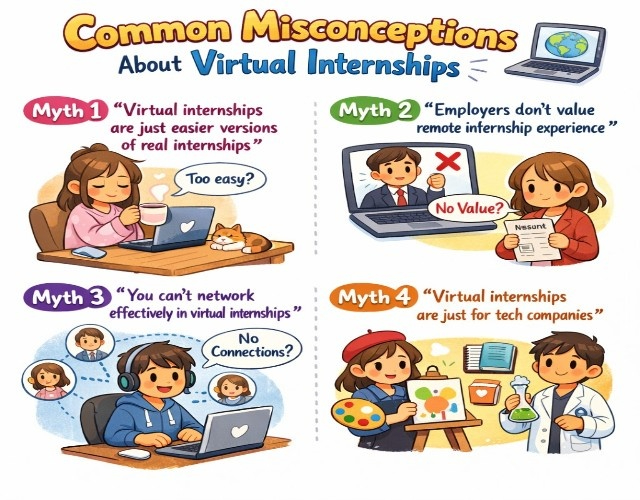
Myth 1: "Virtual internships are just easier versions of real internships."
- Reality: Virtual internships require equal or greater technical skill proficiency
- Remote work demands advanced digital collaboration and communication abilities
- Self-discipline requirements actually exceed in-person internships
- Deliverables and expectations remain identical to traditional formats
Myth 2: "Employers don't value remote internship experience."
- Reality: 89% of employers view remote experience equivalently for hiring decisions
- Many companies now operate fully remote or hybrid permanently
- Remote collaboration skills are increasingly essential in modern workplaces
- Virtual experience demonstrates adaptability and tech proficiency
Myth 3: "You can't network effectively in virtual internships".
- Reality: Intentional networking strategies produce meaningful connections
- Virtual coffee chats and scheduled meetings enable relationship building
- LinkedIn connections and follow up maintain relationships post-internship
- 63% of virtual interns report building valuable professional relationships
Myth 4: "Virtual internships are just for tech companies".
- Reality: Finance, marketing, consulting, nonprofits, healthcare, and government offer virtual internships
- Industries previously resistant adapted successfully during the pandemic
- Remote work capabilities now expected across sectors
- Virtual options exist in nearly every industry and function
What Are the Advantages of Virtual Internships?
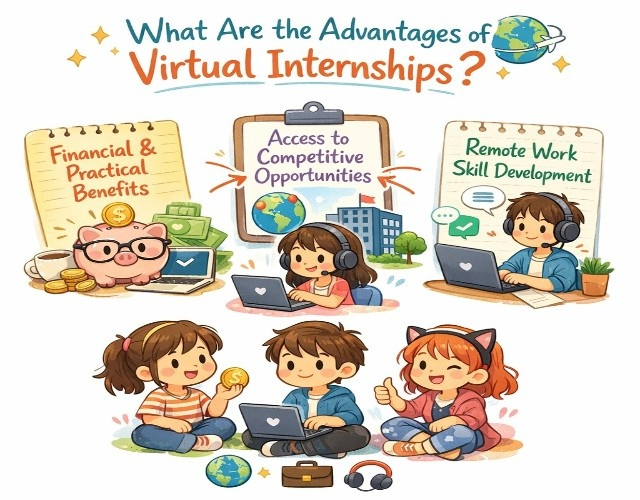
Virtual internships offer geographic flexibility accessing companies anywhere without relocation costs ($3,000-8,000 saved), schedule flexibility allowing part time work during school semesters, zero commute time (reclaiming 5 to 10 hours weekly), lower financial barriers making prestigious companies accessible regardless of location, development of remote work skills increasingly essential in modern careers (73% of companies offer remote work), and ability to complete multiple shorter virtual internships versus single traditional placement.
1. Financial and Practical Benefits
A: Cost savings breakdown
Traditional internship typical costs
|
Virtual internship typical costs
|
The $3,500 to 7,500 savings make virtual internships accessible for students who couldn't afford traditional relocation, democratizing access to prestigious companies and opportunities.
B. Time efficiency benefits
|
2. Access to Competitive Opportunities
Virtual internships expand geographic access to companies previously limited by location.
Examples
|
Students completing two 8 week virtual internships gain exposure to multiple industries and companies, impossible with a single 12 week traditional placement requiring relocation.
Remote Work Skill Development
Virtual internships develop highly valued remote collaboration competencies.
Skills gained
|
With 73% of companies offering remote work options and 58% of knowledge workers working at least part time, these skills provide competitive advantages in modern job markets.
What Are the Disadvantages of Virtual Internships?
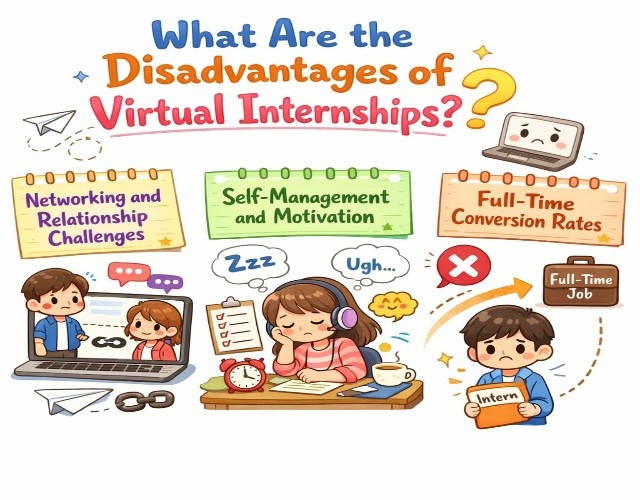
Virtual internships face disadvantages including reduced networking opportunities (42% fewer spontaneous interactions), less immersive mentorship requiring more intentional communication, greater self motivation challenges without office structure, limited exposure to company culture and professional environment, technology and connectivity issues creating barriers, social isolation and reduced team bonding, and lower full-time conversion rates (58% versus 67% for traditional internships).
1. Networking and Relationship Challenges
The most significant disadvantage of virtual internships is reduced organic networking and relationship building.
What you miss virtually
- Casual conversations before meetings or in break rooms
- Spontaneous questions to colleagues at adjacent desks
- Team lunches building relationships beyond work
- After-work social events and happy hours
- Observing office dynamics and unwritten cultural norms
- Overhearing valuable conversations and learning
- Physical presence makes lasting impressions
Impact on outcomes
- Virtual interns report 42% fewer professional connections
- Mentorship relationships require more intentional scheduling
- Company culture understanding remains surface level
- Personal brand building proves more challenging remotely
- Social bonding with team members requires deliberate effort
However, proactive strategies mitigate these disadvantages. Virtual interns who schedule regular one on one meetings, participate actively in video meetings, and initiate virtual coffee chats build meaningful relationships despite physical distance.
2. Self Management and Motivation
Virtual internships demand higher self-discipline and motivation without external structure.
Common challenges
- No visual accountability of colleagues working around you
- Home distractions (family, roommates, entertainment)
- Blurred boundaries between work and personal time
- Lack of routine and commute transition time
- Technical issues disrupting workflow
- Feeling disconnected from team and mission
- Difficulty asking questions without in-person accessibility
Who struggles most
- Students requiring external structure and accountability
- Those lacking a dedicated quiet workspace at home
- Interns in time zones far from the team's core hours
- People who thrive on social interaction and collaboration
- Those new to professional environments need more guidance
Students with strong self motivation, dedicated workspaces, and experience managing independent projects typically succeed in virtual internships, while those benefiting from structure may prefer traditional environments.
3. Full Time Conversion Rates
Traditional internships show slightly higher full time conversion rates than virtual internships.
Conversion data
- Traditional in-person: 67% receive full-time offers
- Virtual remote: 58% receive full time offers
- Hybrid (mix of both): 63% receive full time offers
The 9 percentage point gap likely reflects relationship building and cultural fit assessment rather than performance differences. Employers feel more confident extending offers to interns they've observed in the office and built stronger personal connections with over time.
However, this gap is narrowing as remote work normalizes and companies improve virtual onboarding and integration processes.
How Do You Decide Between Virtual and Traditional Internships?
Decide between virtual and traditional internships by assessing your career goals (networking heavy fields like finance benefit from in-person), personality traits (self motivated students thrive remotely while structure seekers prefer offices), financial constraints (virtual saves $3,500 to 7,500), geographic flexibility (virtual enables access anywhere), and internship quality factors (substantive projects matter more than format). Prioritize high quality experiences over format preferences when choosing between specific opportunities.
Decision Framework
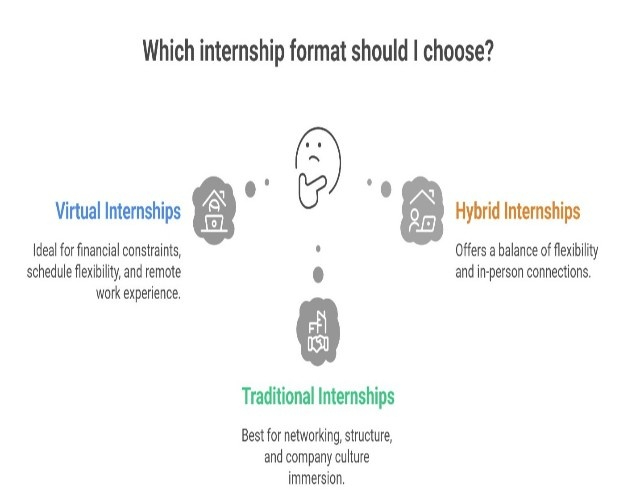
Choose VIRTUAL internships if
- Financial constraints make relocation impossible ($4,000 to 8,000 savings critical)
- You need schedule flexibility for coursework, family, or other commitments
- Target company located in an expensive city or far from the current location
- You possess strong self-motivation and time management skills
- Gaining remote work experience aligns with career goals
- Multiple shorter internships provide more value than a single long placement
- You have a dedicated quiet workspace for productive remote work
- Technical skill development is the primary learning goal
Choose TRADITIONAL internships if
- Networking and relationship building are primary internship goals
- You benefit from external structure and accountability
- Company culture immersion matters for your career assessment
- Industry heavily emphasizes in-person collaboration (some consulting, healthcare)
- You lack a reliable home workspace or internet connectivity
- Mentorship and shadowing opportunities are critical for learning
- Location offers a valuable lifestyle experience or exploration
- Full-time conversion potential is the highest priority
Consider HYBRID internships if
- You want the benefits of both formats (2 to 3 days in office, 2 to 3 remote)
- Company location is commutable, but a daily commute is not desired
- Testing remote work capabilities while maintaining in-person connections
- Balancing flexibility needs with networking opportunities
- Company explicitly offers a hybrid model as standard practice
Quality Indicators (Apply to Both Formats)
Regardless of virtual or traditional format, evaluate internships on these quality factors:
Red flags (avoid these internships)
- Unpaid with no academic credit option
- Vague job description lacking specific projects or responsibilities
- No assigned supervisor or mentor
- Administrative tasks only (filing, data entry, coffee runs)
- Company lacks a structured internship program
- No regular feedback or performance evaluation
- Limited interaction with team or colleagues
- Menial work not developing marketable skills
Green flags (pursue these internships)
- Clearly defined projects with measurable outcomes
- Assigned mentor meeting regularly (weekly minimum)
- Structured onboarding and training
- Regular team meetings and collaboration
- Skill development opportunities (software, analysis, presentation)
- Performance feedback and evaluation process
- Networking events or opportunities with professionals
- Potential for full time conversion or strong reference
A high quality virtual internship outweighs a low quality traditional internship every time. Prioritize substantive work, mentorship, and skill development over format preferences.
When managing internship applications and coursework simultaneously during competitive recruiting seasons, consider using a professional essay writing service for routine assignments, allowing focus on tailored cover letters and application materials, directly determining internship placement quality and career trajectory.
How Can You Maximize Value from Virtual Internships?
Maximize value from virtual internships by establishing structured daily routines mimicking office schedules, proactively scheduling one on one meetings with supervisors and colleagues, building relationships, overcommunicating progress and questions, preventing misunderstandings, creating a dedicated workspace separating work and personal life, participating actively in video meetings demonstrating engagement, and documenting accomplishments with metrics for resume and interviews.
Virtual Internship Success Strategies
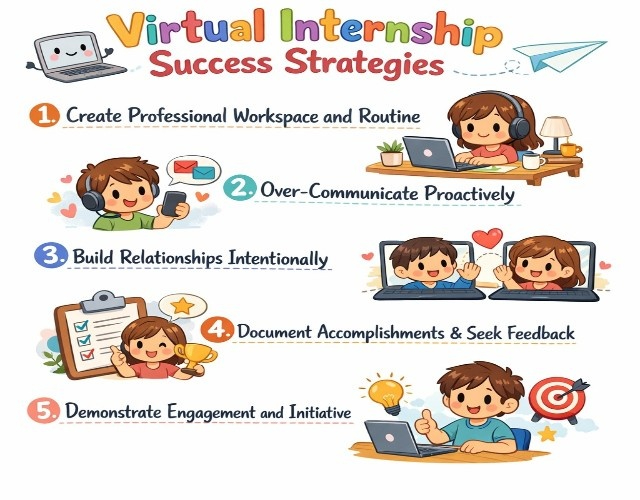
1. Create a Professional Workspace and Routine
Establish boundaries and structure, replicating a traditional office environment.
Workspace setup
Daily routine structure
|
2. Over Communicate Proactively
Remote work requires more intentional communication than in-person environments.
Communication best practices
Virtual interns who over communicate receive 2.4x more positive feedback than those who wait to be asked about progress. |
3. Build Relationships Intentionally
Networking requires deliberate effort in virtual environments lacking organic interactions.
Relationship building tactics
|
Sample virtual coffee chat request: "Hi [Name], I've really enjoyed working with you on [project]. I'd love to learn more about your career path and experience at [Company]. Would you have 15 to 20 minutes for a virtual coffee chat sometime next week? I'm happy to work around your schedule."
4. Document Accomplishments and Seek Feedback
Track your work systematically for resume building and performance discussions.
Documentation practices
|
5. Demonstrate Engagement and Initiative
Stand out by going beyond minimum requirements.
Ways to show initiative
|
Virtual interns demonstrating high engagement receive full time offers at rates comparable to traditional interns (63% versus 67%), nearly closing the 9 point gap through proactive relationship building.
What Industries and Roles Work Best for Virtual Internships?
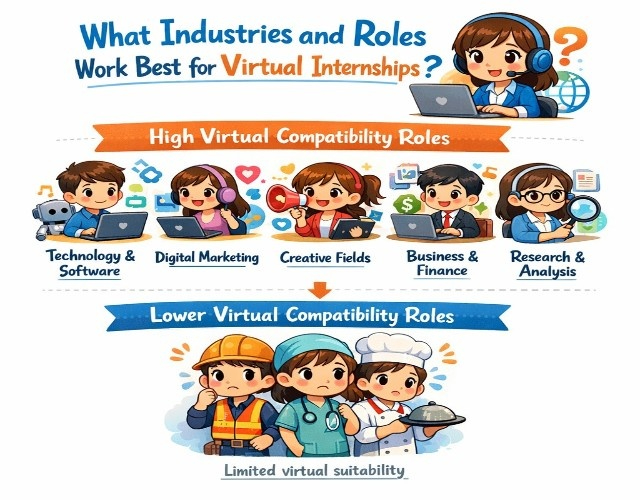
Industries and roles best suited for virtual internships include technology and software development (93% virtual compatible), digital marketing and social media management (87% virtual compatible), data analysis and business intelligence (85% virtual compatible), content creation and writing (91% virtual compatible), graphic design and UX/UI (82% virtual compatible), finance and accounting (74% virtual compatible), consulting and strategy (68% virtual compatible), and research and policy analysis (79% virtual compatible).
High Virtual Compatibility Roles
Technology and Software
- Software engineering and development
- Product management
- Quality assurance and testing
- IT support and cybersecurity
- Data science and machine learning
Digital Marketing
- Social media management and strategy
- Content marketing and SEO
- Email marketing campaigns
- Analytics and performance tracking
- Digital advertising management
Creative Fields
- Graphic design and illustration
- UX/UI design
- Video editing and production
- Copywriting and content creation
- Photography (some aspects)
Business and Finance
- Financial analysis and modeling
- Business analytics
- Market research
- Accounting and bookkeeping
- Project management
Research and Analysis
- Policy research and analysis
- Academic research assistance
- Data analysis and visualization
- Competitive intelligence
- Grant writing
Lower Virtual Compatibility Roles
Some roles inherently require physical presence and translate poorly to virtual formats:
Limited virtual suitability
- Laboratory research (hands on experimentation)
- Healthcare and patient care (direct interaction)
- Retail and hospitality (customer facing)
- Manufacturing and operations (physical processes)
- Events and entertainment (in person production)
- Architecture and construction (site visits)
- Athletic training and coaching (physical instruction)
If pursuing careers in these fields, prioritize traditional in person internships when possible, as hands on experience proves essential for skill development.
How Do Employers View Virtual Internship Experience?
Employers view virtual internship experience positively, with 89% considering remote internships equivalently to traditional when evaluating candidates. Modern employers recognize that 73% of companies offer remote work and 58% of knowledge workers work remotely at least part-time, making virtual experience increasingly relevant. Hiring managers specifically value remote collaboration skills, digital tool proficiency, self-motivation, and asynchronous communication abilities demonstrated through virtual internships.
Employer Perspective Research
Survey findings from 2,400+ hiring managers
What employers look for in a virtual internship experience
|
How to Present Virtual Internships on Resumes
Format virtual internship experience identically to traditional internships, focusing on accomplishments rather than format.
Resume formatting
Good example
Marketing Intern
[Company Name]
Remote
May-August 2025
Managed social media campaigns across 4 platforms, increasing engagement by 340% (12K to 53K interactions)
Analyzed website traffic data using Google Analytics, identifying 3 key optimization opportunities resulting in 28% bounce rate reduction
Collaborated with a cross functional team of 6 using Asana and Slack to launch 2 product campaigns, generating $47K revenue.
Poor example
Virtual Marketing Intern
[Company Name]
Online
Summer 2025
Helped with social media
Used Google Analytics
Worked on campaigns
Key formatting principles
Employers care about what you accomplished and skills developed, not whether you sat in a physical office or a home office. |
Key Takeaways
Choose between virtual and traditional internships strategically using these evidence based insights:
- Virtual and traditional internships provide equal value when structured well, with 89% of employers viewing remote experience equivalently and virtual interns developing identical technical skills. Success depends on internship quality (projects, mentorship, outcomes), not format, making a substantive virtual internship superior to low quality traditional one.
- Virtual internships offer financial and geographic advantages, saving $3,500 to 7,500 in relocation costs, enabling access to companies anywhere, and allowing schedule flexibility during school semesters. These benefits democratize access to prestigious opportunities previously limited by location and financial barriers.
- Traditional internships provide networking and mentorship advantages with 67% full-time conversion versus 58% virtual, stronger organic relationship building through casual interactions, and fuller company culture immersion. However, proactive virtual interns nearly close this gap through intentional networking strategies.
- Choose format based on career goals, personality, and finances rather than perceived prestige. Self-motivated students with strong time management thrive remotely, while those benefiting from structure prefer traditional offices. Networking heavy fields favor in-person, while technical roles work excellently virtually.
- Maximize virtual internship value through structured daily routines, proactive over-communication, intentional relationship building via scheduled video chats, dedicated workspace, active meeting participation, and thorough accomplishment documentation. Virtual interns demonstrating high engagement achieve comparable outcomes to traditional interns.
The format matters far less than internship quality, your engagement level, and skills gained. Two quality internships (virtual or traditional) beat zero internships regardless of prestigious company names or formats. Focus on securing substantive experiences with meaningful projects, active mentorship, and demonstrable outcomes.
When managing internship applications alongside coursework during competitive recruiting periods, consider using a trusted essay writing service for routine assignments, allowing focus on tailored applications, networking conversations, and interview preparation, directly determining internship placement and career trajectory, shaping your professional future.