Understanding a 1000 Word Essay?
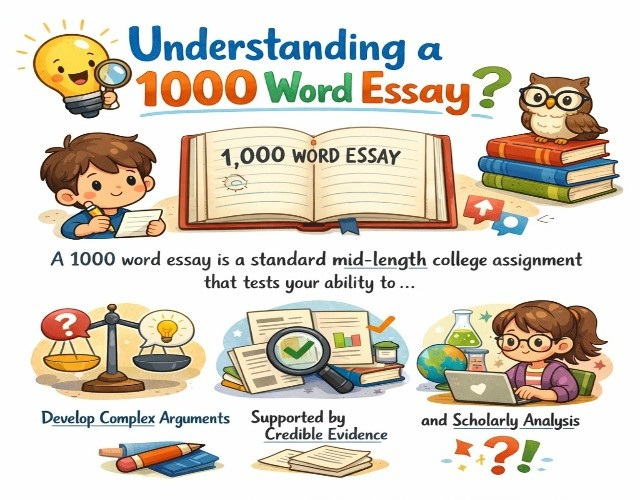
A 1000 word essay is a standard mid length college assignment that tests your ability to develop complex arguments supported by credible evidence and scholarly analysis. Unlike shorter 500 word essays where you prove basic competency, 1000 word essays require substantive research, critical evaluation of sources, and synthesis of multiple perspectives into coherent academic arguments.
How long is a 1000 word essay?
| Single-spaced: 2 pages |
| Double-spaced: 3 to 4 pages (standard for college) |
| Paragraphs: 6 to 8 typically |
| Time investment: 3 to 5 hours for research, drafting, and revision |
This format appears frequently across disciplines, humanities essays analyzing texts, social science papers evaluating theories, business case analyses, history research papers, and scientific literature reviews. The length provides enough space to explore topics rigorously without requiring the exhaustive research of longer papers.
Why College Professors Assign 1000 Word Essays
Professors use this format to assess whether you've made the leap from summary to analysis.
- Can you engage with scholarly sources critically?
- Do you construct original arguments or just rehash what everyone already knows?
- Can you synthesize multiple perspectives into a cohesive analysis?
The 1000 word constraint forces intellectual efficiency; every paragraph must advance your argument with evidence and insight.
Need Help Writing a High-Scoring 1000 Word Essay?
Get expert support when time, structure, or clarity becomes a challenge.
- Professionally structured essays tailored to your topic and academic level
- Clear arguments, strong evidence, and smooth flow from intro to conclusion
- Proper formatting, citations, and plagiarism free content
- On time delivery with revisions until you’re satisfied
Let our essay writing service turn your ideas into a polished 1000-word essay you can submit with confidence.
Order Now1000 Word Essay Structure: The College Formula
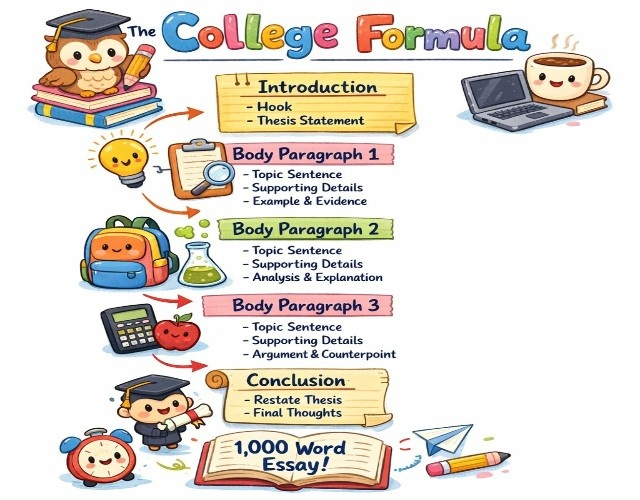
College essays demand more sophisticated organization than the basic five paragraph format you used in high school. Here's the structure that actually works at the university level:
A. 1000 Word Essay Introduction (150 to 200 words)
Your introduction needs to accomplish four things: establish a scholarly context, demonstrate topic significance, preview your analytical approach, and present a precise thesis statement.
1. Opening With Authority
College level introductions don't start with dictionary definitions or generic observations. Open with something compelling, a surprising research finding, a provocative question challenging conventional wisdom, or a brief anecdote illustrating your topic's stakes.
After your hook, establish context. What scholarly conversation are you entering? What do readers need to understand about your topic's background? Then narrow to your specific focus and present your thesis statement.
For strategies on crafting introductions that immediately establish credibility, check our guide on how to start an essay with techniques tailored for college level writing.
2. Thesis Statements That Work
Your thesis must present an arguable claim requiring evidence to defend, not a statement of obvious fact. "Shakespeare uses metaphors" is a fact. "Shakespeare's extended metaphors in Macbeth reveal how unchecked ambition corrupts moral reasoning" is an arguable thesis demanding textual analysis.
Need help developing thesis statements with actual analytical punch? Our comprehensive guide on writing thesis statements explains the formula for college level thesis construction, along with the examples to see strong analytical theses in action across different disciplines.
B.1000 Word Essay Body Paragraphs (650 to 700 words)
The body develops your argument through 4 to 6 substantial paragraphs. Unlike high school's rigid structure, college paragraphs vary in length based on analytical complexity, some points require 120 words, others need 200.
1. Paragraph Architecture for Analysis:
Each body paragraph follows this pattern:
Topic sentence: States the paragraph's analytical claim supporting your thesis |
Context/Evidence: Introduces and presents specific evidence (quotations, data, examples) |
Analysis: Explains HOW this evidence proves your claim and WHY it matters |
Connection: Links this point to your thesis and transitions to the next idea |
The critical difference from high school? Analysis outweighs evidence. Don't just drop quotations and move on; explain their significance. "So what?" should be answered in every paragraph.
2. Topic Sentences As Signposts:
Strong topic sentences function as mini-thesis statements for paragraphs, clearly stating what analytical work that paragraph accomplishes. Our guide on what is a topic sentence shows how to write topic sentences that guide readers through complex arguments while maintaining clear connections to your overall thesis.
3. Maintaining Paragraph Flow:
College essays require smooth transitions showing how ideas connect logically. Our comprehensive guide to transition words for essays provides 300+ academic transitions organized by function, addition, contrast, causation, emphasis, and concession. Learn to signal relationships between ideas with precision.
C.1000 Word Essay Conclusion (150 to 200 words)
College conclusions synthesize insights rather than just summarizing points. The best conclusions do three things: restate your thesis in light of the evidence you've presented, synthesize your key analytical insights, and explore implications or broader significance.
What Makes Conclusions Work:
Weak conclusions repeat the introduction word for word. Strong conclusions demonstrate how your analysis has illuminated something important about your topic. Answer "Why does my argument matter?" and "What are the larger implications?"
For proven strategies that create resonant conclusions, see our complete guide on how to write a conclusion with college-level examples showing synthesis and implication techniques.
The Research Process for 1000 Word Essays
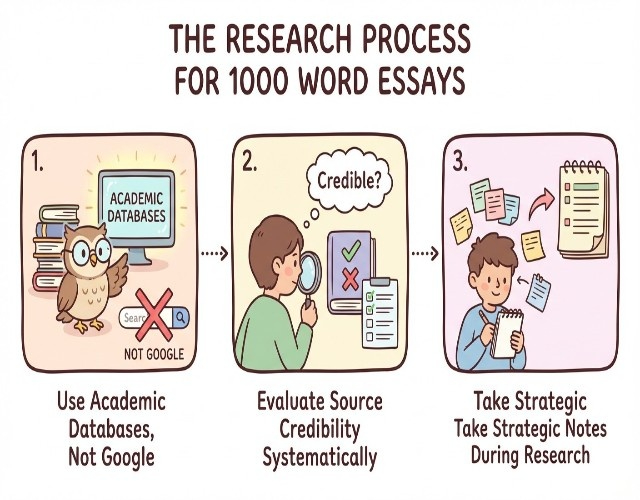
Strong research separates college level essays from high school work. Here's how to conduct efficient, effective research that produces scholarly essays:
1. Use Academic Databases, Not Google
Google Scholar, JSTOR, EBSCOhost, and ProQuest provide access to peer-reviewed scholarly articles meeting college research standards. General search engines return unreliable sources, opinion pieces, and commercial content, undermining essay credibility.
Database Search Strategies Start with broad keyword searches, then narrow using filters for peer reviewed sources, publication dates (prefer recent unless researching history), and relevant subject categories. Read abstracts to assess source relevance before downloading full articles. |
2. Evaluate Source Credibility Systematically
Not all published sources meet academic standards. Evaluate credibility by checking author credentials (university affiliation, expertise in the field), publication venue reputation (peer reviewed journals rank highest), methodology rigor for empirical studies, and whether findings have been replicated by other researchers.
Peer reviewed journal articles provide more reliable evidence than blog posts, news articles, or commercial websites. Check publication dates to ensure information currency, unless researching historical topics.
3. Take Strategic Notes During Research
Don't copy paste quotations randomly while reading sources. Instead, identify key arguments, note page numbers for future citations, write brief summaries in your own words, and record your analytical responses to source claims, agreements, disagreements, questions, and connections to other sources.
These active reading notes become the foundation for your essay's analysis and prevent plagiarism by keeping your voice separate from source material throughout the research process.
Still Struggling With College Essays?
Stop wasting hours on assignments that stress you out. Our expert writers deliver high quality, research based 1000 word essays meeting college academic standards.
- Advanced degree holders across all disciplines
- Proper academic citations in MLA, APA, or Chicago style
- Original analysis with scholarly source integration
- On time delivery with satisfaction guarantee
Don't risk your GPA. Get college level writing now
Order NowWriting Techniques That Elevate College Essays
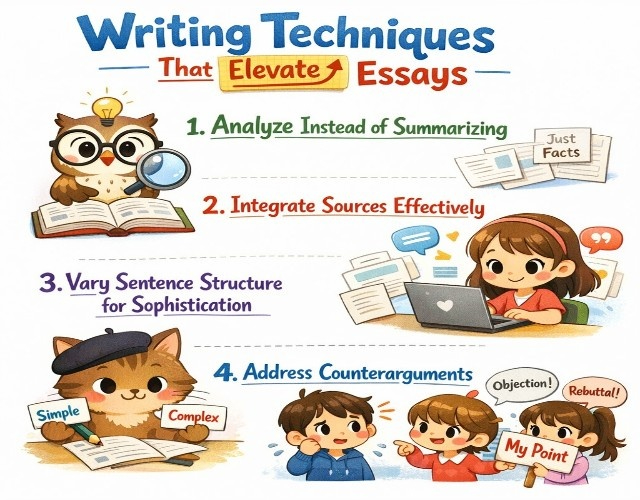
Beyond structural competence, specific techniques distinguish exceptional college essays from merely adequate ones:
1. Analyze Instead of Summarizing
The biggest difference between high school and college writing? You must analyze, not summarize. The summary explains what happened or what sources say. Analysis explains why it matters, how it works, what it means, and what conclusions we can draw.
Professors want to see YOUR thinking, not just your ability to restate information. Every body paragraph should contain more analysis than evidence.
2. Integrate Sources Effectively
Weak essays drop quotations into paragraphs without context or analysis. Strong essays introduce sources with relevant credentials, explain significance immediately after quotations, use quotations selectively while paraphrasing most information, synthesize multiple sources to support points, and maintain your authorial voice rather than letting sources dominate.
Citation Fundamentals All sources require proper citation in college writing. Confirm which style your assignment requires, MLA, APA, or Chicago, and apply it consistently. Our comprehensive essay format guide covers all three citation styles with specific examples showing proper in text citations and reference page formatting. |
3. Vary Sentence Structure for Sophistication
Essays filled with same length, with the same structure of sentences, sound monotonous and immature. Understanding types of sentences, simple, compound, complex, and compound complex, helps you create varied, sophisticated prose that maintains reader engagement while demonstrating stylistic maturity.
Mix short declarative sentences for impact with longer complex sentences for nuanced analysis. Start some sentences with subjects, others with dependent clauses or transitional phrases.
4. Address Counterarguments
Strong argumentative essays acknowledge opposing viewpoints and address them systematically. This doesn't weaken your position; it strengthens it by demonstrating you've considered multiple perspectives and still maintain your argument for valid reasons.
Briefly present the strongest counterargument, acknowledge its merits where appropriate, then explain why your position remains more compelling given the evidence.
Standard 1000 Word Essay Layout
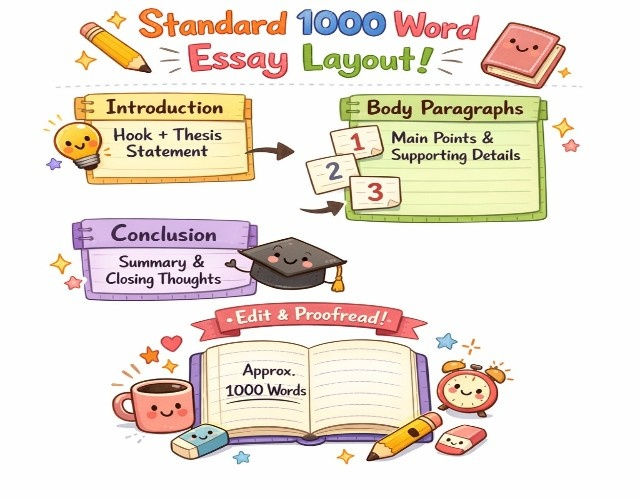
Unless your professor specifies otherwise, follow these academic formatting conventions:
1. Page Setup
| Font: Times New Roman or Arial |
| Size: 12 point |
| Margins: 1 inch on all sides |
| Spacing: Double spaced throughout (including quotations and references) |
| Alignment: Left-aligned text |
| Indentation: 0.5 inches for the first line of each paragraph |
| Header: Last name and page number in the upper right corner |
2. Citation Systems
Different disciplines prefer different citation styles.
MLA format dominates the humanities because it emphasizes authorship (important for analyzing creative works). |
APA format dominates social sciences because it emphasizes publication dates (currency matters in empirical research). |
| The Chicago style appears in history courses because it provides detailed documentation through footnotes. |
Our essay format guide explains all three systems in detail with examples of properly formatted citations and reference pages for each style.
3. Title Requirements
Most 1000 word essays require titles that preview your topic and indicate your analytical approach. Generic titles like "Essay About Climate Change" waste opportunities. Effective titles like "Economic Incentives vs. Moral Imperatives: Why Carbon Pricing Fails to Address Climate Change" immediately signal your argument's sophistication.
Learn to craft titles that work with our guide on how to title an essay, featuring formulas and examples for academic titles that preview arguments effectively.
Common 1000 Word Essay Mistakes That Tank Grades
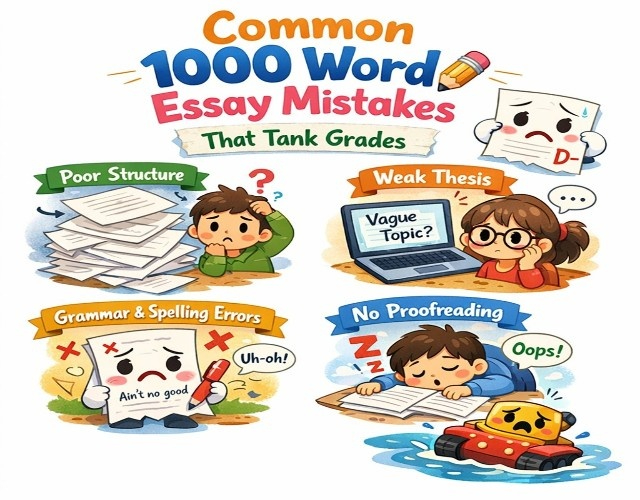
Even experienced writers make predictable errors, undermining otherwise strong college essays:
1. Treating Essays Like Extended High School Assignments
College essays require deeper analysis and more sophisticated argumentation than high school work. Don't simply list three supporting points and call it analysis. Engage with scholarly discourse, acknowledge complexity, and develop original insights rather than rehashing obvious claims.
Your thesis should present an arguable position requiring evidence to defend, not a statement of common knowledge anyone could make.
2. Relying on Weak or Non Academic Sources
Wikipedia, random blogs, commercial websites, and unvetted online content don't meet college research standards. Professors expect peer reviewed journal articles, scholarly books from university presses, and authoritative sources demonstrating subject expertise.
One weak source undermines your entire essay's credibility. Use academic databases exclusively and evaluate every source's credentials before incorporating it into your argument.
3. Insufficient Analysis of Evidence
Don't assume evidence speaks for itself. After presenting quotations, statistics, or examples, you must explain their significance. How does this evidence prove your claim? Why does it matter? What conclusions can we draw?
Analysis should always outweigh evidence in body paragraphs. If your paragraphs contain more quotation than your own analytical writing, you're summarizing rather than analyzing.
4. Poor Source Integration
Quotations dropped into paragraphs without introduction or explanation confuse readers and signal weak analytical skills. Always introduce sources with context, explain significance after quotations, and maintain your authorial voice by paraphrasing most information while reserving direct quotations for uniquely phrased insights.
5. Vague Language and Unsupported Claims
"Many people believe," "throughout history," and "in today's society" are vague phrases lacking specificity. Replace with concrete details: "According to a 2024 Pew Research survey of 10,000 adults," "Between 1945 and 1965," "In contemporary American culture."
Specificity demonstrates knowledge and builds credibility. Vagueness signals ignorance or intellectual laziness.
Time Management for 1000 Word Essays
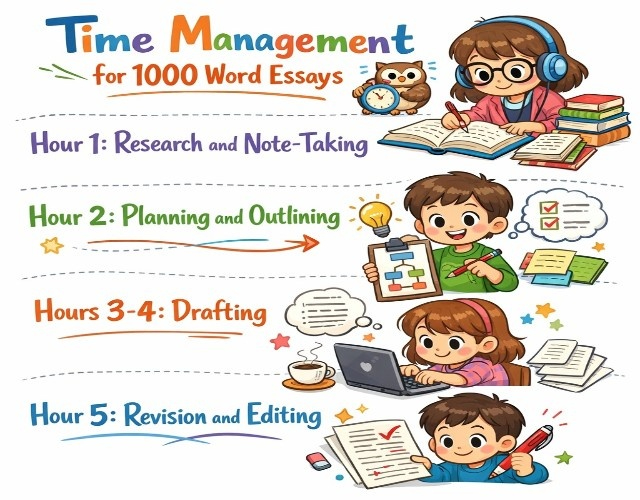
Most students can complete quality 1000-word essays in 3 to 5 hours if they manage time effectively:
Hour 1: Research and Note-Taking
- Use academic databases to find 4 to 6 scholarly sources
- Read abstracts and conclusions to assess relevance
- Take strategic notes focusing on key arguments and evidence
- Record full citation information for all sources
Hour 2: Planning and Outlining
- Develop your thesis statement based on research insights
- Create a detailed outline mapping the argument structure
- Organize evidence under relevant analytical points
- Plan topic sentences for each body paragraph
Before drafting, consult our comprehensive essay outline guide to create organizational structures that transform research into coherent arguments. Learn to map complex analytical work efficiently.
Hours 3 to 4: Drafting
- Write body paragraphs first using your outline
- Draft introduction and conclusion after body is complete
- Focus on getting ideas onto the page without obsessing over perfection
- Maintain separation between your voice and source material
Hour 5: Revision and Editing
- Check that the thesis clearly states your argument
- Verify every body paragraph directly supports the thesis
- Ensure analysis outweighs summary in every paragraph
- Proofread for grammar, citation format, and clarity
- Read the essay aloud, catching awkward phrasing
Struggling to Find More to Say?
If you've developed your argument and you're still under 1000 words, don't pad with fluff. Our guide on how to make an essay longer shows legitimate expansion strategies, developing existing points with deeper analysis, adding relevant evidence, exploring counterarguments, and providing additional context that strengthens rather than weakens your essay.
1000 Word Essay Topics for College
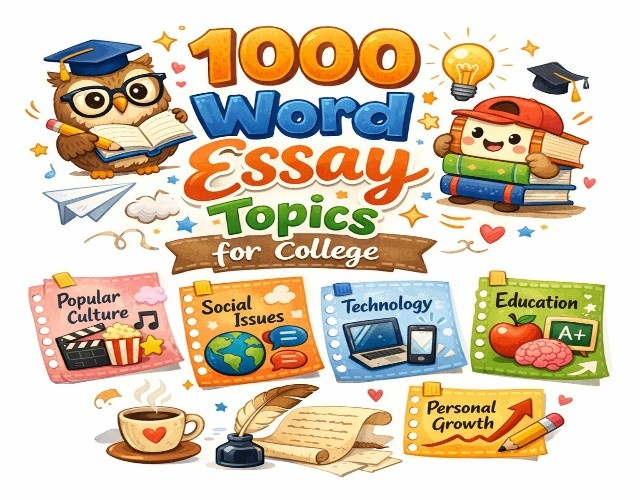
College level topics require analytical depth and scholarly engagement. Here are focused options appropriate for 1000 word research essays:
Social Sciences:
- How social media algorithms amplify political polarization
- The psychological effects of remote work on employee wellbeing.
- Economic factors driving income inequality in developed nations
Humanities
- How modernist poetry reflected post WWI disillusionment
- The role of satire in challenging authority across literary periods
- Ethical frameworks in contemporary philosophical debates
Sciences
- The viability of CRISPR gene editing for disease prevention
- How climate change affects marine ecosystem biodiversity
- The neuroscience of habit formation and behavioral change
Business & Economics
- Market failures requiring government intervention
- The economic impact of automation on labor markets
- Corporate social responsibility versus profit maximization
Want 300+ more sophisticated topic ideas organized by discipline? Check our extensive collection of essay topics with options spanning every academic field and complexity level.
Struggling with source integration or thesis development? Our professional essay writing service writers specialize in the analytical techniques professors expect. From scholarly research to sophisticated argumentation, we'll deliver work that demonstrates intellectual maturity.
1000 Word Essay Example
This complete example demonstrates proper research essay structure, source integration, analytical depth, and scholarly voice appropriate for college level work.
The Impact of Social Media on College Student Mental Health
College students spend an average of 4-6 hours daily on social media platforms, making these digital environments a significant factor in their overall wellbeing and mental health outcomes. While social media offers benefits including social connection, information access, and community building, mounting evidence suggests excessive platform usage correlates with increased anxiety, depression, and decreased self-esteem among undergraduate populations. This essay examines the psychological mechanisms through which social media affects college student mental health, analyzes research on usage patterns and outcomes, and evaluates potential interventions that might mitigate negative effects while preserving positive aspects of digital social connection.
Social comparison theory provides a useful framework for understanding how social media platforms affect user self-esteem and life satisfaction. According to research by psychologist Dr. Melissa Hunt at the University of Pennsylvania, college students frequently engage in upward social comparison when viewing peers' carefully curated social media content, evaluating their own lives against idealized presentations of others' experiences. Hunt's experimental study found that limiting Facebook, Instagram, and Snapchat usage to 30 minutes daily significantly reduced depression and loneliness scores compared to control groups maintaining typical usage patterns. The mechanism appears to involve decreased exposure to comparison triggers that generate feelings of inadequacy when students evaluate their authentic daily experiences against peers' highlight reels.
The addictive design of social media platforms compounds these comparison effects through psychological reinforcement mechanisms that encourage compulsive checking behavior. Technology companies deliberately employ variable reward schedules similar to those used in gambling, creating unpredictable patterns of likes, comments, and notifications that trigger dopamine responses in users' brains. Research published in the Journal of Social and Clinical Psychology demonstrates that this intermittent reinforcement makes social media engagement particularly difficult to moderate voluntarily. Students intending to check notifications briefly often find themselves scrolling for extended periods, sacrificing sleep, study time, and in-person social interaction. This displacement of healthy behaviors contributes to mental health deterioration beyond the direct effects of social comparison.
However, research on social media's mental health effects reveals significant complexity rather than simple causation. Not all platform usage produces equivalent outcomes, and individual differences in usage patterns substantially affect psychological impacts. Studies distinguish between passive consumption (scrolling through feeds, viewing others' content) and active engagement (posting updates, commenting, direct messaging). Active social media use that facilitates genuine social connection and community building correlates with positive mental health outcomes, while passive consumption associates with increased depression and anxiety. College students who primarily use platforms to maintain close friendships and share authentic experiences report mental health benefits, suggesting that usage context matters more than simple duration metrics.
Despite this nuance, the aggregate research evidence supports concern about social media's net effect on college student populations. A comprehensive meta-analysis of 32 studies involving over 28,000 participants found consistent associations between social media usage intensity and depression symptoms across diverse samples and methodologies. The relationship appears bidirectional, with both depression predicting increased social media use and excessive usage predicting worsening depression over time. This reciprocal relationship creates concerning feedback loops where vulnerable students seek connection through digital platforms but experience increased isolation and declining mental health as passive consumption replaces authentic social interaction.
The challenge for college administrators, counselors, and students themselves involves developing strategies that preserve social media's genuine benefits while mitigating documented harms. Complete abstinence seems neither realistic nor optimal given platforms' role in modern social life and professional networking. Instead, intervention research suggests that mindful usage patterns, deliberate limitation of passive consumption, and development of critical media literacy skills can help students navigate social media environments more healthily. Programs teaching students to recognize manipulative platform design, curate their feeds intentionally, and monitor their emotional responses to usage show promise for reducing negative mental health outcomes while maintaining positive aspects of digital social connection.
Social media's impact on college student mental health reflects the complex interplay of platform design, psychological vulnerabilities, usage patterns, and individual differences. While excessive passive consumption clearly correlates with increased depression and anxiety through social comparison and behavioral displacement mechanisms, active engagement that supports authentic relationships can produce positive outcomes. Rather than advocating for complete platform abandonment, effective approaches involve helping students develop mindful usage practices, critical awareness of manipulative design features, and habits that prioritize in-person connection alongside digital interaction. As social media continues evolving and new platforms emerge, ongoing research into usage patterns and mental health outcomes remains essential for supporting student well-being in increasingly digital college environments.
NEED A COLLEGE LEVEL ESSAY FAST?
Our professional writers have helped thousands of students succeed; you're next.
- Advanced degree holders in your subject
- Research based analysis with proper citations
- 100% original, plagiarism free content
- Delivered in 24 hours when deadlines are tight
Trusted. Confidential. 100% human written.
Order NowReady to Write Exceptional 1000 Word Essays?
You've now got the complete college level framework: conduct research using academic databases and peer reviewed sources, develop arguable thesis statements requiring evidence and analysis, structure body paragraphs with topic sentences, evidence, and substantial analysis, integrate sources smoothly while maintaining your authorial voice, address counterarguments demonstrating engagement with multiple perspectives, and revise systematically for clarity, coherence, and citation accuracy.
The 1000 word essay represents your transition to college level intellectual work. Master this format, and you've developed skills transferable to every academic assignment you'll encounter.
For comprehensive coverage of essay writing fundamentals across all formats, explore our complete essay writing guide with detailed sections on every aspect of academic writing from thesis development through final revision.