The Do's: 15 Essay Writing Tips That Actually Help
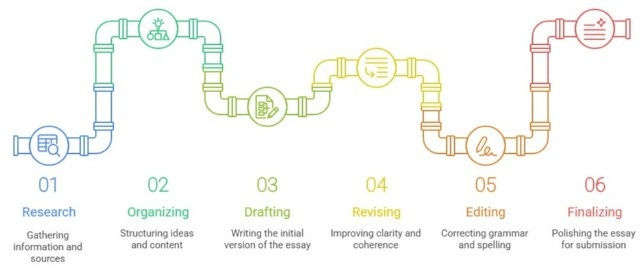
| Stage | Key Actions / Tips |
|---|---|
| Thesis | Craft specific, debatable claim; preview points |
| Outline | Plan main points, evidence, structure; bullet points |
| Evidence | Assign quotes, stats, examples; ensure support |
| Drafting | Hook readers, provide context, write body with evidence & analysis, use transitions |
| Revision | Refine logic, organization, and analysis; reorder/cut as needed |
| Feedback | Get peer/tutor input; implement suggestions |
| Editing | Fix grammar, spelling, formatting, citations; meet all requirements |
1. Understand Your Prompt Before Anything Else
Don't just skim the assignment, dissect it.
Highlight directive words: "analyze" means break down components, "compare" means find similarities and differences, "evaluate" means judge effectiveness. Missing these distinctions means writing the wrong essay entirely.
Circle requirements: word count, citation style, number of sources, specific questions to address. One missed requirement can cost you a full letter grade.
2. Pick Topics You Actually Care About (When Possible)
Forced enthusiasm shows.
If you get to choose your topic, select something you're genuinely curious about. Writing 1,500 words on a boring subject takes twice as long as writing about something interesting.
Can't find interesting angles on assigned topics? Browse our essay topics list for fresh perspectives on common assignments.
3. Outline Before Writing, Every Single Time
20 minutes outlining saves 3 hours of confused drafting.
Create a simple essay outline showing:
- Your thesis
- Three main points
- Evidence supporting each point
- How paragraphs connect
Students who outline first write 40% faster and need fewer major revisions. The structure prevents writer's block and rambling.
4. Research Smart, Not Long
Quality beats quantity.
Use academic databases (Google Scholar, JSTOR, your library's resources), not random websites. Find 5-7 credible sources with specific data, expert opinions, and recent publication dates.
Red flag sources to avoid:
- Sites without authors listed
- Content more than 5 years old (for current topics)
- Sources that don't cite their own evidence
- Anything ending in .com that's trying to sell you something
Stop researching when you have enough evidence for each main point. More research becomes procrastination if you already have what you need.
5. Write Thesis Statements That Actually Take a Position
Your thesis should be debatable, not obvious.
Weak: "Social media has effects on society." Strong: "Social media algorithms prioritize engagement over accuracy, amplifying misinformation and eroding trust in institutions." |
The strong version makes a specific claim someone could disagree with. That's what drives your essay and proves your specific position. Learn more in our thesis statement guide.
Stop Procrastinating. Start Submitting.
Get expert-written essays that meet your requirements and impress your professors.
- 100% original, plagiarism-free work
- Written by subject-matter experts
- Any topic, any academic level
- On-time delivery guaranteed
Trusted by thousands of students worldwide for reliable, high-quality academic help.
Get Expert Help Now6. Use Clear Language, Not Impressive-Sounding Words
Clarity always beats complexity.
Don't write: "The methodology employed facilitated comprehensive examination of multifaceted variables." Write: "This method let us thoroughly examine complex factors." |
Professors value clear thinking expressed simply. Using fancy vocabulary to sound smart usually backfires; it confuses readers and signals you don't actually understand your topic.
7. Master Paragraph Structure Using TEES
Every body paragraph needs four parts:
| T - Topic Sentence: State your paragraph's main point E - Evidence: Provide specific examples, quotes, data E - Explanation: Analyze what your evidence means S - Summary/Transition: Connect to your thesis and next paragraph |
This structure prevents paragraphs that dump facts without analysis or make claims without proof.
8. Connect Ideas With Transition Words
Smooth transitions show logical thinking.
Use connectors that show relationships between ideas:
- Adding information: Furthermore, additionally, moreover
- Contrasting: However, nevertheless, conversely
- Showing cause/effect: Therefore, consequently, as a result
- Giving examples: For instance, specifically, namely
Browse 300+ transition words for essays organized by function to improve flow.
9. Start Strong With Hooks That Grab Attention
Your first sentence determines if anyone keeps reading.
Weak opening: "In this essay, I will discuss climate change." Strong opening: "By 2050, climate migration could displace 1.2 billion people, more than every war in human history combined." |
The strong version creates curiosity and stakes. Check out 200+ hook examples for every essay type.
10. Take Breaks to Maintain Quality
Writing for 4 hours straight produces worse work than writing for 90 minutes with breaks.
Your brain needs rest to think clearly. Work in focused 45-60 minute blocks, then take 10-15 minute breaks to recharge. This prevents mental fatigue that leads to repetitive ideas and sloppy sentences.
11. Format Correctly From the Start
Don't wait until the end to worry about formatting.
Set up your document with correct specifications before writing:
- Font (usually Times New Roman, 12pt)
- Margins (typically 1 inch all sides)
- Line spacing (double-spaced for most academic work)
- Header with page numbers
- Proper citation style
Check our essay format guide for MLA, APA, and Chicago formatting requirements.
12. Use Grammar Tools, But Don't Rely on Them Completely
Grammarly and similar tools catch obvious errors, but miss context issues.
Run your essay through grammar checkers to catch:
- Spelling mistakes
- Basic punctuation errors
- Commonly confused words (their/there/they're)
But don't trust them blindly. These tools often suggest changes that make your writing worse by removing voice or suggesting incorrect "corrections" for technical terms.
13. Read Your Essay Out Loud
Your ears catch what your eyes miss.
Reading aloud reveals:
- Awkward phrasing that looks fine but sounds wrong
- Run-on sentences you didn't notice while reading silently
- Repetitive word choice
- Places where logic jumps without transitions
This single technique catches more problems than any other quick editing method.
14. Get Fresh Eyes on Your Work
You're too close to your essay to spot all issues.
Ask a peer, tutor, or family member to read your draft and answer:
- Does my thesis come through clearly?
- Do my paragraphs connect logically?
- Where did you get confused?
- What's my strongest/weakest section?
Outside feedback reveals blind spots you can't see yourself.
15. Revise Multiple Times, Focusing on Different Elements
Don't try to fix everything in one editing pass.
First revision: Check organization and argument strength Second revision: Improve sentence clarity and word choice Third revision: Fix grammar, spelling, and formatting |
Separating revision tasks makes each pass more effective. Learn comprehensive strategies in our essay writing guide.
Essay Writing Tips for Revision & Editing
1. Take a Break Before Revising
After completing your first draft, step away for at least a few hours, ideally a full day. This mental distance helps you see problems you'd miss while the writing is still fresh in your mind. You'll spot unclear arguments, weak evidence, and organizational issues more easily with rested eyes.
When you return to your draft, read it as if you're encountering it for the first time. Better yet, read it aloud. Hearing your words helps identify awkward phrasing, run-on sentences, and places where your argument loses clarity.
2. Revise for Content and Structure First
Start with big-picture issues before worrying about grammar and punctuation. Ask yourself: Does every paragraph support my thesis? Is my argument logical and convincing? Have I provided sufficient evidence for each claim? Are my ideas organized in the most effective order?
Be willing to make substantial changes. Sometimes entire paragraphs need to be cut, moved, or rewritten. This can feel painful, but it's necessary for producing excellent work. Remember: writing is rewriting.
Check that your introduction accurately reflects your essay's content and your conclusion effectively summarizes your argument without simply repeating the introduction.
3. Strengthen Your Analysis
Many students summarize sources without adequately analyzing them. Good essays don't just report what others have said; they explain why it matters and how it supports the argument. After presenting evidence, always include analysis that interprets significance and connects it to your thesis.
Look for places where you've made claims without support or provided evidence without explaining its relevance. Add the missing pieces to make your argument complete and convincing.
4. Get Feedback from Others
Fresh eyes catch problems you've become blind to. Ask a peer, writing center tutor, or trusted friend to read your essay and provide honest feedback. Specifically request comments on clarity, organization, and persuasiveness.
Don't take criticism personally. Even the best writers benefit from feedback. Use suggestions to improve your work, though ultimately you decide which changes to make.
Essay Writing Tips for Polishing & Formatting
1. Eliminate Grammar and Spelling Errors
Grammar mistakes undermine your credibility and distract readers from your ideas. Use grammar-checking tools like Grammarly or Hemingway Editor to catch obvious errors, but don't rely on them exclusively. These tools miss context-dependent issues and sometimes suggest incorrect changes.
Proofread carefully yourself, reading slowly and focusing on each sentence. Common errors to watch for: subject-verb agreement problems, comma splices, sentence fragments, incorrect pronoun usage, and apostrophe mistakes.
Reading your essay backward, sentence by sentence from end to beginning, helps you focus on grammar rather than content, making errors easier to spot.
2. Apply Proper Formatting
Follow the required essay format exactly. Whether it's MLA, APA, or Chicago style, pay attention to font requirements, margin specifications, line spacing, indentation, and page numbering.
Create a properly formatted title page if required. Learn how to title an essay effectively while following style guidelines can make a significant first impression on your instructor.
3. Ensure Proper Citations
Academic integrity demands proper citation of all sources. Use in-text citations every time you quote, paraphrase, or reference someone else's ideas. Create a properly formatted works cited or reference page that matches your citation style.
Citation management tools like Zotero, Mendeley, or EasyBib can help maintain consistent formatting and prevent missing citations. However, always double-check generated citations against style guide examples; these tools sometimes make mistakes.
Stress Less. Score More.
Professional academic writing support designed to help you succeed.
- Custom-written for your exact instructions
- Thorough research with proper citations
- Fast turnaround for tight deadlines
- Free revisions until you’re satisfied
Join students who submit on time and score higher, every single semester.
Order Your Essay Today4. Verify You've Met All Requirements
Before submitting, review your assignment requirements checklist. Confirm you've met the word count, included the required number of sources, followed formatting guidelines, and addressed all parts of the prompt.
Double-check that your file is named correctly (if submitting digitally) and that you're submitting the final version, not an earlier draft.
Essay Writing Tips to Avoid Common Mistakes
| Mistake | Key Tip / Prevention |
|---|---|
| Procrastination | Start early; break into small tasks |
| Ignoring Prompt | Refer to prompt constantly; stay on topic |
| Weak Thesis | Make thesis specific, arguable, clear |
| Poor Organization | Use topic sentences, logical transitions |
| Overly Complex Language | Write clearly and directly; avoid unnecessary jargon |
| Plagiarism | Cite sources; paraphrase carefully; use quotes |
| Incorrect Word Count | Edit to meet length requirements; develop points fully |
1. Procrastination and Last-Minute Writing
Starting your essay the night before it's due almost guarantees poor results. You won't have time for research, multiple drafts, feedback, or thorough revision. The stress also makes writing harder and less enjoyable.
Start early, even if you only brainstorm topics or create a rough outline. Breaking the project into small tasks over several days produces better essays with less stress.
2. Ignoring the Assignment Prompt
Some students write competent essays that don't address the actual assignment. They answer a question they wish had been asked rather than the one in the prompt. This costs major points regardless of how well-written the essay is.
Constantly refer back to the prompt throughout writing and revision. Make sure every major point directly relates to what you've been asked to do.
3. Weak Thesis Statements
Vague, obvious, or overly broad thesis statements doom essays from the start. "Many factors contribute to climate change" tells readers nothing interesting and gives you no clear direction. Sharpen your thesis until it makes a specific, arguable claim.
4. Poor Organization and Flow
Jumping randomly between ideas confuses readers and weakens your argument. Use clear topic sentences, logical transitions, and coherent paragraph structure. Each paragraph should flow naturally to the next, building your argument step by step.
5. Using Overly Complex Language
Don't try to sound smart by using unnecessarily complicated words or convoluted sentence structures. Clear, direct language is always better than confusing "academic-sounding" prose. If you wouldn't say it in conversation, you probably shouldn't write it.
6. Plagiarism
Plagiarism, using others' words or ideas without proper attribution, is academic theft. It destroys trust and often results in serious consequences. Always cite sources, use quotation marks for direct quotes, and paraphrase carefully in your own words.
7. Exceeding or Falling Short of Word Count
Following length requirements demonstrates discipline and planning. Going significantly over suggests you couldn't identify key points and edit ruthlessly. Falling short indicates you haven't fully developed your argument or explored the topic adequately.
Need to adjust your length? Check our guide on how to make an essay longer (without adding fluff) for strategies that add genuine value.
The Don'ts: Essay Writing Tips That Are Not Helpful
1. Including Irrelevant Information
Problem: Padding your essay with off-topic content to meet word count.
Why it hurts: Professors recognize filler immediately. Irrelevant paragraphs signal you don't have enough substantive points to support your thesis.
| Fix: If you're short on content, expand analysis of existing points or conduct more research. Don't add unrelated information just to fill space. |
2. Using Unnecessarily Complicated Language
Problem: Writing "utilize" instead of "use" or "commence" instead of "start."
Why it hurts: Overcomplex language makes you sound like you're trying too hard. It often obscures your actual points and creates confusing sentences.
| Fix: After drafting, replace any words you wouldn't use in normal conversation with simpler alternatives. Clear writing demonstrates confident understanding. |
3. Plagiarizing, Even Accidentally
Problem: Copying information without proper citation or paraphrasing too closely to original sources.
Why it hurts: Plagiarism can fail you out of a course or get you expelled. Even unintentional plagiarism carries serious consequences.
| Fix: Always cite sources, use quotation marks for exact phrases, and paraphrase in your own words with citations. When in doubt, cite it. |
4. Ignoring Your Prompt's Specific Requirements
Problem: Writing a great essay that doesn't actually answer the assigned question.
Why it hurts: You might write beautifully about the wrong thing. If the prompt says "analyze" and you "describe," you've missed the assignment entirely.
| Fix: Check your prompt after writing each paragraph. Does this section directly address what was asked? If not, revise or cut it. |
5. Submitting Without Proofreading
Problem: Hitting submit on your first draft or skipping final error checks.
Why it hurts: Typos, grammar errors, and formatting inconsistencies make even strong content look careless. Professors grade more harshly when work appears rushed.
| Fix: Build in 24 hours between finishing your draft and submitting. Come back with fresh eyes for final proofreading. |
Essay Writing Tips for Time Management
Create a Realistic Timeline
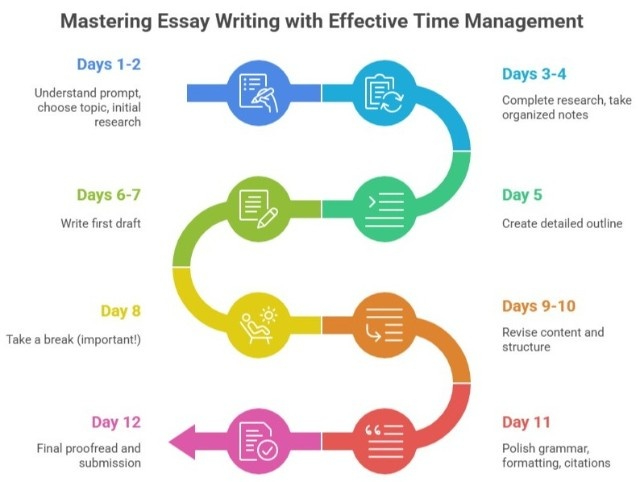
Break your essay into stages and allocate specific time for each: research, outlining, drafting, revision, and polishing. A typical timeline for a major essay might look like:
- Days 1-2: Understand prompt, choose topic, initial research
- Days 3-4: Complete research, take organized notes
- Day 5: Create detailed outline
- Days 6-7: Write first draft
- Day 8: Take a break (important!)
- Days 9-10: Revise content and structure
- Day 11: Polish grammar, formatting, citations
- Day 12: Final proofread and submission
Adjust this timeline based on your essay's length and complexity, but always build in buffer time for unexpected problems.
Use Time Blocks Effectively
Set aside dedicated writing blocks when you're most alert and focused. Many people write best in the morning when mental energy is highest. Eliminate distractions: close social media, silence your phone, and find a quiet space.
Use techniques like the Pomodoro method: 25 minutes of focused work followed by a 5-minute break. This maintains concentration while preventing burnout.
Build in Buffer Time
Things go wrong: sources become unavailable, computer files corrupt, life emergencies happen. Always finish your essay at least 24 hours before the deadline. This buffer protects you from disasters and allows time for a final proofread with fresh eyes.
Revision taking forever? Our trusted essay writing service delivers polished, submission-ready essays the first time, properly researched, structured, and edited so you can focus on understanding content rather than perfecting drafts.
Free Downloadable Resource
Stop Stressing. Start Submitting. Our professional writers craft essays that impress professors and earn top marks. Trusted by 50,000+ students worldwide
Bottom Line
Strong essay writing comes down to specific, repeatable techniques, not natural talent or inspiration.
The 15 tips above work because they address the actual challenges students face: unclear thesis statements, weak organization, poor evidence integration, and sloppy execution. Master outlining, TEES paragraph structure, clear language, and thorough revision, and your essays improve dramatically.
Avoid the 5 common mistakes, irrelevant content, overcomplicated language, plagiarism, prompt deviation, and skipping proofreading, and you eliminate the biggest grade killers.
Essay writing is a learnable skill that improves with practice and feedback. Use these strategies consistently, and you'll write stronger essays in less time.